Budgets and Overspending

I’ve rewritten this several times over the last two months, constantly afraid of who I’d offend. Instead, I’m just going to share my raw observations and hope it makes sense to the people who need it. Plus, what’s a better time to discuss budgets than the first post of the year? I actually have quite a few posts related to budget planned. So we’ll start with why I believe budgeting leads to overspending.

I don’t like budgets in the sense of the word’s common understanding. A literal definition of the word is, “an estimate of income and expenditure for a set period of time.” In this context, I’m all for a budget. I have a detailed (over-the-top, probably unnecessary) spreadsheet that I use to manage our money. In any given two-week period, since 2012, I can tell you my projection of money-in and money-out. I make sure my expenses are covered.

ENVELOPE SYSTEM

The extreme version of budgeting (in my opinion) is the ever-popular “envelope” concept. It’s simple: you decide on your monthly spending categories, and then you put your cash* in the respective envelope to pay your bills. (*Please don’t pay for everything in cash!) When you run out of money in a given envelope, that’s it for the month. There must be a way that this works for enough people that it keeps getting touted as a great idea, but I’ve seen it fail. You’re creating a dependency on these envelopes instead of an understanding of your finances.

What happens with any leftover money in the envelope? The articles I’ve read about this system literally tell you to celebrate if you come in under budget. No. How does taking your extra money and spending it frivolously get you to your goals faster? Or it tells you to add it to next month’s envelope (e.g., if you have $50 left over in this month’s envelope for groceries, put it in next month’s envelope and now you have $350 instead of $300 to spend on groceries). How are you creating discipline and an understanding of budgeting if you can splurge next month? Now you’ve spent an extra $50 in month 2, but you need to scale back to $300 for month 3. That’s not creating a routine.

I want you to create a relationship with money.

RELATIONSHIP WITH MONEY

We don’t budget in the colloquial sense. We have a relationship with money. I make sure that my mandatory expenses are taken care of (e.g., mortgage payments, utility bills). Everything that can, goes on a credit card. When it comes to paying off the credit card every month, it goes back several steps.

My thought process is cemented in whether or not the value of an item is worth it to me. When I’m about to buy something, I take the time to think:
1) Is this item worth the price I’d pay for it?
2) Will this item serve a need (not a want)?
3) If it’s a want, will this item bring me enough happiness that I’m willing to spend this amount of money on it?

Want to know something I recently struggled with? For years, I’ve wanted a desktop tape dispenser. Years. I don’t even think about it until I’m wrapping Christmas gifts. So once a year, I have tape, but I wish I had a desktop tape dispenser. I never bought it. I thought, I can struggle through needing two hands for my tape dispensing needs for a couple of days out of the year. I thought, if I buy a desktop tape dispenser, then I need to buy a different kid of tape than I already have on hand. Every year, I just dealt with it because it wasn’t worth the cost to me to invest in something that would make things marginally easier for me for a few days of the year. This year, after wrapping more than half the gifts, I decided enough was enough. I purchased 6 rolls of tape for 9.99 and a dispenser for 4.22. I’ve been wrapping gifts outside of my parents’ house (where there were tape dispensers) for more than 15 years. I’ve struggled with the decision to purchase a dispenser every single year, and it finally got to the tipping point this year. All that thought process, over all those years, to spend less than $15.

That’s my thought process for every non-routine purchase. Instead of putting cash in an envelope marked “something for me” each month, I’ve trained myself to manage our money from the purchase point instead of an envelope full of cash that I mindlessly spend down. I can make an informed decision on whether or not I need or want something. I’m taking the time to decide whether this is going to bring me long-term happiness, short-term happiness, and whether the cost of the item is worth it. Had that tape dispenser been $15, plus new rolls of tape for $10, I probably wouldn’t have bought it. Because at that point, I’d be happier with a new shirt or new pants for $25. So I would have decided that my $25 is more valuable to me than to spend it on tape. That doesn’t necessarily mean that I go out and buy a shirt arbitrarily; it just means that I’ve decided that the value of that money is worth more to more towards something else than this item I’m currently contemplating.

OVERSPENDING

I see it over and over: people who budget seem to be the ones buying things they don’t really need. Instead of changing your mentality to be whether a purchase is necessary or is worth the price, the decision becomes “I have $300 left over, what can I do with it?” I see people have their sights on a product that they want. They build it up in their mind that it becomes unattainable, so when the extra money is there, they splurge on it. But did they ever step back and ask if it was really necessary or if their money could be put to better use in their overall wellbeing?

There’s a time and place for splurges. I understand that buying something you want makes you happy, in that moment. What if you thought: does my happiness in buying this gaming console outweigh the anxiety and frustration that I can’t pay my bills in a couple of weeks?

If you struggle to pay your rent month-to-month, then a large influx of money should be earmarked for future bills, not to splurge over and over again. An envelope system creates a reward-driven desire to your spending. The goal should be a more comfortable lifestyle where you’ve set yourself up for success instead of a groundhog-day-struggle to make ends meet.

There have been several instances that I’ve seen in the last couple of months, but the one that really has been weighing on me happened in October when I was working.

I was working at the racetrack. It’s temporary work – working during the race meets and possibly during their horse sales. The Fall meet was 17 days. Depending on where you’re working, you can make some really good money. I happened to be placed in one of those locations, and next to me was a young girl. She complained of having to work two jobs and not getting a day off all month because she was working two jobs. She also shared that she struggles to “make a decent living,” and that she borrowed money from a friend to be able to pay rent on October 1.

The first day, we made over $400 in tips. The second day, she asked how we celebrated making that amount. I bought the Hatch sound machine. I’m going to assume that most of our readers have no idea what that is, but it’s a sound machine and a light that can be programmed for different needs (for instance, I wanted it to give our toddler the signal that it was OK to get out of bed). It’s $60. I had already looked into several options, and I had already determined that I was in a place in life where it was worth it to me to spend the money on the original than to attempt to buy a knock-off that doesn’t work great for $40. Personally, I was going to buy this thing regardless of what I made while working, but I used that as my example on what I splurged on with our unexpected earnings. She shared that she took her boyfriend out for a steak dinner. One celebration isn’t going to break the bank, but it became a routine. It wasn’t until the middle of the month that she said she had paid her friend back for helping her pay rent. That $150 you spent on one meal could have been prioritized to keeping a roof over your head, or being a good friend and paying your debt.

So often, I see someone else blamed for one person’s mistakes. It’s the greedy landlord’s fault that you need to pay rent. It’s the government’s fault for not increasing minimum wage. What if you stepped back and looked at your decision making? Did you buy the new gaming console and then struggle to pay rent on the first of the next month? Did you go to Costa Rica and then struggle to pay rent on the first of the next month? Did you buy that new gaming console, and not add to your savings for future planning? The televisions in our house aren’t huge, but they work. I don’t have a need to replace a working television simply so that I can have the newest technology and the biggest screen.

If you don’t create a relationship with money and an understanding of how to make informed decisions, you may end up with unnecessary expenses with money that could have been more productive. It’s time that you step back and look at your entire spending picture to know whether you’re truly budgeting and learning, or you’re mindlessly spending money because you’ve accepted that’s the cost.

Cash out refi

There’s a company in Virginia that advertises no-closing-cost-refinances. If it’s your personal residence, then this holds true. For investment properties, there are some closing costs, but it’s cheaper than the usual refinance. We used them for two other loans – one at the beginning of the pandemic when we signed the paperwork in a tent in the parking lot, and another where we signed the paperwork at our kitchen table in Kentucky with a traveling notary (that’s a thing!).

There was a threshold requirement in order to qualify for this refinance, and that was the new loan had to be at least $100,000. Only 2 of our houses had a loan originated for over $100k originally, so that limited our abilities.

Mr. ODA came to me and said he wanted to do a cash-out-refinance. This company had changed their policy, and they’d allow a cash-out-refinance to get us to the 100k threshold. The first two Virginia houses we purchased (2016) had balances of about 70k and 60k. We had enough equity in these houses that we could take a substantial amount out in the refinance, but Mr. ODA chose $50k each.

Here’s a run through of the thought process on how to do this and why it’s a benefit. I personally like seeing the details behind other’s decisions, so hopefully this will help someone or help make the concept click and open up an opportunity. This process was only just initiated, so I’ll do an update after we execute the plan to see how it changed.

The original goal was to use that money to pay off another loan. We’ve made our decision on which loan to pay off based on the highest interest rate. Right now, our highest interest rate is a loan with our partner at 5.1%, but this is also the loan that we’re actively paying off (leaving a balance right now of 26k, which we’re responsible for half). Since we need to time our principal payments to be matched with our partner, we can’t just dump money into this loan without really complicating things. So our second-highest interest rate is 4.625%. This loan originally was $89k in 2017 and has a balance of $62k. If we paid this off, that would leave about $35k in cash (based on the other two loan refinances that we’d take $50k out of each) that we could use to pay towards another loan or earmark for another purchase. As this discussion happened, Mr. ODA pivoted.

This company is only available to refinance loans in Virginia. Instead of paying off that $62k loan for a Virginia property, what if we also refinanced that loan and paid off one of two loans remaining on our Kentucky houses? I’m a visual person and needed to see how this would actually play out.

The terms were that if we picked a 15 year loan, that brings the interest rate down to 2.5%. With a 30 year loan, it’s 3.125%. I compared the current amortization schedule to the proposed amortization schedule, and here they are. Note that the interest isn’t a one-to-one comparison because we’ve already paid 4-5 years of interest on these loans.


HOUSE 2

The original loan terms were a 20 year at 3.875%.

The new terms would create a new 15 year loan, reduce the rate to 2.5%, and increase the loan to about $123k (pay off old loan, fees for closing, and $50k cashed out). This decreases our monthly cash flow, on this property, by $294.38.


HOUSE 3

The original loan terms were a 15 year at 3.25%.

The new terms would create a new 15 year loan, reduce the rate to 2.5%, and increase the loan to about $113k (pay off old loan, fees for closing, and $50k cashed out). This decreases our monthly cash flow, on this property, by $155.89.


HOUSE 8

The original loan terms were a 30 year at 4.625%.

The new terms would create a new 30 year loan, reduce the rate to 3.125%, and increase the loan to about $ (pay off old loan, fees for closing, and $35k cashed out). This is slightly off because the new loan isn’t showing at exactly $100k, but for all these the final numbers will be slightly different. This decreases our monthly cash flow, on this property, by $84.87.


In these projections, we’ll receive $135,000 cash in hand. With that, we’ll pay off the higher loan in Kentucky, which has a balance of about $81k. That mortgage has a monthly payment of $615.34. These three loans have increased their monthly mortgage payments by $535.14 in total. Since we’ve eliminated a monthly mortgage with the cash from these new loans, our total monthly cash flow actually has a net increase of $80.20. In addition to this net positive cash flow, we also have over $53k in cash in our account.

Now, if you know us, cash in our account isn’t a preference by any means. In my last monthly update, you can see that we have almost 20k in cash and that’s abnormal. Add $53 to that, and that’s just too much money sitting in a checking account. At this point, the goal is to buy another house. With the way the market is, we’re probably not going to hit the 1% Rule we strive for (the expected monthly rent will be at least 1% of the purchase price – $1000 rent for $100,000 purchase), and we’re not going to see the margins that we’re used to. It’s going to take a lot of effort to get our psychology right for this next purchase. We’ll have to hold strong in knowing that our other houses have great margins, and at least it won’t be negative cash flow.

At this point, we’ve started the refinance process by signing our initial disclosures and providing all the many, many documents needed to originate a loan.

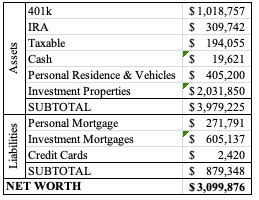
November Financial Update

Last month, I mentioned that there would be a lot of rental property expenses and bills being paid this month. Well, they will hit in November, but they don’t hit until the end of the month. I scheduled all the payments to be made right after our current credit card cycle closes, which is around the 20th of the month for most of our credit cards.

I had to update our 401k numbers with more recent data (usually the data I’m using is a couple of weeks old since updating those accounts involves an unnecessary amount verifications). I also updated one of the balances on our mortgages (one with a partner that I don’t have access to the account to see regular updates).

I’ve been working the second half of October and a few days in November, which has kept our spending low. This month I have the last of my Christmas shopping to do (hopeful for deals on Black Friday for items already in my cart!) and several insurance payments that will cause our credit cards to increase more than usual, but we’ll stay on top of paying them off.

We have yet to receive September, October, and November rent from one of our tenants (more information in the next post in a few days). Otherwise, everyone is paid up on rent, and we even had a tenant pay part of December’s rent!

We had several reimbursements come through this month that increased our cash on hand. Mr. ODA purchased things for our HOA on his credit card, so that was reimbursed. We had issues with our escrows and insurance payments, so the overages were reimbursed to us. I also worked, serving beer, in October, which increased our cash balance more than usual.

There are a few line items that were changed significantly because I wasn’t working with clear data the past few months. We may have hit $3 million net worth before this update, but I know that it’s official now! At 35 and 34, that’s a fun accomplishment. It doesn’t feel like we have money to throw around, and we certainly don’t live lavishly. You can see that $2 million of this is tied up in the appraisal value of homes we own, and most of the other parts of this is tied up in accounts that we can’t access until retirement. We still make decisions for the longevity of our net worth because, well let’s face it, we’re only in our mid-30s and there’s a lot of life to live.

October Financial Update

We’ve been busy, which has kept our expenses down in our personal life. I’ve been working a few days at our local racetrack, which has been for my entertainment and a good way to bring in some money for our household. While our busy schedule has kept us from eating at restaurants and spending money on activities, the last quarter of the year brings big expenses on the rental front for insurance and taxes.

I still haven’t decided how to format these financial updates, but I did work on categorizing all the expenses for our year. I’d like to see how our spending changes through the year, and if I keep a running tally of the information, I’ll be able to consistently categorize expenses. At this point, I’ll just report for the whole year later in January, but it feels good to have that process started since there are a lot of transactions (already at 786 line items!).

RENTALS

We paid an extra $2000 towards the mortgage that we’re trying to pay off (we paid $1000 and our partner paid the other thousand). That mortgage balance is about $26k, which we’re responsible for half.

Kentucky taxes are due in October. Well, they’re actually due in November, but they give you a 2% discount if you pay before 11/1, so we of course do that. Two of our houses are still escrowed, so I don’t need to worry about that, but I had to pay one of the houses, which was about $1300. As an aside, I put it in the mail on 10/6 and it was taken out of our account on 10/8; I’ve never seen the mail and processing of taxes happen so quickly!

We had someone do the work on a house (fix bedroom doors and replace a missing section of fence) that was left over from my July walk throughs, and that was $490 (split with our partner). This house has been notoriously late on payments with very little communication, but they’ve turned a corner. They’re still late with payments, but they pay the late fee without prompting and give us advanced notice, which is all we ask for! They say they’ll be back on track with on time payments next month.

We’ve had issues with another rental, which I shared in my last post. They were approved for state assistance, so I’m expecting September, October, and November rent from the state here soon. Since there’s no timeframe for when that will come in, I’ve told her that she has to keep paying on the payment schedule we agreed to, and anything she pays will just go to December rent at this point.

PERSONAL EXPENSES

We had all the drywall for the basement delivered in September for $788. Several pieces arrived damaged from the strap that held them down. Mr. ODA called Home Depot since the delivery fee was $75 for this convenience, and they were super nice. She refunded us for the broken sheets and the delivery fee ($125!).

Only $130 spent in gas (that will probably go up next month since I’m driving to/from Lexington 3 times per week for work, plus a few more personal trips there). Only $92 spent in restaurants!

SUMMARY

While some of the expenses for rentals have trickled in, the next month is when most of them are going to hit. We’ll also have an annual medical bill come due in November.

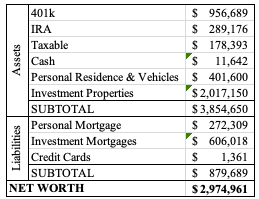
Our net worth increased by $21k from last month. Our credit card balances are low, and then our cash balance is higher than usual because we used to just put any extra cash towards mortgages, but right now we’re trying to pay off that mortgage we have with a partner and rethink our approach (do we want to save for another down payment.. type question).

September Financial Update

Cooler weather is here! We have a full calendar these days with pre-school and sports. I’ve been managing that by setting a lot of alarms giving me a half hour warning that we need to leave the house for something. We also celebrated our son’s 3rd birthday with both sides of our family, which was so much fun. He knew all about a birthday and the traditions, did a great job at being grateful for his gifts, and hasn’t stopped playing with all those new toys. This month, his birthday party and a long weekend trip to Virginia were our big expenses, while the sports and activities kept us home and not eating at restaurants in between those things! On top of all this craziness, Mr. ODA went on a work trip, then I picked up a few shifts at the race track to help them out. And so, here we are, two-and-a-half weeks since my last post.

NET WORTH

About once a month, we have a meeting with our financial advisor. During last month’s meeting, his software system said that we hit $3 million net worth! Unfortunately, my numbers last month didn’t say that, and they still don’t, but we’re right there. I didn’t think it worth it to line up my information against how the software is reporting the number because a lot of our net worth is based on the current market value of our real estate, which isn’t necessarily an exact amount. I know Mr. ODA had a goal for the first million in net worth, but I wouldn’t say that we had a goal to hit this particular number. With the financial advisor, we’re working on our mentality. We’re basically trying to figure out what’s our true goal (instead of just this number), and if we had (and did) everything we wanted, what would that cost difference be? I’m working on two other posts about our mentality, and I’ll have to include this side of the thought process as well.

DETAILS

One of our credit cards has a balance of over $2,200 in this net worth update. That includes almost $1,000 of a hotel that Mr. ODA had for a work trip, the hotel for Richmond at $450, and an AirBnB charge for an upcoming trip of $424. It also includes Mr. ODA’s food purchases while on travel, which amount to about $180, and an Uber trip of $10. The work expenses will be reimbursed, but that’s not yet accounted for in the math since the payment hasn’t hit our checking account yet.

With the child tax credits coming in, our investments have gone up each month. We’re putting some of that into the kids’ investment accounts. We’ve also had other unexpected income, which led to another $500 transfer into Mr. ODA’s investment account. Usually, we see an automatic contribution of $1100 between our Roth accounts and the kids’ accounts. This month, we had $1,900.

All of our housing expenses were about the same. This coming month has a trip planned, a day to hang drywall in the basement, and me working at the race track nearly every weekend.

August Financial Update

This has been a crazy month. We went to St. Louis and New York, we tiled the basement bathroom that we’re building, I refinished a desk that I purchased 6 years ago, and we had several activities to occupy our time. Being that we’ve been so busy, we haven’t set any new goals and are still talking through what we think the next few years look like. We are still managing sleep disruptions with our nearly 3 year old, and that takes a lot of time from my day and night. Anyway, here’s how things shook out over the last month – very high credit card bills to cover many large expenses.

just for fun – my before and after of the refinished desk that I bought for $15
  • Utilities: $240. This includes internet, water, sewer, trash, electric, and investment property sewer charges that are billed to the owner and not the tenant. I find it interesting that it’s not routine to have irrigation in Central KY, and that’s led to surprisingly low water bills. Our water, sewer, and trash is all together each month, and it’s only $53 in the middle of the summer!
  • Groceries: $390. On top of that, I had a charge for a 4 month supply of the vitamins that I take, which I pay for up front because I don’t want to pay a surcharge to pay monthly (if I can afford to pay $300 now, I’d rather pay that then end up paying $340 for the same product at the end of 4 months).
  • Gas: $230
  • Restaurants: $215
  • Entertainment/Travel: I broke down the St. Louis trip costs in my previous post. We booked our flights to NY through the Chase portal using points. It was the equivalent of $833 for 3 round trip flights (our daughter as a lap child). We paid for parking at the airport ($36), and that was it. On top of those costs, we had several sports fees and activities that we paid for. I didn’t add up the details, but I estimate that those cost us about $300 this past month.
  • I paid $3,800 worth of medical bills (high deductible plan… we got there).
  • We spent about $175 on tile supplies for the bathroom, which includes returning about $40 worth of materials.
  • Rental work cost us a good bit this month.
    • Our plumber made his rounds to 3 of our houses on one day to address items that I found during the walk throughs in July; this cost us $730.
    • Somehow (very unlike us), we had an outstanding pest control bill from December. When I called to schedule another appointment, they requested payment (rightfully so!). We spent $290 on pest control then.
    • We purchased a hot water heater and a refrigerator for a rental property after our property manager did her walk through. We also purchased a fan and had that installed (we would have done it, but we don’t live there anymore), but we split that cost with our partner. These cost us $2,317.
    • As usual, two houses were late on rent. One paid on Friday and actually included the late fee (10% of rent). Another gave us a letter about a car accident she was in and said she wouldn’t have rent until she received the settlement money from that. It’s the 16th and we still don’t have rent. The positive here is that we have several other properties worth of income that cover the expenses on this house (mortgage), so we’re not floating the mortgage with our own money for this one house.

Here’s a tidbit of my spending. I don’t have Amazon Prime. Rarely do I need something in 2 days or less than $25 that I would need to pay for this service. I search Amazon for things that I eventually want, put it in my cart, and then when I need to hit the $25 free shipping threshold, I add the items to the cart to check out. This is how I handle Christmas shopping basically. I have thoughts on what to get for people, keep it in my “save for later” section, and then order it when I place an order. I actually have several Christmas gifts already purchased.

NET WORTH

Since I’m not able to find the time to coordinate updating all our accounts with Mr. ODA, this is just a rough update of our financials. Our net worth has increased about $58k. I’ve paid down the very high balance on our Citi card already this month, so this snapshot in time isn’t showing that I’ve already made $5k worth of payments towards that. About half of that increase is attributed to an increase in property values. The rest is attributed to the usual mortgage payments and investment balances increasing.

July Financial Update

We paid off a mortgage! Reaching this accomplishment was threatened once again when I was told another rental property needed the HVAC replaced ($3,900), but we were able to cover the cost of the unit replacement and pay off the last $3,000 on the mortgage. This gives us $391 worth of positive cash flow each month going forward.

Our two usual suspects are late on rent. One said that her bank account was frozen, and she has no idea why. With a history of forgery, fraud, and domestic abuse, I can’t imagine how this could have come about (sarcasm..). The other just casually emails us and says “Rent will be late. Sorry for the inconvenience.” Lovely. They also don’t pay the late fee, although I’m tracking that to be able to recoup it from the security deposit.

Last month, I mentioned that we had credit card rewards expiring without our knowledge. After several unanswered phone calls, it was resolved through a checking account credit.

  • Utilities: $420. This includes internet, cell phones (we pay quarterly, so this is a big bump from last month’s total), water, sewer, trash, electric, and investment property sewer charges that are billed to the owner and not the tenant.
  • Groceries: $590.
  • Gas: $327. We traveled to Virginia this month, so that caused a higher use of gas. Mr. ODA’s work trip also caused an increase in gas usage, but that’s covered through his employer.
  • Restaurants: $275.
  • Entertainment/Travel: $1,167. But this includes $485 worth of Mr. ODA’s work hotel that was reimbursed. This also includes $535 for our hotel stay in Virginia for 5 nights.
  • Investment: $1,100
  • Rental work cost us about $150 in supplies, and I paid one house’s quarterly HOA dues of $240.

Our net worth has increased again this month thanks to the stock market and property values. We’re down to 7 mortgages. We’d like to pay off one of the houses that our partner holds the mortgage on, but we need to re-evaluate our finances together first because that equates to about $20,000 for each of us.

ANNUAL TRACKING

I don’t love the format of these posts, so I’m brainstorming ways to share updates going forward. For now, I created a chart to show our spending so far this year and how it has changed month-to-month. I have a feeling I’m not categorizing our spending consistently after seeing this information, so I’m going to dive in deeper. At the end of each year, Mr. ODA asks me what our spending by category is, and I need to recreate that information each time. I thought I was being better about it this year with these monthly updates, but I’m not.

That’s my lesson learned for this month – while tracking your spending, track it consistently and look back at previous months. I thought $300 in gas was consistent with previous spending, but now I see that it’s much higher. While we did travel to Virginia this month, is that really representative of such a drastic increase? We may be ok with the entertainment that driving more has given us, or we may decide we want to scale back our spending in this category. It’s also important to know that some spending is seasonal. While our gas usage is high during the summer, we knew we were planning several trips and wanting to be out of the house more than we were over the winter.

Overall, I don’t feel like I have a good grasp of our spending after seeing this graph, and I plan to dig deeper into the costs. I’m glad I looked at it in this format halfway through the year, before I would have to go back through all 12 months of spending! It’s easy to see an increase in net worth and be complacent, but I’d rather be more intentional with our spending than we have been over the last few months.

Hear more from Mrs. ODA

Back in May, I was a guest on Maggie Germano’s Podcast, “The Money Circle.” I shared some of our background and how we started investing in real estate. We brushed on topics like establishing an LLC, tax advantages, and how you don’t need to start big to just get started. It was a brand new experience for me, but I’m passionate about our real estate experiences, and I loved being able to share. I hope you’ll check it out!

June Financial Update

We’re continuing our spring/summer of travel and activity, which is why there are fewer posts and lots more spending.

The stock market has increased, which has been the main factor in our net worth change. We paid $2,000 towards the mortgage we’re paying down, leaving a balance of $3,300. This mortgage will be paid off once all our rent is collected for July; it was pushed back a little bit because of the flooring replacement that occurred in one of our rentals, which is why our credit card balance is much lower than last month. We’re also still waiting for half of one property’s rent, which is the norm these days.

  • Utilities: $250. This includes internet, cell phones, water, sewer, trash, electric, and investment property sewer charges that are billed to the owner and not the tenant.
  • Groceries: $518
  • Gas: $268
  • Restaurants: $165. Our credit card reimburses for many of these expenses; we received credits totaling $120.13 in the last month.
  • Entertainment/Medical: $1,093
  • Investment: $1,100
  • Insurance Costs (personal and rentals): $845

VIGILANCE ON CREDIT CARD REWARDS

Mr. ODA discovered that our PNC credit card rewards balance was decreasing, despite earning new rewards this cycle. He investigated further and noticed that we had been losing rewards for a few months now. PNC has a policy that they don’t issue their rewards until you hit $100 worth of rewards. Once we hit $100, PNC sends us a check in the mail. Since they send a check, we still receive paper statements, even though we regularly check our financial accounts online. Over the past few months, both of us checked the balance to see “ok, we’re nearing $100,” but didn’t put any more effort into knowing the details of the balance. Mr. ODA happened to notice that the statement didn’t make sense.

$89+3 somehow equals $82. There isn’t a single section on our statement or via our online account that identifies the loss of rewards Mr. ODA called PNC to ask for more details and learned that our rewards expire after 2 years, despite their policy of not issuing a check until you hit $100. They basically said, it doesn’t matter that your account is over 10 years old, or that credit has been used less in the last year due to the pandemic, or that they don’t clearly identify the expiration of rewards and just identify a lower balance. As a comparison, and I keep going back to Chase, but Chase changed up their reward categories to allow the consumer to earn more rewards during the pandemic (e.g., in addition to giving rewards in the travel category, since consumers weren’t traveling, they added grocery and home improvement stores as major reward categories).

The PNC customer service representative reinstated 60 days worth of lost rewards and issued a statement credit. We don’t want a statement credit because we no longer want to use this credit card, earning rewards that we’ll never be able to capture. If we use this credit card to use up the statement credit, that’s rewards that could be earned on a different credit card. Now Mr. ODA is fighting for the credit to be applied to our checking account or to have a check sent to us (which is the preference on our profile) and fighting for the reinstatement of the rest of the rewards lost.

Without PNC, we’re down to 4 credit cards in our regular rotation. We have 3 cards that we use for categories (gas, grocery, restaurants, travel, home improvement stores), and then we have the Citi Double Cash card that is for “everyday purchases.”

Medical Bills

Here’s something different. Medical insurance isn’t something I’m going to pretend I understand fully, but I know enough to protect my money. So here’s two quick stories about how due diligence saved us hundreds.

First, an overview.

When you see a provider (e.g., doctor), they bill your insurance on your behalf. The claim that’s submitted is reviewed by the insurance’s benefits administrator, and any coverage is paid out. Your insurance will likely have a “disallowed” amount (what your insurance deems is too expensive to be billed for the given service), a benefits paid amount (what insurance pays on your behalf), and then a member responsibility amount (what you owe). Once the claim is processed, these are outlined in an explanation of benefits, or an EOB. If and when you receive a bill from the provider, verify against your EOB to ensure that it aligns with your insurance benefits.

Here’s an example of an EOB. By using a provider that is in-network (in a negotiated agreement plan with my insurance company), the doctor and the insurance have agreed costs for services provided. My insurance’s “allowances” are negotiated with each provider who participates in the network. Allowances may be based on a standard reduction or on a negotiated fee schedule. For these allowances, the provider has agreed to accept the negotiated reduction and you are not responsible for this discounted amount. In these instances, the benefit paid plus your coinsurance equals payment in full. So here, for the services that I received, the insurance company is saying, “I see you billed for $115, but we agreed that this service only costs $65.34, so that’s what we’re allowing.” You, as a covered member, are not charged for the ‘disallow’ amount of $49.66.

In our case, we have a high deductible plan, which means we have to spend a certain amount of money on covered services before the insurance pays out benefits. Ours is $3,000. This means that for the first $3,000 worth of doctors visits to in-network providers, we’re paying the total allowed amount (e.g., our son had to go to the ER, and we paid $609 for the visit, which is the fully allowed amount). There are plans out there where you don’t have a deductible, but you have a copay (e.g., I had a plan where I paid a flat $20 for each doctor’s office visit and $125 for each hospital visit, but I was also paying a higher premium for that coverage type). In a future post, I will share how we compared our plan options and chose a high deductible plan.

After we meet the deductible, most of our services are covered at 95% (i.e., we’re responsible for paying 5% of the allowed charges). In the example above, we had to pay 5% of the $65.34, or $3.27.

There are tons of nuances to insurance though, but hopefully this broad overview helps understand how to read the EOB. I have more stories of where my interpretation of the coverage in my brochure doesn’t seem to match the benefits administered, but those are for another time. For now, here’s how we protected hundreds of dollars by staying on top of our coverage.

MR. ODA’S STORY

Speaking of nuances, here’s one of those. Preventative care is covered at 100% (e.g., maternity screenings and annual physical exams). Mr. ODA needed a physical to qualify for his agency’s wellness program (they’re given 3 hours per week to exercise). When he went to get the physical, it got coded as a sports physical because the doctor had to sign off on a paper that said he was healthy enough to participate in the wellness program. A routine annual physical is fully covered by insurance, regardless of deductible. Apparently, a sports physical is not the same concept and regular coverage requirements apply.

Mr. ODA had to call back to explain that the exam was routine with a signature on paper, and not any more in depth to be considered a sports physical. The doctors office offered a reduction in the amount owed, twice, but eventually realized they were spending more in postage and phone calls than the bill was worth while Mr. ODA fought the coding, and they wrote it off.

MRS. ODA’S STORY

I saw a doctor in December 2019 when having pregnancy complications. In February 2020, I received a bill, which I promptly, and erroneously, paid. A few days ago, I received a check for the amount I paid a year and a half ago. So it wasn’t a quick resolution, but I wasn’t going to let $300 go.

The bill said:
Charges to Date: $451.00
Payments/Discounts to Date: $157.85
Remaining Patient Balance: $293.15

I had seen multiple doctors in a short period of time, so I was just in auto mode to pay all the medical bills that I had. After I paid it, I realized that on the back of the bill there were more details about that “payments/discounts” line item. There were three columns: Insurance Payments, Patient Payments, and Adjustments to Date. The total $157.85 was in the Adjustments to Date column, and the insurance column said $0. I checked into my insurance claims online and didn’t see this date of service. Well, I’m insured, so this should have been submitted to my insurance for review first. I called the hospital to indicate that there was an error made, and I shouldn’t have paid this in full, even with an “uninsured discount” they graciously offered me.

I called the hospital to ask why this wasn’t submitted to my insurance and discovered that my name was spelled wrong, my insurance was entered wrong, and this claim wasn’t tied to all my other hospital-related claims I had processed. Supposedly, they updated my information and resubmitted. I still didn’t see it on my online claim history after the 30-45 day window they told me, so I called again in April 2020. I was told they would resubmit. Two months later, I was managing a newborn and we were just deciding to move, so this fell off my radar. Then all of our things were in storage for two months. By the time I got this paperwork back out, it was March 2021.

I explained my story to the hospital again and asked for it to be properly submitted. I was again told they would submit the claim, but this time they’d submit by paper handling. Again, nothing showed up in my insurance. I called in April 2021 and was again told that they would try submitting again. This time I escalated to a supervisor. I said that this was unacceptable, and I didn’t want to keep being told they would try again, delaying my reimbursement by another 30-45 days each time I called. The supervisor said she would ensure the paper claim was sent out and call me back in a week. I never got the call. On May 18, I called again, immediately asking for a supervisor. This supervisor said that my account showed a refund was approved, but he needed to issue it (why couldn’t that just have been done?!).

Well, on June 1, I received a check in the mail for $293.15. That’s the amount I paid back in February 2020 for a December 2019 date of service. I could have written this off in my mind a year ago and not made these five or six phone calls, taking about 90 minutes of my time in total. I could have said to myself, “I called. There’s nothing more I can do.” But we wouldn’t be in the position we’re in now with our finances if I kept saying “oh well, that’s all I can do.”

The moral of the story is that you should be an informed consumer. If you know how to determine your benefits and calculate your coverage, you can make sure the proper payments are made to the provider, and that you aren’t overcharged.