February Financial Update

This month is basically just story telling, from insurance tidbits to mortgage annoyances, while not addressing the decline in the market and our investment accounts. 🙂

It seems all my mortgage payments are increasing on 3/1, so I’ve been managing those changes. I mentioned recently that one of our houses had the escrow analysis done incorrectly. Luckily, that was addressed, and the increase in our mortgage payment is only about $100 instead of nearly $200. Our personal mortgage increased by $16, another property increased by $52, and then our last 3 mortgages were all refinanced in January and this ‘first payment’ has been a bear. The information out of the refinancing company has been contradictory, they requested a bunch of information weeks after closing to support all the money they already gave us, and it’s just been rough. Rough enough that I ran to the post office to get a check in the mail at 4:48 pm today, only to get home to an email saying that I had to send that check (due tomorrow) to a different address. Ugh.

I was excited to share some positive news this month, but that got overshadowed by these mortgage payments! Anyway, we came home to some surprises after our vacation.

First, I had a medical procedure done in January. It was originally scheduled for November, but the week of the procedure, I had my heart go crazy on me. That cancelled my procedure because I couldn’t go under anesthesia until they knew my heart would be OK. We got my heart sorted out enough that I was cleared for the procedure, but once I was able to reschedule it, it went into 2022 ….. a new deductible year. They said that I needed to pay half the cost of the procedure before they’d schedule it. Since I had been waiting since September for this, I wasn’t going to question anything, and I gave my credit card number for $1200. Well, my insurance hasn’t processed the procedure yet, but I guess since I paid in advance, some sort of system review showed I had overpaid, and they refunded me $1196. I don’t know how they decided to keep $4, but I’ll cross that bridge when I see my claim is processed on my insurance website.

Second, I’ve mentioned before that you need to stay on top of insurance! I received a bill for my heart-related-ambulance-ride for over $900. The last time I was in an ambulance, I ended up owing the full bill, which was $500 at that time. When I saw $900, I figured, gosh 10 years later and a new jurisdiction, and THAT is what I owe. It said “we billed your insurance, and this is your balance.” Hmmm. Log into my insurance website and see there’s no claim history for an ambulance ride. I then learned, for the first time ever, how to submit my own insurance claim. I let the fire department know I submitted the claim, and then they said they’d do it for me! Why did your paper say you already did?! Well, the surprise I got was that my insurance covered all but $46 for the ride!!! I couldn’t believe it. That’s the happiest I’ve ever been to spend $46.

The most random thing that happened was a check from our electric company from our Virginia house. We sold that house in September 2020. Our mail forwarding isn’t active anymore and it was sent to our old address, so I really have no idea how we got it. It was $31.09 due to a required review of all accounts every 3 years. It’s not anything crazy or life changing, but that was truly a surprise!

RENTAL UPDATES

We had our usual suspects not pay rent earlier this month. One flat out said they won’t pay until the 23rd. I’m not even sure how to handle them anymore. I keep reminding myself that we raised their rent $150/month to get them to leave, but they accepted. So at least we’re in a good position there? The other paid us $700/$1150 on Friday (late). She at least emailed us with the awareness that we shouldn’t have to hunt her down for rent payments, so she got a pass because I was about to send the default notice at 12:01 am on the 6th. I’m also once again in a position of tracking down a rent relief payment on another house that’s supposed to cover December, January, and February. While the tenant ended up paying December rent, we’ve still been floating the January and February finances. The approval of their application (that was submitted in November) was January 10. As of today, no information from the State and no check in the mail.

I got a tenant renewal processed this morning. We increased their rent by $50/month (starting 5/1 when their current term ends), after it having been steady for 2 years. Our usual baseline to keep a good tenant is a $50 increase every 2 years.

We gave two property managers notice to increase rents on 2 properties that are up for renewal on 4/30. We do 60-day notices. It’s not entirely necessary, but I look at it as a way to negotiate with the tenant for a month, and then if they don’t agree to new terms, we have a month to get it rented. One ‘cried COVID’ last year, and we let her by. She’s been there 2.5 years at the same rate, and she even got the house under market value originally because it was November (bad timing). She’s at $875 and we said we’d go to $950. That’s a larger increase than we usually do, but the market rate for the house is $950-1000. If she balks, we’ll manage the turnover and get a new tenant in there. For another house, they’re at 1025 and have been since October 2019. They even negotiated a discount back then for an 18 month lease, so they’ve been under market. Despite our efforts to grieve our taxes, the City thinks this house is in an affluent neighborhood and has charged as such. We’re offering them a bump to $1100. Again, more than our usual $50 increase, but it’s been more than 2 years and $1100 is under market value. Then we had a 3rd person say she wants to stay in the house, but her lease isn’t up until August. She’s been there since August 2017 and has been at $850 rent since then. We’re looking to increase her rent to $900. She’s an awesome tenant that never needs anything, and I know she’s in grad school without much money. We’ve made her so happy for the last several years by renewing her without an increase, so I hope she understands the need to increase it now.

I paid the insurance on our townhome, which is a property we own outright, so I need to manage the escrow-type transactions. That was $210.

After our cash-out-refis in January, we have been looking for a new property to purchase. We’ve made 4 offers that have been out-bid. Mr. ODA has been trying to work the off-market angle. We made a full price offer for one of the houses contingent on seeing it, and the guy said that he’d now prefer to sell off his portfolio as one instead of each individual house. He declined our full-price-off-market offer. Sketchy. Then another guy said he wanted to wait until the new flooring was installed in his house before letting us see it, and then he won’t respond to messages now a week or so later. Interesting. We’re now trying to work another off-market deal through our Realtor, but the seller and our Realtor are out of town. I ran the comps on it and come to $235ish, while they were expecting $250k. I don’t deny that they’d get an offer in this market at $250, but I don’t know that it’s worth it to us. Then again, to be done with this driving around, seeing houses, making offers, and losing out, may all be worth an extra $15k.

PERSONAL TIDBITS

This month, we went on a trip for just about a week. The flight was paid for in a previous month, so that’s not captured in our spending. We stayed with a friend, and she made us nearly all of our food. We paid for our brewery visits with her. It was a great trip, and I definitely recommend Bend, OR! We did a last minute change from Touro for our rental car to a ‘regular’ car rental place at the airport, so that charge shows up in this month’s finances. We also booked 2 last minute hotel rooms, once for the night of our arrival and one for the night of our departure (we flew in/out of Portland, which is about 2.5 hours from Bend, so it was easier with the kids sleep schedules to be near the airport those two nights instead of arriving really late or leaving really early).

We bought Hamilton tickets. We were late on that band wagon until we finally found a friend with Disney+ who wanted to watch it with us even though they had seen it 257 times. Since December 2020, we’ve watched Hamilton a whole lot. We got on right when tickets were being sold and were about to accept the $200+ ticket price until Mr. ODA found the ticket sales through the actual venue were only $130! It’s not until June, but that’s something to look forward to!

We finished our basement over the last year and have been using for the last month now. We had a projector on hand that we used as our TV down there, but it started to die shortly after we hooked it up. We bought a new projector and have been really happy with it, and I was happy with it only being $270.

While our electric bill was surprisingly low last month, it was surprisingly high this month. They did an estimated meter reading, putting the estimated kWh usage at the highest it’s ever been. When I questioned their estimation process and shared the current meter read, they said that next month will probably be an actual reading and since it’s not more than 1000 kWh difference, they’re not going to change anything. Sure, I can afford this $414 bill that may be offset next month, but many people can’t. Their estimation process shouldn’t put the projected energy usage at an all-time-high, thereby dumping surprisingly large bills on people. Regardless, it’s something that works itself out, and isn’t something I’m going to fight any harder on right now. It’s just annoying knowing that our energy usage was high last year because we had a broken unit without our knowledge, and then with a working unit, they’re estimating that we’ve used more than ever.

Mr. ODA changed one of our credit cards, so I’ve been all out of sorts here now. The credit card was a travel-related card, and they increased their annual fee by $100. He ran the numbers and determined the benefits didn’t outweigh the cost increase. Instead of closing the card, they agreed to change the type of card. However, all the things we used that card for are now on different cards, and this change “activated” an old card of mine. Our credit card usage is convoluted; perhaps I’ll do a new explanation and update my last post on it (and then maybe that’ll get me to remember all the changes!).

NET WORTH

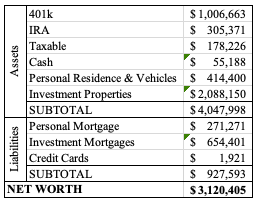
Our net worth dropped about $15k from last month, but that was due to the market. While not fun to see those numbers go down, it doesn’t affect our day-to-day. Our cash balance is really high right now while we keep cash liquid for a downpayment while finding another investment property.
Escrow Analysis Update

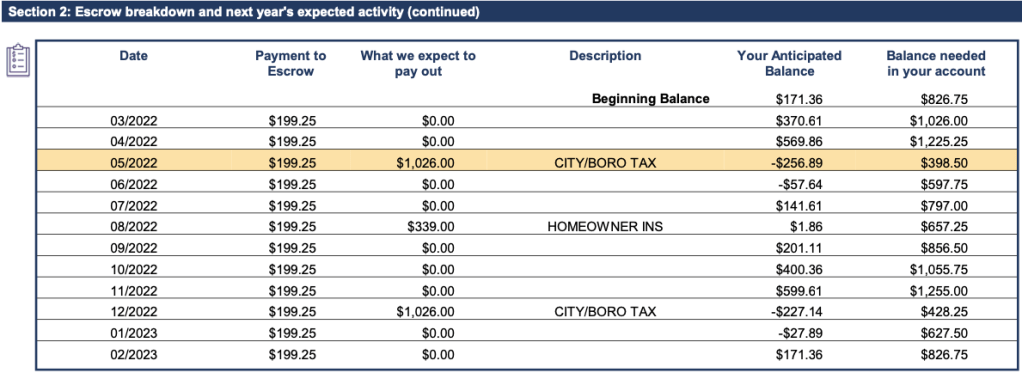
I posted about how one of our houses updated the escrow calculation and claimed our new mortgage payment needed to be $185 more than it had been to cover an escrow shortfall. Our escrow balance was negative, so it wasn’t a surprise that the amount was increasing, but that seemed to be a drastic increase. Most of what I said was right, but I did the increasing math incorrectly. The concept was there, but not the details.

Here’s the current escrow analysis from the mortgage company. It’s similar to what I did on my own. I knew that the new escrow amount to cover just what we owe in the year is $199.25, which is the same. I knew that there would be a shortfall in May of $256.89. This next step is where I was wrong in my calculation.

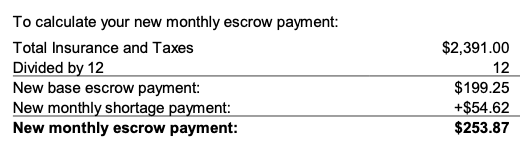
I took $256.89 and divided that specific shortfall by 12 months to come up with $16.60. Instead, I needed to take that shortfall and add it to the required balance of 2 months worth of the escrow payment. Therefore, $199.25*2+$256.89=$655.39. Take that number and divide by 12 to get the monthly payment to cover the shortfall, which comes to $54.62 (rounded).

The new payment is the new base amount plus the shortfall coverage. So our payment actually increases by a total of $96.95 because our previous escrow payment was only $156.92.

Reaching Goals

Whether you have a lofty goal of paying off a mortgage or a short term goal of not struggling to pay rent each month, it helps to establish a plan. The first step should be learning your relationship with money instead of mindless spending paycheck to paycheck. Last month, I mentioned budgeting and how it can lead to overspending instead of spending wisely. I also mentioned the envelope system and not liking it.

The envelope system is where you establish your spending categories and put cash in the envelope each month. When the money is gone from the envelope, that’s it. Don’t borrow from another envelope. If there’s money left over in an envelope, it can be added to next month’s envelope to increase your spending, or you can use that money to treat yourself to something. In few articles that I read did I see that the extra money should be put towards your goal.

THE GOAL

The first step is to write your goal down. What is it? How long do you think it will take to reach it? I’ve learned that establishing interim goals helps reach the bigger goal that may seem too lofty.

The second step is to track your expenses. Look at what you’re spending your money on. Start categorizing your spending. Can you see that you’re spending more than you thought on something other than essentials? Is hitting up the drive through several times a week costing you more per month than you realized? Have you purchased decorations for your home that aren’t on display, but you’re scraping together rent or mortgage for the beginning of each month? Are you paying up-charges and delivery fees for a meal delivery service instead of going to pick it up yourself (or cooking your own meal)?

MONEY RELATIONSHIP

I have experience living paycheck to paycheck. It’s not like we’ve always been in a position where we’re not worried about how to pay our bills. I thought if I shared two defining stories from our finances, it may trigger an idea for you.

College

I lived on campus for the first two years of college. My parents were paying my tuition, and they said that either I needed to take out a loan to pay the following year’s room and board, or I had to be a Resident Assistance to get free boarding. I didn’t want the responsibility and having to be in my dorm so much to be an RA (I never researched it; I was just 20 and knew everything.). I decided the best approach was to live off campus because I’d be able to pay my living costs monthly instead of in two large chunks at the beginning of each semester. If I broke down the monthly cost of the ‘room and board,’ it was $1533 per month (and only for 9 months of the year). I figured I could live for less than that, while paying month-to-month as I earned income, if I moved to an apartment. My rent off campus that first year was $650/month. My utilities were about $150/month in the winter. I don’t know how much I spent on food, but I know it was the bare minimum. It wasn’t that I was purposely trying to be debt-free and a hero; I just simply didn’t know how to get a loan, so that wasn’t an option to me.

I had a job at JCPenney. I was making 5.15/hour (minimum wage in 2006), and I worked outside of my school schedule as much as I could. I was able to pay my rent every month because that was my priority. I dipped into my savings from my summer jobs, but I mostly changed my lifestyle. I packed my meals with peanut butter and jelly sandwiches for when I was working. I ate pasta for dinner. I didn’t go to restaurants often. I wasn’t in a phase of life where I wanted to go to bars, so my social life was hanging at my boyfriend’s house, where he lived with 3 other guys, drinking cheap beer and watching tv. I made sacrifices in my spending so that I could pay rent every month. I didn’t want to pay a late fee every month. If I could just barely afford $650, I certainly didn’t want to owe an extra $65 because I couldn’t pay rent by the first of the month.

There is one caveat in my story that first year. Since I was making just what it took to have a roof over my head and food in my stomach, I chose to forego heat. Do you know where Albany, NY is? It’s into freezing temperatures in October. It was fine – I had sweatshirts, sweatpants, socks, slippers, blankets. I lived on the first floor of a two story home, so that helps keep the temperature reasonable into October, but I knew I couldn’t last through the days of teen temperatures without eventually turning the heat on. My parents found out that I didn’t have my heat on, and they sent me $100/month to cover that. So I did get assistance. They sent me that for 6 months to cover my utilities, and that was the last assistance I received.

My parents paid my tuition, which was $2,175 per semester in 2004. Yes, less than $5,000/year for my college education.

Buying a House

Mr. ODA and I wanted to buy a house and settle down. We had each been part of a training program at work that would end with our placement anywhere in the country, so we weren’t in a good position to purchase a house in Albany, NY. Mr. ODA got placed in Pennsylvania, while I was still employed in their NY office. It wasn’t handled well, so we started looking for other options. I accepted a job in Washington DC, and Mr. ODA went to Sterling, VA; we moved to an apartment in Fairfax, VA to live in between those two places. We chose an apartment because we didn’t know anything about Virginia and needed a place to live while we scoped it out.

This wasn’t a scenario where we couldn’t afford to live, like my college example. This was a situation where we set a goal, and to achieve that goal, we needed to spend less.

Mr. ODA was saving and preparing for a house in the $150-200k range, not the $350-500k range as a first time home buyer. So we needed a plan to come up with over $70k worth of the downpayment and closing costs.

We set a goal of spending no more than $5/day/person on food. We ate a lot of peanut butter and jelly sandwiches, pasta sides, chicken nuggets, canned vegetables, etc. That threshold meant we weren’t paying to go out to lunch at work. We were eating the bare minimum at dinner. We were eating any leftovers that were in the refrigerator. We didn’t have a desire or lifestyle where we would want to go out for a drink or buy a lot of things, so it wasn’t hard to scale back in that area. After a month or so of doing this, we decided that happiness should be part of the equation too, and we started going out to a restaurant no more than once per week.

This isn’t a magical story where we went from $10k in savings to $75k in 6 months, but we were able to increase our savings a decent amount. We each took a residential loan from our retirement accounts, and we borrowed $5,000 from Mr. ODA’s parents. We didn’t expect to find all the funds needed, but we were able to decrease the amount of money we had to borrow from our retirement accounted by changing our spending pattern.

Our rent at the apartment, including utilities, was over $1800/month. When we purchased our house, our mortgage was $1576 and our utilities averaged $150/month.

REACH THE GOAL

If you don’t know where your money is going, you don’t know how to get your money to work for you. If you don’t take the time to evaluate whether or not you’re spending wisely, then you don’t know if there’s wiggle room in your budget to put you in a position that you’ll be more comfortable. Create a relationship with money. Know where each dollar is going. Determine if you should make changes to your spending to reach the goal, or if you should find a way to create additional income.

There’s usually a way to create more room in your budget with your spending. Some examples are to eliminate alcohol purchases, reduce your restaurant spending (whether it’s not going to restaurants as often or it’s changing how you order – do you need the steak; do you need a soda, or could you get by with water and drink a soda at home), reduce your home decor type purchasing, put your heat down a degree or two.

Instead of complaining that there are bills to pay, change your mentality to take control of your money instead of it controlling you.

Expense Tracking

In January, I mentioned how I have a very detailed spreadsheet to track my expenses. I started this spreadsheet concept in 2012 when my husband and I started combining living expenses. We also moved from NY to PA to a VA apartment to a VA house in a matter of 22 months. I needed to have a way to make sure I didn’t miss any bills. I didn’t want to rely on receiving the bill itself in the mail or in my email before paying it. I chose to develop the spreadsheet based on our pay check dates, which were every 2 weeks.

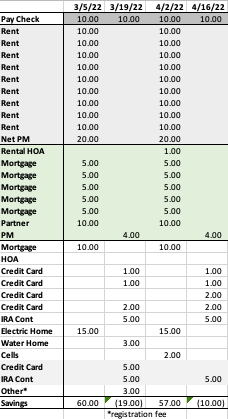
Here’s my sheet, in essence. Pay no attention to the actual numbers in this screenshot, as I didn’t take the time to make sure they were made up but still proportioned to each other. The format is exactly as I use it though. I set it up at the beginning of each year.

For the entire year, I record the pay check receipt across the top of the sheet. The dates are based on the day the money hits our account. This has changed over the years, as we used to get paid on Tuesdays, but now Mr. ODA’s pay check shows up in our account on a Saturday.

The first section, which is all gray, is the rental income. I then record all the rental income near the 1st of the month. If a pay check isn’t near the first of the month, I record it for any pay check date that shows up in the first 10 days of the month. Realistically, I receive the majority of our rent on the 5th of each month, so it doesn’t make sense to record it as a projection any earlier than the 1st, and as near the 5th as I can. The ‘Net PM’ is because I don’t collect rent on our KY houses; the property manager collects rent, removes their expenses, and then we receive the net by the 10th of the following month.

The next section is the light green, which captures routine expenses on the rental properties. I record the HOA due date every 3 months, each month’s mortgage payment, the payout to our partner (I take in all the rent each month and then pay him out his half plus our half of the mortgage payment), and then the VA property manager’s expenses.

The white section covers all our personal expenses.
– The bottom two gray lines are simply an indication to me that those affect Mr. ODA’s account and not our main checking account.
– I pay our personal mortgage near the 1st of the month (some time between the 1st and the 10th, but I typically prioritize this getting paid as close to the 1st as possible).
– Our personal residence’s HOA is only due one per year, which is why there’s nothing on that line for this particular snapshot.
– Then I have all our credit card payments. For the year, I project based on the previous year’s average bill. As I get closer to the statement end period, I update the projection. If I project that a credit card bill is going to be $1000, but as we spend through the month, we had more expenses than I thought, I update the projection on the spreadsheet to reflect that. So where it said $1000, I may put $1700 to cover my savings projection.
– I project our my utilities too. I know that I have an electric and water bill each month, and I have a cell phone bill that I pay in 3-month increments to my sister-in-law for a family plan. When setting up the sheet for the year, I simply keep the same numbers from last year for the utility lines. While I can log into my account and see the details, it’s easier if I already have it laid out like this. Then I can see, “last year, for this month, my bill was only $40; why is it $70 now?” One caveat here is that I usually keep the lines on this sheet to those items that are going in or coming out of our checking accounts. The water bill can now be paid by credit card (since we moved to KY last year). Technically, I should remove that from the sheet because I track bill due dates separately from this part of the sheet, but since I’m used to tracking the water bill’s due date like this, and I like seeing how the bill changes from last year’s amount due, I’ve kept it on the list.
– I have our IRA contributions listed as well, since that’s a big chunk that comes out each month. The maximum contribution into a Roth IRA is $6,000. We have automatic contributions twice per month, so that’s actually $500 out of each ‘pay check’ grouping.
– The “other” line is for expenses that happen every year, but they aren’t worth having individual lines because there’s only one or two payments per year. As I type that, perhaps my own HOA payment could be added to the other line since it’s only paid once per year. In Virginia, we had personal property tax that would be due each year. We also have our taxes that we owe (because we purposely plan our taxes so that we don’t get a refund because that means you’ve given Uncle Sam an interest free loan). We have vehicle registration fees due. All these ‘one off’ payments are recorded on the “other” line and then I describe the expense two lines below with the asterisk.

As for the savings projection, this is probably mislabeled. It has always said ‘savings,’ but it’s really just the net of that two-week period’s income and expenses. To know if I’m in good shape (if perhaps I’m in a position where my account balance is being kept really low), I net the two ‘savings’ next to each other (so I would add the $60 and the -$19 to know that my income from that first two-week period will cover my expenses for the second two-week period also).

In practice, as I receive the income or I pay a bill, I change the text from black to gray. This tells me that it’s paid and accounted for. I also update to actuals as I go. So if I projected a credit card payment to be $150, but the actual payment was $147.34, that’s what gets put in the sheet when I make the payment. This helps me track actual amounts through the year, as well as sets myself up to create projections for the next year.

I have a separate tab in my workbook that tracks additional income for the year. For example, when I was working part time, I recorded that income on that other spreadsheet. Each time we get money from our credit card rewards, it gets recorded on my income spreadsheet. By keeping track of our additional, unplanned, income, I have the ability to identify our actual savings net for the year. I take the ‘savings’ bottom line from this spreadsheet and add all the additional income we’ve brought in from the other sheet.

While I’m not budgeting the details of our expense categories (e.g., $300 per month for groceries), I’m tracking my income and overall expenses based on bill payments. Last year, I had tracked my expenses by category to see if overspend in one area in particular. I didn’t keep up with it though because the billing cycles didn’t line up with when I’d be running my financial update, but I hope to get in a better grove this year. This set up makes me feel comfortable that I’m not missing a bill. If I get to the end of a 2-week period, and I haven’t grayed out an amount, then I know it’s time to investigate why I didn’t receive mail or an email prompting me to pay a bill. Usually what happens is I’m tracking Mr. ODA’s credit card payment and wondering how much longer he’s going to wait to pay it until the due date. 😛

I hope that was easy to follow. I don’t want to put all our exact numbers in there, but I wanted to share how I “budget.” If you have any questions, don’t hesitate to reach out!

House7 Escrow Analysis

We received a notice that our escrow needed to be increased by $185 on this account. That seemed to be a huge jump, considering this was a new account for this year (we refinances January 2021). Our taxes went up about $35 per month, so the $185 increase stood out.

Mr. ODA’s brain works best in these scenarios, and he quickly noted that the analysis double counted our tax payment (they claimed it to be paid in December 2021 and January 2022). My brain can figure it out, but I need to write down every step of the math to understand it. 🙂 Since I took the time to analyze the escrow changes, I thought I’d share it in case anyone was interested in knowing how their analysis works.

They double counted our tax payment, so the increase truly should only be $58*. As someone who needs to see the details and can’t think in the abstract when it comes to math, I ran my own escrow analysis.

First, you need to know your taxes and insurance total for the year. Take that total, and divide it by 12 to get your monthly expense. This is because your escrow additions occur monthly. For this property, our monthly cost of our taxes and insurance comes to $199.25 (green). The old escrow amount of our monthly mortgage payment was $156.92 (orange).

The ‘Escrow Needed’ column is increased each month by $199.25. The ‘Required Balance’ is double the monthly expense for our account (199.25*2). Then the difference between the ‘Escrow Needed’ and the ‘Required Balance’ is the column in blue. The escrow shortfall is determined by the greatest negative. Therefore, I took the difference for that month (May 2022) and divided it by 12, getting $16.60*.

The escrow analysis then results in an escrow increase of $199.25 (the amount needed to cover projected expenses), minus the old escrow contribution amount of $156.92, plus the shortfall amount of $16.60*, bringing the increase to $58.93 per month and making the new monthly escrow payment $215.85.

EDIT: *These numbers are not right. For a detailed edit, see this post: https://onedollarallowance.com/2022/02/14/escrow-analysis-update/.

Rental Property Management

Every once in a while, I like to share what I’ve been doing to manage the properties. There was a lot of activity needed over the last two months.

RENT INCOME

One of our usual suspects for late rent payments was late again. We seem to only have a one-month streak for on-time payments with them. She at least communicates with us that they’ll be late and gives a projection on when we’ll see it. She ended up paying rent on the 14th, and said she needed to pay the late fee on the 21st.

Two other houses haven’t paid rent, but they’ve applied for rental assistance.

RENT RELIEF PROGRAM

House2 applied for rent assistance in September, and we still haven’t received that from the State. I did finally get a tracking number on the 19th that it’s on its way. She paid $400 worth of January’s rent on a Friday and said she’d have the rest on Monday. Well, as she has a history of not communicating and not upholding her word, I wasn’t taking a chance with her. I served her the default notice on Saturday to indicate that she didn’t pay rent in full and had 14 days to remedy that. She remedied that by applying for rental assistance again. She said that she only applied for January assistance, so hopefully we’ll have February rent on time. I wish I could dig into her finances and find out how she didn’t have to pay any rent for September, October, or November, only had to pay $600 towards December because she had a credit from a payment plan previously in place, and then can’t pay January rent in full.

House3 had to apply for rent assistance. They’re great tenants and have been with us since we purchased the house. In November, she applied for December, January, and February assistance. The application expires 45 days after it’s sent, as a means to protect the landlord from floating the expenses on the property indefinitely. This tenant ended up paying December’s rent, but hasn’t paid anything towards January. Luckily, we did receive approval for their application on January 11. Hopefully we’ll receive that money in less than 3 months time like the last time this program was involved. What she paid in December will be counted as March’s rent (2021 income for tax purposes, but she won’t pay March rent because she has that credit now).

REFINANCES & MORTGAGES

We had to provide several post-closing documents on the refinances. It was horrendous. They asked for new types of documentation. Clearly, whoever is purchasing our loans didn’t like the lack of due diligence done pre-closing. Except for the new request, everything else they requested could have been ascertained by looking at the documentation already on hand, so we didn’t appreciate that. Then the new request was to explain how we paid off a mortgage, which was paid off 4 months prior to us establishing a relationship with this company to refinance the other loans. I had to provide proof that it was paid off, and then I had to provide the funds used to pay it off. The balance was $3,100. Paying a $3k bill hardly touches our finances. I want to become an underwriter so I can understand how they need so much detail and are sticklers for the type of detail, but they don’t need to know how to read the details they request.

We had an escrow analysis done on House7. It said that our mortgage was going to increase by $183 each month, but the increase should have been just about $60. I’ll explain details in another post, but that took some time. Mr. ODA called and walked the representative through the error. He said it took a while for her to get there, and we’re awaiting an update.

Since our refinances occurred at the end of the year, and all our city tax payments are due in January, I was nervous about the right amounts getting paid. The initial closing disclosures had the old tax payment amounts on it, but every one had increased. I was able to catch it and request that they be updated before our closing, but it was a day or two before closing. I was afraid it wouldn’t catch correctly. I had to stay on top of the payments and make sure they were all paid in full, and I had to pay the property taxes for those that aren’t escrowed. I was most worried about the three properties that were being refinanced, but then the issue ended up being one of our other houses. The escrow check was sent on 12/21, and it still hadn’t processed as of the tax due date of 1/14. I sent an email to the finance office hopefully showing that I had done my due diligence timely. Luckily, when I checked on 1/20, the taxes were processed by then.

LEASE MANAGEMENT

We require action from the tenant no later than 60 days from the end of their lease. There are 3 properties that have an April 30 lease term expiration. One tenant already reached out and asked to renew their lease. They’ve already been there for two years, and their rent has remained steady at $1300. We have precedent of increasing long-term tenant rent every 2 years by $50 (but we also have precedent of not actively managing houses and not increasing the rent at all.. oops). I explained to this tenant how there have been several increases in our expenses over the last two years. They’re really great tenants, and they hardly ever ask for anything from us. I felt guilty, but we’re trying to run a business, so we need to take care of that side too. Plus, if we didn’t increase slightly this coming year, it’ll be hard to manage future increases. It’s a lot harder to keep a good tenant if you don’t raise their rent and then hit them with $100-$200 increase down the road, so it’s best to keep with inflation. I did the cash-on-cash analysis for this property and discovered that the $50 increase falls slightly short of our expenses and keeping our rate of return the same.

I have to work with two other houses (via a property manager on those) to determine their new rent amount. One house negotiated a lower rent for a longer lease term at their lease initiation, which was October 1, 2019. This property in particular has had the highest jump in taxes. We grieved them to no avail. They’re claiming our neighborhood is part of a more affluent neighborhood and refuse to see how their district lines aren’t accurate for the type of house and street it’s on. I plan to push for an increase of $75 on that one, since their original lease amount is based on a discounted rate. One the other house, the tenants wield a lot of power to our property manager. We tried to increase rent last year, and the tenant flipped out on us about it. We’re already below what we thought market value was on the house, so 2.5 years without an increase is insult to injury. I’m going to request an increase from $875 to $950 on the house and see what the property manager says. If she agrees to a $50 increase, that’d be acceptable, but it’d be nice to recoup some of the other expenses too.

EXPENSES

We have a tenant in one of our houses that is amazing. He treats the house as if he’s the owner. He’s quick to take care of problems, and only seems to let us know when it gets to be a certain level of problem. This house has always had a mice problem. One tenant, who we evicted, created a really big problem that involved several mice making this house their home. She refused to do her part in cleaning up food messes, be it old food sitting on the counter or in the sink, grease splattered all over, or just general mess left behind. We got it under control, but the occasional mouse still rears its head. He sent us an email saying he’s been having an issue, and he’s tried really hard to address each individual mouse appearance. He said it has gotten to the point where he wants to do something more drastic, but wanted our permission. I said that it was absolutely at the point where it’s our issue to deal with, not his, but we thank him for his efforts. I called our pest control company, and we’ll see if that helps. One or two mice is one thing, but for him to say he’s caught 9 in a year, that’s a bit much. The pest control was $165.

One of our KY houses has a bunch of little and weird expenses pop up. This month’s explanation on my report from the property manager simply said “Repaired door by adjusting door to fit opening and resetting stuck plates.” I don’t know what door or how the plates got stuck, but I threw in the towel on that $60.

We were also informed that a toilet at another property stopped flushing. When asked for more detail, we were told that she presses the handle and nothing happens. My response? “Please don’t tell me I’m going to have to spend $125 for someone to reconnect a chain.” Our property manager’s husband said he’ll go look at it, for $80. That’s a downside to not living near the property and being able to check on the issue yourself. We got a text later saying that he talked the tenant through the issue, and it turned out that the flapper was just stuck. So luckily it’s nothing at the moment, but it could be an expense down the road.

SUMMARY

So that was a lot for one month. Luckily, our expenses themselves were low (225), even though we’re missing some rental income ($1,900 and $145 worth of a late fee) and we had to do more management than usual. By having 12 properties, late rent payments or non-existent payments don’t create a strain on our finances. For example, if we only had House2, who paid $1550 worth of 5 months of rent because of the rent relief assistance program, then we’d be floating those mortgages each month. By having more houses, those other rents are covering the expenses on the one house.

In 4 weeks time, a ‘full time job’ would be 160 hours of work. I estimate that all the action that I took this month (and the phone call Mr. ODA had to make to our bank on the escrow issue) comes out to about 6 hours. There’s the perspective. Even when it seems like a lot, because it’s more than nothing, it’s still hardly anything.

January Financial Update

I’ve spent a lot of time thinking about how to set up our financial updates in this year. I didn’t like the format last year. I think I’m going to focus more on how spending changed month-to-month. Since my posts are late this month, this is written as of January 20, but didn’t post until today. I want to do several detailed posts about last year’s activity, this is going to be a shell of a look at our finances, and more of a “what have we been up to” type post. As a reminder, I usually post this around the 15th of the month because I can capture the mortgage payments made in the month (we pay our mortgages around the 10th, after all our rent is presumably collected).

RENTAL PROPERTIES

We left off last month with 3 refinances in which we took cash out. We paid off 2 mortgages with some of that money and have been looking at houses to purchase this month. We made an offer on one recently, but lost to another bid that was $5,000 more. We were about to make an offer on another one, but the HOA was $100 per month, and that really ate into our monthly cash flow. In this market, we’re not even close to our 1% Rule that we strive for (rent is at least 1% of the purchase price). Today’s deal I considered was going to be $240k purchase price with $1500 (maybe) in rent. We would have lost money every month with the HOA costs and such a low rent.

I’ve spent a lot of time managing these properties over the last month, which I’ll detail in another post.

One of our houses finally had the rental assistance check cut, so that’s 3 months worth of rent, going back to September 2021, that’s on its way to us. We’re waiting to receive a check for another property’s rental assistance approval, so that has us one month behind on that house. And the original house that applied for assistance applied again for January, so we’re waiting on 65% of that house’s January rent. We had to do pest control for mice on one house, and a toilet needed fixed on another.

One property’s HOA went up $10/quarter. I had already paid the $240 bill in December to count it as a 2021 expense, so I had to add $10 to that in January after I was notified of the increase.

EXPENSES

We had fraudulent activity on our main credit card, so that had to be closed and reissued.

Our swim lessons that were scheduled last March/April were finally rescheduled. That’s been $88 sitting in suspense – we paid for the lessons, they cancelled them, and then they kept our payment as a credit until they rescheduled.

We were sick the first week of January. Between our travel to NY in December and being sick for over a week, our expenses were pretty low this month. Our gas usage was higher than usual since we drove to/from NY. We hardly ate at restaurants, and our grocery runs were more focused on meals than just randomly buying things and hoping it makes a meal later.

Our electric bill was about half of what we expected it to be, so that was a pleasant surprise. It’s been colder this month, so I expect it to be back up to the $300.

NET WORTH

Our net worth increased by about $15k since mid-December. Our taxable investment accounts increased a good amount over the last month, but our retirement accounts took a hit. Our cash balance increased, and our credit card balances are lower than usual. Our investment property mortgages didn’t decrease the usual amount because we didn’t have to pay 3 mortgages this month due to the refinance; they only decreased by $671 worth of total principal.

Budgets and Overspending

I’ve rewritten this several times over the last two months, constantly afraid of who I’d offend. Instead, I’m just going to share my raw observations and hope it makes sense to the people who need it. Plus, what’s a better time to discuss budgets than the first post of the year? I actually have quite a few posts related to budget planned. So we’ll start with why I believe budgeting leads to overspending.

I don’t like budgets in the sense of the word’s common understanding. A literal definition of the word is, “an estimate of income and expenditure for a set period of time.” In this context, I’m all for a budget. I have a detailed (over-the-top, probably unnecessary) spreadsheet that I use to manage our money. In any given two-week period, since 2012, I can tell you my projection of money-in and money-out. I make sure my expenses are covered.

ENVELOPE SYSTEM

The extreme version of budgeting (in my opinion) is the ever-popular “envelope” concept. It’s simple: you decide on your monthly spending categories, and then you put your cash* in the respective envelope to pay your bills. (*Please don’t pay for everything in cash!) When you run out of money in a given envelope, that’s it for the month. There must be a way that this works for enough people that it keeps getting touted as a great idea, but I’ve seen it fail. You’re creating a dependency on these envelopes instead of an understanding of your finances.

What happens with any leftover money in the envelope? The articles I’ve read about this system literally tell you to celebrate if you come in under budget. No. How does taking your extra money and spending it frivolously get you to your goals faster? Or it tells you to add it to next month’s envelope (e.g., if you have $50 left over in this month’s envelope for groceries, put it in next month’s envelope and now you have $350 instead of $300 to spend on groceries). How are you creating discipline and an understanding of budgeting if you can splurge next month? Now you’ve spent an extra $50 in month 2, but you need to scale back to $300 for month 3. That’s not creating a routine.

I want you to create a relationship with money.

RELATIONSHIP WITH MONEY

We don’t budget in the colloquial sense. We have a relationship with money. I make sure that my mandatory expenses are taken care of (e.g., mortgage payments, utility bills). Everything that can, goes on a credit card. When it comes to paying off the credit card every month, it goes back several steps.

My thought process is cemented in whether or not the value of an item is worth it to me. When I’m about to buy something, I take the time to think:
1) Is this item worth the price I’d pay for it?
2) Will this item serve a need (not a want)?
3) If it’s a want, will this item bring me enough happiness that I’m willing to spend this amount of money on it?

Want to know something I recently struggled with? For years, I’ve wanted a desktop tape dispenser. Years. I don’t even think about it until I’m wrapping Christmas gifts. So once a year, I have tape, but I wish I had a desktop tape dispenser. I never bought it. I thought, I can struggle through needing two hands for my tape dispensing needs for a couple of days out of the year. I thought, if I buy a desktop tape dispenser, then I need to buy a different kid of tape than I already have on hand. Every year, I just dealt with it because it wasn’t worth the cost to me to invest in something that would make things marginally easier for me for a few days of the year. This year, after wrapping more than half the gifts, I decided enough was enough. I purchased 6 rolls of tape for 9.99 and a dispenser for 4.22. I’ve been wrapping gifts outside of my parents’ house (where there were tape dispensers) for more than 15 years. I’ve struggled with the decision to purchase a dispenser every single year, and it finally got to the tipping point this year. All that thought process, over all those years, to spend less than $15.

That’s my thought process for every non-routine purchase. Instead of putting cash in an envelope marked “something for me” each month, I’ve trained myself to manage our money from the purchase point instead of an envelope full of cash that I mindlessly spend down. I can make an informed decision on whether or not I need or want something. I’m taking the time to decide whether this is going to bring me long-term happiness, short-term happiness, and whether the cost of the item is worth it. Had that tape dispenser been $15, plus new rolls of tape for $10, I probably wouldn’t have bought it. Because at that point, I’d be happier with a new shirt or new pants for $25. So I would have decided that my $25 is more valuable to me than to spend it on tape. That doesn’t necessarily mean that I go out and buy a shirt arbitrarily; it just means that I’ve decided that the value of that money is worth more to more towards something else than this item I’m currently contemplating.

OVERSPENDING

I see it over and over: people who budget seem to be the ones buying things they don’t really need. Instead of changing your mentality to be whether a purchase is necessary or is worth the price, the decision becomes “I have $300 left over, what can I do with it?” I see people have their sights on a product that they want. They build it up in their mind that it becomes unattainable, so when the extra money is there, they splurge on it. But did they ever step back and ask if it was really necessary or if their money could be put to better use in their overall wellbeing?

There’s a time and place for splurges. I understand that buying something you want makes you happy, in that moment. What if you thought: does my happiness in buying this gaming console outweigh the anxiety and frustration that I can’t pay my bills in a couple of weeks?

If you struggle to pay your rent month-to-month, then a large influx of money should be earmarked for future bills, not to splurge over and over again. An envelope system creates a reward-driven desire to your spending. The goal should be a more comfortable lifestyle where you’ve set yourself up for success instead of a groundhog-day-struggle to make ends meet.

There have been several instances that I’ve seen in the last couple of months, but the one that really has been weighing on me happened in October when I was working.

I was working at the racetrack. It’s temporary work – working during the race meets and possibly during their horse sales. The Fall meet was 17 days. Depending on where you’re working, you can make some really good money. I happened to be placed in one of those locations, and next to me was a young girl. She complained of having to work two jobs and not getting a day off all month because she was working two jobs. She also shared that she struggles to “make a decent living,” and that she borrowed money from a friend to be able to pay rent on October 1.

The first day, we made over $400 in tips. The second day, she asked how we celebrated making that amount. I bought the Hatch sound machine. I’m going to assume that most of our readers have no idea what that is, but it’s a sound machine and a light that can be programmed for different needs (for instance, I wanted it to give our toddler the signal that it was OK to get out of bed). It’s $60. I had already looked into several options, and I had already determined that I was in a place in life where it was worth it to me to spend the money on the original than to attempt to buy a knock-off that doesn’t work great for $40. Personally, I was going to buy this thing regardless of what I made while working, but I used that as my example on what I splurged on with our unexpected earnings. She shared that she took her boyfriend out for a steak dinner. One celebration isn’t going to break the bank, but it became a routine. It wasn’t until the middle of the month that she said she had paid her friend back for helping her pay rent. That $150 you spent on one meal could have been prioritized to keeping a roof over your head, or being a good friend and paying your debt.

So often, I see someone else blamed for one person’s mistakes. It’s the greedy landlord’s fault that you need to pay rent. It’s the government’s fault for not increasing minimum wage. What if you stepped back and looked at your decision making? Did you buy the new gaming console and then struggle to pay rent on the first of the next month? Did you go to Costa Rica and then struggle to pay rent on the first of the next month? Did you buy that new gaming console, and not add to your savings for future planning? The televisions in our house aren’t huge, but they work. I don’t have a need to replace a working television simply so that I can have the newest technology and the biggest screen.

If you don’t create a relationship with money and an understanding of how to make informed decisions, you may end up with unnecessary expenses with money that could have been more productive. It’s time that you step back and look at your entire spending picture to know whether you’re truly budgeting and learning, or you’re mindlessly spending money because you’ve accepted that’s the cost.

Refinance Results

There’s a company in Virginia that offers $0 closing costs for refinances. That applies to personal residences being refinanced. They still cover most of the closing costs associated with investment properties, but there’s an investment property fee that we need to pay. They also have a fee associated with taking cash out as part of the refinance. Another stipulation is that the new loan has to be at least $100,000 after the refinance. I spoke of the initial details in a post last month, and now I can discuss the details and results of the refinance.

We first talked about taking $50,000 out for each Property2 and Property3. Then we added Property8 into the refinance. The opportunity to use this company to refinance a loan is only available in Virginia. We decided it was best to pay off both Winchester, KY houses instead of just one. The appraisals came back higher than anticipated, so we decided to increase each loan to the max amount of 60% loan to value ratio.

Note the change in value on these houses. We’ve owned 2 and 3 for 5.5 years, and we’ve owned 8 for just over 4 years. The value of these houses have more than doubled in that time, with minimal effort on our part, all the while having a tenant cover the mortgage and maintenance costs.

CASH FLOW

At first, the thought of going from $60-70k to $123k-138k worth of loan payments is an overwhelming sight. I’m a visual person, so I broke it down to a place where I felt comfortable with this move. That comfort is in the cash flow.

With the $190k cashed out, we paid off two loans. Due to a huge issue with our insurance payments, our escrow accounts were substantially negative. Therefore, the payoff required making the escrow accounts whole. Our bank that held these loans used to have such a great online system. Through the course of 3 updates, they killed it. They took away loan history in an easy-to-view format, they took away options to make principal-only payments same day, and they removed the payoff request concept (they had made it difficult in the last update by making it a request that you would have emailed to you, and then in this update, they took it away all together, forcing me to call an automated system that just kept telling me about covid-relief options….. I’m not bitter).

After these two loans were paid off, we were left with just under $50k in cash. This will be used for a downpayment and closing costs on a new rental property, which is a search underway.

To the cash flow part – the removal of those two loan payments was worth $1,184.62. The three properties refinanced had their mortgage payments increase by $1,117.70. The change in my monthly cash flow is now $67 more than I had been netting. I’ll note that the cash flow also involves one of the houses going from a 20 year mortgage to a 15 year mortgage, which increases the monthly payment disproportionately to just an interest rate change.

That’s the black and white, month-to-month change; there are some caveats though. Previously, Property2 hadn’t been escrowed, so I was paying that on my own. Now, with the two houses paid off, I’ll need to pay those previously-escrowed costs on my own. When I factor those details in, my annual cash flow actually decreases, and my out of pocket costs for the year increase by about $700.

While the monthly cash flow increase of $67 isn’t a drastic difference, the fact that we have cash left over and $50k of the new loan balance will be used to create more cash flow with the purchase of a new rental-producing property benefits our portfolio.

MANAGING BILLS IMPLICATION

With the payoff of the two houses in Winchester, KY, I now am responsible for paying the taxes and insurance on the properties (instead of escrow). In October, Kentucky sends the owner as of January 1 of that year the tax bills (meaning, if you own the property on January 1, 2020, then you receive the tax bill on October 15, 2020). It’s frustrating. It’s on the old owner to forward to the new owner if there was a sale during that year. They also send it to the owner even if there’s a mortgage with escrow. So every year, I need to call the mortgage company and make sure they received the bill themselves. Even though I need to stay on top of paying the taxes and insurances now that there’s no escrow, it’ll actually save me time because I won’t have to call these companies to make sure they received the current tax bill. Oh! They also give an incentive for paying early, so I’m always worried that the escrow payment won’t be released to give me that incentive and that they’ll focus on the due date.

Property2 had not been escrowed. There was a screw up in the paperwork that I capitalized on because I don’t like that escrow keeps my money tied up without any incentive to me. Well, Mr. ODA thought I had said I preferred things to be escrowed, but I don’t remember ever definitively saying that. I may have said a comment like “gosh, it’s nice to not have to remember to pay this bill,” but not that I’d prefer to see my monthly payment go up each year because of an escrow reanalysis (I feel like I wrote a post about this……). Property 2 is now escrowed through the refinance.

I removed two tax payments to Virginia and one insurance payment, but then I added back 4 tax payments and 1 insurance payment for each year. The one insurance payment for two properties is what caused me to have an escrow fiasco, so now we’ll avoid that mess by paying it ourselves. Plus, when we pay the insurance ourselves, it can go on a credit card where we earn cash rewards.

SUMMARY

In 4-5 years, we’ve more than doubled the value of these houses that we purchased. While that isn’t immediate cash in our pockets, that’s a substantial increase in our portfolio’s net worth. That increase in value costs us more in taxes in each year, but it also provided us with this opportunity to refinance and take cash out to purchase another property. With two houses paid off, we have also increased our monthly cash flow by about $67. On top of all the near-term gains for this transaction, there’s also the interest payment gains we received. All 3 loans dropped their interest rate, and one loan transitioned to a 15 year loan from a 20 year loan, which decreases the interest owed as well.

December Financial Update

Here’s one for the “I don’t want to be a landlord” category. At 9:30 pm on the night before Thanksgiving, our tenant EMAILED us that their basement flooded. This basement has been a terror from the start; every few months an issue (a water issue, at that) rears its head. While I appreciate that she wrote a very nice email and included pictures, email isn’t the best way to communicate this to your landlords. She also acknowledged that there was a holiday, and that they turned the water off to everything in the basement, so this could wait until Friday. After a quick panic of “what the heck am I supposed to do about this at 9:30 pm the night before a holiday,” I let it go. I couldn’t do anything about it until Friday morning – the same as if I was living in the house and needed to contact a plumber. I texted my plumber at 7 am on Friday. He responded at 8 am that he’s sick. I called a big company (I don’t prefer big companies), and they were able to get me an appointment for Saturday morning between 8 and 10. After I confirmed that, Mr. ODA sent a text to someone who did some major plumbing reconstruction work for us, and he said he could be there in an hour. So before noon, we had the issue taken care of! $250.

Mr. ODA wanted to take our cash balance and throw it at the mortgage that we are planning to pay off with our cash-out-refinance that’s scheduled for mid-December. The thought was, why pay interest on the current mortgage balance while we have money sitting in our account not earning anything for us. I went a little higher on the amount I “allowed” because we always seem to come into some sort of money throughout the month that increases the balance from my projection. Well, I didn’t factor in a very expensive Black Friday for us. It was 16 separate purchases, but it wasn’t too bad… we didn’t hit 4 digits. Lucky for us, Black Friday fell the first day of a new credit card cycle, so we have until January to make this payment.

On top of Black Friday purchasing, we bought things for our basement finishing project: 3 cabinets, a sink, and a minifridge/beverage cooler. That was about $1000 worth. We have the basement cabinets in place now, and we’re waiting to be told the countertop has arrived so we can get this all installed and finish the baseboards. We have a flooring appointment today to get the final big piece out of the way. We still have to do the window casings and moldings around that, too.

I’ve paid 2 tax bills on houses that aren’t escrowed, a large medical bill (plus several smaller ones), and our car insurance payments. December is a big month for bill paying. It helped that we have dividends from some of our accounts go into our checking accounts instead of being reinvested, so that was about $5k more of income than we planned.

At the beginning of last week, we closed on 3 refinances. I’ll go into details on a separate post, but these refinances are why this financial update is a little later than usual. I wanted the cash influx, the loan payoffs, and then the credit cards to be more tame before updating the financial status.

We have 12 rental properties and our personal residence. We’re carrying 8 mortgages (well, two are in our partner’s name) now that we paid off two houses. It’s nice that we have 5 houses owned outright now; although that does mean that I need to be on top of paying the taxes and insurance on them now. With that said, since we took a substantial amount of cash out in the refinances, our loans on investment properties have increased this month. Our investment properties have continued to increase in value, especially once we learned of the appraisals on the 3 refinances. Our investment and retirement accounts have taken a hit since last month. So while our overall net worth has increased, there were some big changes in the line items themselves.