March Financial Update

Well, my desire to post every Thursday fell off there. I started a new job, Mr. ODA’s Federal job has been in limbo, and just general life things have been going on and keeping us busy. The kids started t-ball in the past few weeks, our youngest was waitlisted at both of the preschools we tried for, and the rentals have needed more attention than average. Let’s dive in.

NEW JOB

I was approached by someone I serve with on our HOA board. They were looking for a new person who has a financial background, was really organized, and could handle talking to people regularly. It appears that I made such an impression on him and his wife. I wasn’t ready to get back into the workforce. While I have enjoyed my temporary jobs I’ve done since I quit my career in May 2019, I always had a ‘sunset date’ on those activities. I knew that each job was only for a short period of time, and I’d get back to freedom/flexibility. This was a new territory they were asking of me – be on a set schedule and away from my kids.

I expressed that my need for entering back into the workforce was that I wanted to be part of my kid’s activities and I needed to work between school hours for the most part. They expressed a desire for me to work 30 hours, and that just wasn’t feasible. Based on what they told me about the tasks required of the job, I was able to come up with about 18 hours of work, knowing it would likely become 20 hours. So far, I’ve worked more than 20 hours each week as I’m learning, and things are not moving as quickly as I expected them to. I’m 2.5 weeks in, and at this point I can do all the main tasks. Where I’m struggling is the knowledge of all the “one off” transactions and how some people are treated a little differently than the standard.

Overall, I’ve been super grateful that Mr. ODA has given me the space I needed to get my feet under me these past couple of weeks, and I’m really enjoying learning these new tasks and being involved in this sector.

FEDERAL WORKERS

It’s been rough around here for almost two months now. While Mr. ODA is still employed, there is a daily concern that the news will come in. There’s no security like there used to be expected for a government position. The blows have become a bit more scattered than it being such a daily barrage, but there’s still uncertainty and daily updates and waiting for more information that’s occurring.

PRESCHOOL

Both old kids will be in regular school next year. Our youngest has a late-in-the-year birthday, so he wasn’t eligible for preschool until this coming school year even though he’s already 2. The preschool where both of the other two went to shut down. My middle is finishing out the year there, but next year, they sold the preschool concept off to a third party. The company that took over has terrible reviews, and everything about them screams ‘daycare.’ While people need daycares, and that’s fine, we don’t need that. I wanted a space that had a curriculum.

The school previously had a daily agenda and an expectation that the kids were there from 9 to 12. This new school has a come and go as you please set up, and they couldn’t provide me a break down of their daily schedule. The admissions person was actually quite rude and condescending to me, after taking 4 days to return my phone call. I’m not in a desperate need for our youngest to go anywhere, so I won’t be trying to enroll him there.

We had hoped to get into another preschool by our house, but the closure of our old school sent a mass exodus to the nearby preschools. I told Mr. ODA that I wanted to join their church so I could get 3 weeks ahead on signing up, but he said that wasn’t ethical and was more than just saying “I want to join your church.” So I didn’t. But several other families did. And they got in. And I’m still really sad about that. He’s waitlisted there, and there’s been no indication of hope that he’ll get off the waitlist.

I tried for a “moms day out” program, which would cover one or two days per week (I was looking for 2 days previously). He’s waitlisted there, but she gave me a glimmer of hope that even though they don’t have a lot of turnover, there is a chance a space opens up either right at the end of this school year or at the beginning of next school year.

I had originally ‘mourned’ the loss of my freedom with the preschool closing down. I have been at my kids’ beck and call for 7 years by the time our youngest would go to school. Even though it was only going to be 6 hours per week, I was excited to get things done that have been on my to do list for years and just run errands unencumbered. I’ve lessened my extreme feeling on that over time, but it still would be nice to have a few hours dedicated to me and my schedule at some point.

RENTALS: RENT RATE

I evaluated our current tenants and their rent rate back in December. I should have just written the letters at that point and been prepared for the deadlines, but I didn’t. So this week, I got those rent change letters prepared, printed, and mailed. We typically change the rent by $50 every two years for our long term tenants. That’s the approach we took here except for a couple that needed more catch up. One tenant has already responded and executed a change to increase their rent. I have 4 more out there waiting for the tenant to tell me they accept the adjustment or will be leaving at the end of their lease. I also have another tenant who will be staying another year, but I didn’t change their rate since I had changed it by $25 last year.

RENTALS: TERMITES

We have a house that we purchased with termite issues. We knew it going in. We had it treated, and then we fixed the really bad areas. We then didn’t get notification about an annual warranty payment they would do, so our coverage lapsed for a few years. We saw swarmer termites in one part of the house and called them back. They offered to let us backpay those missed warranty years, saving us about half the cost it would have been for a new treatment. Well, we’re paying for that now. For the last 4 years, they’ve checked the property once per year. They’ve noted termites actively being there with more damage, and they didn’t clearly communicate the concern of the condition until this month. We have major problems in the house. One wall in the laundry room is so bad that the termites ate the backing off the drywall and the drywall is all cracking off the wall because it’s not being held onto anything. It really hasn’t been fun, but I know we will be able to fix it. So far, we’ve had the crawl space cleaned out and relined with a vapor barrier, and some plumbing issues fixed that were creating a perfect moist condition for termites to gravitate to. We still have to rip up the carpet, fix the subfloor, lay LVP, rip out a shower insert, reinstall the insert, and get the shower operational after that. It’s a lot.

PERSONAL FINANCES

Mr. ODA reduced our monthly contributions to our investments. We were putting $3,000 per month in (3 separate $1,000 transactions), and now those have been reduced to $500 three-times per month. The kids still get $100 per month each into their UTMAs.

We’ve been so busy that we have hardly spent any money. Outside of insurance and medical payments, the only extra spending I’ve done is for our daughter’s birthday parties we’re having this month. I’ve bought some clothes since I’ve lost weight on my post-three-kids journey too. Usually, we’ve booked a trip by now, but we haven’t done that either. Overall our spending is lower than it has been.

NET WORTH

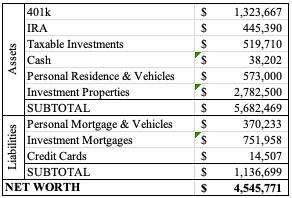
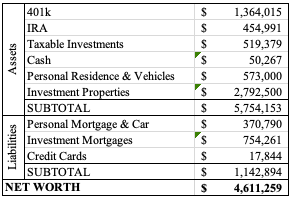
The market is well below where it has been, and all our numbers show it. We are over $189k lower than last month. I haven’t updated our property values yet. I’ll probably do that next month as the spring market ramps up.

Rental Cost Changes

In November 2023, I posted about rental changes that had occurred over the previous year. I wanted to update that analysis a few months ago, but I didn’t have all the KY data. I recently shared that my rent increases aren’t covering my cost increases, and my portfolio’s cash projections are lower now than when we first purchased all the houses. Here’s more of a breakdown of those changes per house.

ESCROW

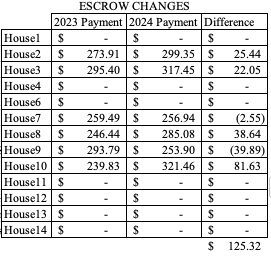
Escrow is an account that your mortgage company holds money to pay your insurance and taxes on your behalf. I have little faith in their management, as I’ve had to follow up on balances in the account and payments made incorrectly.

I created this table to show the differences between escrow payments over the two years. I kept the houses that don’t have an escrow because it can be compared to a future table in this post. There is no House5 in this table because we sold it several years ago (houses didn’t get renumbered because House5 still exists in terms of tax documentation).

INSURANCE

We had 3 insurance claims last year, and a big one the year before. It turns out, our portfolio is looked at as a whole, so 4 claims in a 12 month period doesn’t look good, especially when one of those was 6 digits and one was 5 digits. None of it was egregious, and they were each necessary. We were just a victim of poor timing (and for some reason, the 12 years prior to that with 0 claims of any kind mean absolutely nothing). While our own history is to blame in some aspects, insurance costs as a whole are increasing quickly over the few years. Here’s Google’s AI response:

And with that between payments made in 2023 and payments made in 2024, insurance is costing us almost $2,000 more for the year. I also just made my first 2025 payment, which increased that one house by $343. The total increase from 2022 and 2024 is over $3,000.

From the initiation of insurance on each house (so, when we first bought the house, which were mostly between 2015/2016) to today, we’re paying over 43% more in total for insurance.

TAXES

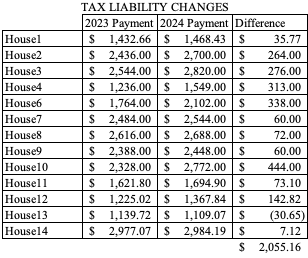
The table below shows the change between 2023 and 2024 for our tax payments. Last year, many jurisdictions that hadn’t captured the assessment changes since the pandemic made up for it last year, when we saw about a $3,500 increase for the year. This year, our increase was over $2,000. Fifty-five hundred over two years is nearly $230 per month, spread over 13 rental properties is $17 each. So for those that I didn’t increase rent last year, they’re not capturing that cost increase for our portfolio.

RENT INCREASES

So far this year, I’ve missed two opportunities to increase rent. I had planned on increasing one house by $25 to keep up with inflation costs, but it didn’t register that their notice had to be given by 1/1 (every one else is by the end of the month). The second is above market at this time, which was by design since they’re not easy to work with (tried to phase them out, but they accepted the rent increase). We last raised their rent in September 2022, so it’s been two years. But I couldn’t bring myself to do it. Next year we’ll increase them by $50 per month.

My plan is to increase the rent for 5 of our other houses. Four of these houses are planned to be $50 per month of an increase, and one is planned to be $75. Our management is generally to increase rent by $50 every two years if you’re a long term renter. There have been a few that we didn’t increase for a while, and the carrying costs have drastically increased, so we’re behind now.

SUMMARY

For our cost increases between taxes and insurance, we have over $4,000 that was paid out last year (and it’s really more than that in cases where the house has escrow, so our escrow was increased more drastically that the specific amount of change in bills).

We had 3 houses turnover from long term tenants, so we were able to increase the rent to market value. I prioritize keeping long term tenants, so I don’t always do rent increases. That means that sometimes the rent is stuck below market value, but I’d rather keep a good tenant than push them out with large annual rent increases.

By bringing those houses up to market rent, I’ve made up a good amount of our deficit. Now remember, these rent increases are catching up on multiple years of drastic increases. So even though it seems we’ve brought in more, we’re both making up for previous years that didn’t have such large rent increases and paying for more large scale improvements to these houses, in addition to larger contractor costs.

Organization Push

It’s the new year, so that means everyone’s pushing to “start fresh” and “get organized.” Someone I follow on Instagram talks about “getting organized” at least once per month. This month, she bought a new electronic tool that her husband hung on the wall to get her organized. Here’s my unpopular opinion: organization happens in your consistency, not in a new gadget or container.

This electronic calendar costs $300, unless you want the biggest one, then it’s $630. I bought a $14 chalk board with calendar boxes on it. Each month, I write the month’s agenda day by day. Then at the end of the month, I erase it and put the next month’s activities on it. It requires about 10 minutes of my time each month, which I acknowledge is more effort than an automatically synced electronic calendar (if you’re even using your electronic calendar), but I believe those 10 minutes per month are worth keeping that $300 in my bank account to use on something else that brings me joy.

Here’s the thing: the $300 calendar is only as good as your commitment to using it. This isn’t a special robot that keeps your life organized and calendar up to date. You still need to input data. Then you need to create an expectation and routine where you check that data. If you can commit to putting items on your electronic calendar that syncs with the system, why can’t you make the commitment to consistency in other areas? That’s all it comes down to – consistency.

I don’t disagree that there are some people who benefit from this product. But I’d venture to say those are the people and families that are already organized and already have systems in place to provide a well-oiled-machine type household.

STRESS AND MESS

I haven’t delved into the topic in detail, but the blurbs I’ve seen have stuck with me. I think they ring true. “A 2009 study found that mothers with cluttered homes had higher levels of the stress hormone, cortisol.”

The people I know who have high levels of stress and anxiety are also the people who have a lot of clutter in their home and office. They’re surrounded by a lot of distractions and don’t keep a routine, have systems, or make an effort to eliminate the mess. Less things to tidy up, means less time putting things away or finding a home for things. Everything having a home and putting things in their home as soon as possible are good first steps.

MY KEYS TO SUCCESS

Everyone has a different way of thinking, so this isn’t a one-size fits all situation. However, I do have a few things that I do that could be little nuggets into improvements in your day.


Room “Sweeping”

Another thing I’ve seen on social media is that expectation that things are put where they belong in one action. The concept seems like a good idea, but to me, it provides for inefficiencies and everything taking longer. If it takes longer to complete a task, then I don’t think it’s something you’d keep up with.

The idea is that instead of placing your keys on the counter, which then need to go on a key rack or in a drawer, you just put them there to begin with.

Where I see a flaw come in, is that when I’m tidying after my family, if I pick up one item that goes to the basement and put it away, then come upstairs and find another item that needs to go to the basement, I’ve waste that time walking up and down the stairs. Instead, I move room to room.

I usually start in the living room. I move items to where they belong. If they go in the living room, they get put away right away. If they go to another room, they just get placed on a surface (e.g., cups and bowls are placed on the kitchen counter, basement toys are placed at the top of the basement stairs). Then once that room is tidy, I move on to the next, which is probably the kitchen table. The table gets cleared and items get placed in the room they belong in, unless it’s the living room, then it gets put away since I already cleared that room.

I do my best to complete this task all at once. I do the kitchen last because I know an unkept kitchen drives me crazy, so it motivates me to complete the other rooms so that I can get the kitchen cleaned up.

I’ve seen basket concepts too. I haven’t tried this out, but it seems to be generally the same concept. The only issue I’ve noticed is that there’s no expectation that it’s cleared out daily. Once the items are in a basket, it doesn’t seem the room is cluttered anymore, so it doesn’t motivate the final step of clearing out the baskets and putting the items away.


Resets

My days are significantly better if I wake up to a clean kitchen and house. If I need to clear dishes from the sink, pick up toys in the living room, and wipe off the table and counters, then I’ve put my ‘morning chores’ 15-20 minutes behind. I learned that I appreciate focusing only on morning chores in the morning, so I make sure I tidy up the house before I go to bed.

My morning routine is simple, but I know it takes at least a half hour. I empty the dishwasher (which is essentially ran every other night), make the kids’ snacks and lunches for school, get their water bottles filled and set on the table, lay out their vitamins, start my coffee, and get the dog ready for the day. It’s the same thing every school day morning.

I also know that I much prefer to have it all done before any children wake up. They create a distraction. Tasks that take me 3 minutes now take me 8 minutes because I’ve been interrupted several times. While I’m trying to empty the dishwasher, they can now see a plate or cup they want, and then they start asking for these things. While I’m trying to make someone’s lunch for school, they’re asking me what I’m giving them and now having an opinion on whether they want it or not. If everything is done and out of sight before they wake up, it eliminates those distractions and I can accomplish tasks quicker and more efficiently. It also gives me the ability to give them attention for their stories and their breakfasts requests once they start waking up, so I’m not flustered or forgetting steps of the morning that make the rest of my day feel successful.

I used to require all dishes be put immediately into the dishwasher. There was no reason to set a cup in the sink when it could have easily been placed in the dishwasher without having it sit in the sink first. Then I had 3 kids. There’s no way I can keep on top of the dishes, and the fact that they even clear the table and put things in the sink at their ages is a huge win. Instead, I just make sure that before I start any meal, the sink is emptied. One, it allows for no distractions in my own head (because I know that I will see dishes and keep thinking about them being there when they shouldn’t be). Two, it clears out the sink so that I have room to fill pots with water or dump dirty things into the drain (I can’t stand when plates are rinsed off on top of other plates, leaving those plates with a greasy film that I then need to touch). Keeping up with a reset before each meal means that it doesn’t get to an overwhelming point at the end of the day that’s taking a lot of focus and time.

SYSTEMS

Organization comes down to systems. You don’t need to spend a fortune to create organization in your life. Sure, bins here and there create a distraction-free, clutter-free environment. But having an aesthetic container that you pour a box of cereal into creates another step for you to be successful, and it doesn’t gain you anything in the organization realm.

My pantry isn’t organized with perfectly matched bins or containers, but it’s organized. I have all our cereal boxes on one shelf. I expect those boxes to go back on that shelf, not left on the counter and not just put anywhere in the pantry. Cereal has a home. Pasta has a home. Appliances have a home. Every once in a while I realize that we could benefit from having a container, and I’ll get a bin to house several tiny things that kept falling on the floor when someone touched something else. Overall, everything has a home in its original container.

Don’t get me wrong, there are clean ups that need to happen in my life. There are 5 of us touching things in that pantry and this house, so things aren’t perfect. However, everything has a home. There’s a well-known expectation that things are put where they belong (especially since mom answers enough “where is…” questions here).

SUMMARY

The general concept is that your desire to get organized is fueled by your own actions and thoughts. It’s not going to be ‘fixed’ with expensive gadgets if you’re not willing to put the effort into the follow through.

Don’t take this as I’m perfectly organized and have everything under control. I cheat. The last load of laundry is in the dryer. If it stays in there instead of on my bed, then I don’t have to deal with it until I really need or want to. This happens about 75% of the time I do laundry… that last load just lays in there until the next time I do laundry and need to move things along. I also have learned that if I fold the clothes during the day, then I can put them away right away. If I fold clothes after the kids go to bed, then they sit on my dresser for days because I couldn’t immediately put them away while they were sleeping, and I’m typically only seeing them and being reminded while I’m in the middle of another task.

So on top of creating systems and expectations for your household, it’s a matter of finding what makes you tick. When you’re successful at keeping the kitchen clean, does it make you feel like you have better control over the rest of the day? Find these little items that you can be successful at so that they snowball into bigger actions – all of which can be done for free.

Rental Profit Calculations

When we consider purchasing a house to be used as a long term rental unit, we perform a “cash on cash” analysis. I’ve discussed this in the past, and I regularly share this with other people for their use. The gist of this calculation is to determine whether we would get a return on the cash put into the house.

The calculation considers the cost of taxes, insurance, homeowners association fees, vacancy expectation, maintenance expectation, costs to get the place rented, property management, etc. This is compared to the projected rental income. The upfront costs are compared to the annual cash flow projection. That ratio is hopefully in the 8%-10% range to be considered a reasonable cash flow to look further into the purchase.

Since we’re not really looking to purchase properties these days, I use this spreadsheet to consider changes in a tenant’s rent when it’s time for renewal. I kept all the original cash flow amounts to see how things change over the years. As I sat down to determine what changes, if any, are needed in the rents I charge, it was disheartening to see how our portfolio has dwindled in profitability over the years.

A few years back, housing prices skyrocketed, which drastically increased our taxes owed. Unfortunately, I hadn’t increased everyone’s rent consistently. I kept many people level or did small increases every two years, but that means I’m now “behind the 8 ball” in trying to make up for those drastic increases that happened in 2021-2022. In addition to tax increases, we’ve also seen huge insurance premium increases that weren’t projected in our portfolio.

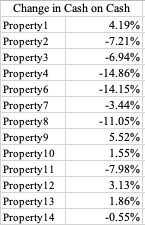
Our total “cash on cash” started at 11.42%. It’s now projected to be 7.58% – if the increases I project actually go into effect over the next few months.

We historically increased long term tenant’s rent by $50 every two years. Some of these tenants have been with us for over 5 years, and the $100-200 changes in their rent have not covered the increases we’ve seen. I hadn’t worried too much about it because the losses on those houses were offset by houses where we saw greater margins. Now, everything has leveled out, so those losses are felt harder.

The table above shows the change from our original “cash on cash” to our current status. In some instances, we’ve been able to increase our margins. But there are 8 instances our margins decreased, with some being drastic. Even though some are drastic decreases, there are only 5 properties that fall below the 8% goal we have.

For Property2, the projection shows that rent would need to be at $2,500 for us to hit our cash flow goal. The rent is currently at $1,600. The neighborhood doesn’t call for $2,500. I also don’t want to be in a position where I’m floating someone’s rent at that price. From the time we bought the house to now, our taxes and insurance have increased by $1575. That number only continues to grow. Our insurance started at $390 and is now at $765. Our taxes started at $1,500 and are now at $2,700.

On top of the obvious ones like that, our maintenance costs have also increased. As one example, our HVAC technician first was charging $125 per site visit. He now charges $325 just to show up. I’ve found someone who charges $200, so I’ve been going with that guy, but just knowing that there’s been such a change in pricing structure needs to be factored into our costs.

These are really big affects on our houses that a tenant and the average public opinion don’t seem to grasp. I don’t get paid hourly or per transaction I perform to manage these properties, so that decrease of 3.8% in our cash-on-cash analysis is actually a net loss in my “income.” In many cases, we catch up when there’s tenant turnover, but watching the rent compared to our expenses are things that I need to be more on top of year-to-year.

January Financial Update

We’ve done a good job at enjoying time together this past month. We haven’t had a lot of expenses pop up, which was a nice reprieve. However, the market is much lower at this time this month than it was last month, so our net worth actually decreased. I keep focusing on the long term picture though, and our net worth is much higher than a year ago.

RENTALS

We have 13 rental properties. They were mostly purchased in 2016-2019, with one purchased in 2022. Most of them have sustained very little tenant turnover.

I had 4 houses not pay their full rent on time this month. As of this post, only 1 is still outstanding. They’ve had car troubles and have communicated regularly with me. While I’d prefer to see at least something paid towards rent by now, they’ve been with us for 8 years, and I know they’ll eventually be whole. They never take more than the month to get rent fully paid. Of the other 3 that were late, I only charged one a late fee. The others aren’t usual offenders and communicate up front, but this one has been more difficult to get rent paid from the time we purchased the house.

While looking back at last year’s January post, I must note that this past year has been fairly easy on the rental front. We’ve had a lot of frustrations and things to manage, but it hasn’t been as time consuming in the “people management” side of things. We had a few issues with a tenant that first moved in last winter, but they’ve been quiet since. We had 4 houses turnover tenants in 2024, with fairly little loss of rent.

PERSONAL

We have been battling snow for almost two weeks now, which is very unusual in Central KY. We’ve already taken the kids skiing twice this year. Even the baby got on skis! He’s 2, so I guess he isn’t such a baby anymore, but that’s the earliest we’ve put a kid on skis. He’ll slide down the mountain, but he doesn’t stand on the skis; he’s just squatting the whole way.

NET WORTH

Last year at this time, I was sharing that our goal was to reach $4 million. We were at $3.869 million.

Our net worth is about $66k less than last month. I don’t always update the value of our assets, so that’s a fairly static number. Everyone few months, I’ll check on the ‘zestimates’ though. Typically, we expect to see the total decrease in the winter months because there are less sales and less activity to raise the sale prices like you see in the Spring months. On top of that, all of our investment accounts (except one that increased by $22) decreased a bit.

We have a 0% interest credit card that has a balance over $12k on it. We also added a car payment, which we haven’t had since about 2015. Tesla was offering a 0% interest loan, so that monthly payment isn’t going away for nearly 5 years. Overall, our credit cards balances total more than $3k less than last month’s, which makes me happy to see.

December Financial Update

We bought an electric vehicle. Honestly, I didn’t see this coming. Since our trip in July, Mr. ODA has been reading about them. He decided he wanted a Tesla for numerous reasons. We test drove one in mid-November, and we picked up our new car order by the end of that week. Tesla was offering 0% financing, if we put $3,999 down. The purchasing process was as easy as buying something off Amazon. I’m still in awe over it. We’ve now added a $589 payment into our monthly finances, but it was worth it for the trade off of interest earned by keeping the balance in our savings account. As part of this purchase, we sold Mr. ODA’s vehicle. It was 15 years old and in relatively great condition. We got much more out of that than we expected, and that check helped cover a gap I had in our checking account (yes, I could have transferred from savings).

I’ve continued to monitor the status of our insurance woes. Luckily everything is complete. I was able to get the new policy executed (after about a weeks worth of work) on the house with the roof that was too old, which meant I had to manage the cash flow between us and a partner. I had to answer a couple more questions on executing a new policy, and we received all the reimbursements from the old policy that was cancelled. I’m happy that’s behind us now.

We have a tenant who hasn’t paid anything towards December rent. Honestly, it’s expected each year. But they seem like good people, and they always work really hard to get things situated, so I’m always lenient with them.

NET WORTH

Well, we bought a new car, paid off a credit card with a $6,500 balance since the 0% interest expired, and added a hot tub purchase to a different credit card, so there was some big swings in our net worth this month. With the hot tub added, our credit card balance went up $6k. Our cash only went down about $600, which was interesting to see. Our liabilities increased with the car purchase, but with our investments, our net worth increased by over $30k.

EV vs Gas

I’m late to this comparison, but I didn’t have a reason to pay attention to electric vehicles (EVs) until our trip to Denver in July. As seems to be the case regularly there, the rental car company didn’t have any available inventory of gas vehicles, even though that’s what we booked. I’m actually starting to wonder if they have any gas vehicles because it’s suspicious that they thrust these EVs on customers so consistently. Here are some quick thoughts on an EV after experiencing it, but also the gas usage versus electricity usage math comparison we did while there.

EV EXPERIENCE: THE NEGATIVE

It started out stressful. Had we been given a tutorial or any guidance at all, it may have started out easier. However, we started the trip by having to wait in a 90 minute line to even get the car. Then we were greeted by a disgruntled employee who had no intention of helping us. Then when Mr. ODA tried to talk to a manager, she just kept saying “we don’t have any gas vehicles. I can’t do anything for you.” Well ma’am, you could maybe take 2.5 minutes and quell all our fears of the unknown, in a foreign place, while traveling with 3 kids that are 5 and younger.

The biggest issue was our timing. We arrived later in the day, needed to get the kids fed and their bedrooms set up, while also allocating enough time for them to just play and have fun since we’ve been traveling all day. The next morning, we planned to get out of the house and head to the mountains. That’s the problem. We don’t know our range. We don’t know where to fill up or how to fill up. We do know that charging it is not a 4-5 minute process like filling up a tank of gas. We do know that there aren’t super chargers everywhere. There was a lot of “I don’t know what I don’t know.”

Luckily, a friend of ours recently had a similar experience, and she shared some tidbits with us. For instance, there are multiple charger apps you need to download. Then once you download all of them and use the map to figure out where in town the closest one is to what you’re doing, you have to figure out what the data means. “6.6,” $ vs. $$$, “fast charging.” There were different filter options in different apps, but no legend on what these terms mean.

The first charge came while Mr. ODA dropped us off at McDonald’s, drove down the block to a “fast charger,” ran down to eat with us, then ran back to get the car and pick us up. This wasn’t ideal. This was really affecting our trip with this dark cloud hanging over us trying to figure out how to efficiently charge this thing. Plugging a car in while trying to entertain 3 kids for 45 minutes wasn’t how I expected our trip to go.

EV EXPERIENCE: FIGURING IT OUT

ChargePoint ended up being the easiest to use. They have a lot of stations around Denver, especially free ones. We looked for places to eat a meal where we could utilize a free charger and take advantage of the “down” time. It involved walking a block or two each time, but it gave us the peace of mind to get through the next phase.

One morning, we went to Red Rocks. There were a few free charging stations in the parking lot. We plugged in, spent two hours exploring the place, and received about 80 miles on our range, which was plenty for the next day of our trip. That night, we went to a concert at Ball Arena. Instead of parking where most of the other concert-goers parked, we went one block further and parked a well-lit, clean garage. We had to pay to park in the garage, but the charging station was free.

We also learned how to utilize the charging available within the car itself. EVs don’t “coast.” They have regenerative braking. You basically drive the car only using the accelerator, and don’t use the brake. You slightly hold down the accelerator to keep the car moving as you approached a stop, and it charges as that happens. There were different levels you could put the car at to take advantage of this charging process.

GAS VS ELECTRIC COSTS

We spent time figuring out the apps and the types of chargers. We avoided the chargers that had flat fees on top of the kwh charge cost. Almost all of the chargers had a “parking fee,” which meant that if you remained plugged in after the car was fully charged, they’d charge you by the minute for taking up that space. It makes a lot of sense since charging spots are limited, and you want to disincentivize people just walking away from their car for hours.

After we figured out the process of how to use the vehicle and the charging locations, we were able to do some math on the cost per mile. We specifically charged the vehicle either at free locations or in off-peak charging time (there is variable pricing on some chargers). We calculated that the cost per mile came about a few cents higher than if we were in a gas vehicle. However, that could be higher if you were charging during peak time or you needed to use the fast charging locations more often based on your vehicle distance/use. Gas prices in the Denver area were in the high $3.20s to low $3.30s, and we calculated a charge equivalent of $3.34.

There is the opportunity cost of your time. It only takes a few minutes to fill your car with gas. You’re not walking away from an EV charging location in less than 20, and it’ll likely be longer. If you have the ability to charge at your house, while the car is in the driveway, then it changes the equation. Since we were at a rental, that wasn’t an option available to us.

EV EXPERIENCE: END RESULT THOUGHTS

After the initial anger and fear of the unknown subsided, I’m not against EVs. If you can charge them at your own home, they’re great. They’ll get you around town just fine, and you’ll have the convenience of it charging while you’re home and comfortable. Your home charger won’t be a fast charger, but having it plugged in overnight for that 10-14 hour charge wouldn’t be an inconvenience.

I wouldn’t take them on long road trips. There would need to be careful planning of your charge range compared to where charging stations are. Unless it’s a truly a fast charger (15-20 minutes, and more expensive), you’ll need to plan to be somewhere for hours to get a charge. Then there’s the fear of availability when you arrive there, and whether you’ll get a spot because it’s not likely you can just travel down the road a few miles to find another station.


I wrote the initial draft of this in August. So it’s interesting to say – we bought an EV.