Rental Cost Changes

In November 2023, I posted about rental changes that had occurred over the previous year. I wanted to update that analysis a few months ago, but I didn’t have all the KY data. I recently shared that my rent increases aren’t covering my cost increases, and my portfolio’s cash projections are lower now than when we first purchased all the houses. Here’s more of a breakdown of those changes per house.

ESCROW

Escrow is an account that your mortgage company holds money to pay your insurance and taxes on your behalf. I have little faith in their management, as I’ve had to follow up on balances in the account and payments made incorrectly.

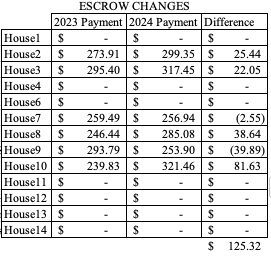
I created this table to show the differences between escrow payments over the two years. I kept the houses that don’t have an escrow because it can be compared to a future table in this post. There is no House5 in this table because we sold it several years ago (houses didn’t get renumbered because House5 still exists in terms of tax documentation).

INSURANCE

We had 3 insurance claims last year, and a big one the year before. It turns out, our portfolio is looked at as a whole, so 4 claims in a 12 month period doesn’t look good, especially when one of those was 6 digits and one was 5 digits. None of it was egregious, and they were each necessary. We were just a victim of poor timing (and for some reason, the 12 years prior to that with 0 claims of any kind mean absolutely nothing). While our own history is to blame in some aspects, insurance costs as a whole are increasing quickly over the few years. Here’s Google’s AI response:

And with that between payments made in 2023 and payments made in 2024, insurance is costing us almost $2,000 more for the year. I also just made my first 2025 payment, which increased that one house by $343. The total increase from 2022 and 2024 is over $3,000.

From the initiation of insurance on each house (so, when we first bought the house, which were mostly between 2015/2016) to today, we’re paying over 43% more in total for insurance.

TAXES

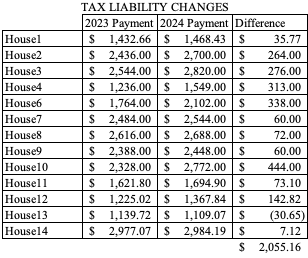
The table below shows the change between 2023 and 2024 for our tax payments. Last year, many jurisdictions that hadn’t captured the assessment changes since the pandemic made up for it last year, when we saw about a $3,500 increase for the year. This year, our increase was over $2,000. Fifty-five hundred over two years is nearly $230 per month, spread over 13 rental properties is $17 each. So for those that I didn’t increase rent last year, they’re not capturing that cost increase for our portfolio.

RENT INCREASES

So far this year, I’ve missed two opportunities to increase rent. I had planned on increasing one house by $25 to keep up with inflation costs, but it didn’t register that their notice had to be given by 1/1 (every one else is by the end of the month). The second is above market at this time, which was by design since they’re not easy to work with (tried to phase them out, but they accepted the rent increase). We last raised their rent in September 2022, so it’s been two years. But I couldn’t bring myself to do it. Next year we’ll increase them by $50 per month.

My plan is to increase the rent for 5 of our other houses. Four of these houses are planned to be $50 per month of an increase, and one is planned to be $75. Our management is generally to increase rent by $50 every two years if you’re a long term renter. There have been a few that we didn’t increase for a while, and the carrying costs have drastically increased, so we’re behind now.

SUMMARY

For our cost increases between taxes and insurance, we have over $4,000 that was paid out last year (and it’s really more than that in cases where the house has escrow, so our escrow was increased more drastically that the specific amount of change in bills).

We had 3 houses turnover from long term tenants, so we were able to increase the rent to market value. I prioritize keeping long term tenants, so I don’t always do rent increases. That means that sometimes the rent is stuck below market value, but I’d rather keep a good tenant than push them out with large annual rent increases.

By bringing those houses up to market rent, I’ve made up a good amount of our deficit. Now remember, these rent increases are catching up on multiple years of drastic increases. So even though it seems we’ve brought in more, we’re both making up for previous years that didn’t have such large rent increases and paying for more large scale improvements to these houses, in addition to larger contractor costs.

Buying versus Renting

I have a tenant who, in the same day, told me that she couldn’t pay rent on time and asked whether she could buy the house. She said she paid $60,000 to me and that could have gone towards owning a house. While I understand the lump sum of what you paid being a pain point, owning a house isn’t that simple. I thought I’d break down a comparison of what she would have done to own this house versus her renting it over the last several years.

RENT HISTORY

Based on the proximity to Main St and the comps in the area, we went into the purchase expecting about $1,000 per month in rent. At the 1% Rule (where you set monthly rent at 1% of your purchase price), we should have been at $1,020. Knowing that it was October/November by the time we would get it rented (there aren’t as many people looking for a new rental in the Fall, after school has started and holiday activities are ramping up) we chose to list it at $975 and keep it below that 4 digit threshold. It sat for 3.5 weeks with hardly any activity, and we dropped it to $875. We found a tenant in under 2 weeks then, but we weren’t thrilled amount our cash flow on it.

The tenant’s lease started on November 1, 2019. Her rent was $875. My property manager incorrectly established a one-year term lease instead of an 18-month lease like she was supposed to, so we had to do a 6-month extension after the first year. Then in March 2021, we tried to increase the rent to $900, and she complained that due to the pandemic, she couldn’t afford that. We let it go and she renewed a year lease at $875.

Come February 2022, we were significantly under market value for rent and she hadn’t been a friendly tenant, so we were content pushing a raise to $950. If she didn’t want to pay that, she was free to leave and we would take the vacancy hit to fix it up and get it re-rented. She complained about the increase, and our property manager told her to take a few days to look around to see if she could find somewhere to rent that was at a price she would feel more comfortable with. She came back and said she couldn’t find anything and accepted the increase to $950.

Not including a few late fees she has owed over the last nearly-five-years, she’s paid us $52,850. While in total that appears to be a significant number, that number does not mean that you’d have $52k in equity in a home had you paid towards a mortgage.

OUR PURCHASE INFORMATION

We paid $102,000 for the house in 2019. We asked for several options for the loan structure. We asked about putting 20% versus 25% down, and whether the rate for a 15 year, 20 year, or 30 year loan would have the best rate. Going through those details is something I’ve done in the past, so for this purpose I’ll just note that we chose to put 25% down because then we didn’t need to “buy down” the rate. The rate for each loan length was 4.55%. With no incentive to do a shorter loan term (and therefore increase our monthly payment), we chose the 30 year term. I do want to note that our interest rate is higher than the average for 2019 (3.9%) because it was an investment property and not a loan for a primary residence.

Based on the 25% down and the closing costs, we had to come to the table with $26,589.12.

Our mortgage was $538.46, which includes escrow. We paid off this loan fairly soon after we closed on it, so we don’t have a monthly mortgage payment. However, I do need to plan for our current mortgage and insurance payments each year, which is currently over $2,000.

FACTORS TO CONSIDER

To keep this more consistent in the message, note that the loan discussed will be based on the purchase price of $102,000.

First, you need to have favorable credit to qualify for the mortgage. In an example, the lowest credit score I could plug in was 620. However, in much of what I’ve read, anything below 680 is questionable on qualification. Our requirement to rent a property is to have a credit score of 600. Perhaps there are lenders that will process a mortgage if your credit score is below 620, but you’re going to pay a premium via the interest rate.

With a credit score of 780, say you’ll have a rate of 6%. But then with a score of 680, you’re looking at 6.5%. At 6%, your principal and interest payment (doesn’t include the escrow required) would be $599.19. At 6.5%, it goes to $631.69. That’s only $32.50 per month extra; over 30 years, that’s an extra $11,700 paid to the bank. I have some tenants where an extra $32 per month is a big deal.

Without at least 20% down on a loan, you’ll likely have to pay private mortgage insurance (PMI). This amount could add a monthly premium to your mortgage payment anywhere from 0.2% to 6%. I did a quick calculator with the example of $102,000 purchase price, $3,060 down (typically the lowest available without any special loan structures is 3%), and a credit score of 620 (lowest it allowed). The PMI was calculated as $187 each month.

I mentioned that our final closing costs were over $26k. If I remove our down payment, that leaves $1,089 in closing costs. I will note though, that our contract had $2,000 in seller subsidy (a credit). Without that purchase agreement structure, that means your closing costs are actually $3,089. This means that you need to come to the table with $6,149. Buying a house is not like buying a car where you can roll all the costs into the loan, and I feel like people don’t realize this.

Your debt to income ratio also plays a factor in whether you can qualify and what your interest rate would be. So even with a decent credit score, you need to show a low debt-to-income ratio, meaning you can’t have your credit cards maxed out. The lender wants to see that you don’t have high monthly costs that would prevent you from paying your mortgage.

That brings me to the flexibility of paying rent. She paid $475 worth of August rent (due August 1st, with a grace period to August 5th before a late fee is owed) on August 20th. If you pay your mortgage late, there’s a late fee and it gets reported to the credit bureaus. Your late payment of rent doesn’t get reported to anyone. She also has the extra advantage that I’m willing to work with her on late payments. An apartment complex type owner is going to immediately file for eviction on the 6th without full rent payment, regardless of your story.

SUMMARY

While a mortgage payment of $538.46 looks favorable against a rent payment of $950, it’s not that simple. I was able to qualify for the mortgage, qualify for a favorable interest rate, and put significant money down.

If I add a premium to the rate we were able to get, assuming my tenant’s credit score is similar to what it was when she rented our house, and then add the PMI that would be applied by not having 20% down, then the mortgage payment (including escrow) would have been $903.02. PMI stays on the mortgage until you reach 78% loan to value ratio (unless you pay for an appraisal and can prove 80% earlier than that). That threshold in this example is $79,560. That principal balance would be achieved in over 11 years, which means you’ve paid $25,058 for essentially nothing.

Then on top of paying these premiums for the mortgage, she would need to pay for the maintenance of the property herself, which is included in my rent factors. I’ve paid over $3,000 for repairs and maintenance on the house over the last 5 years (which is fairly low). However, that includes a deck replacement that we did ourselves and probably would have cost $4,000 instead of the $400 we paid in materials.

So the next time you think that you could be paying half of your rent with a loan, know that you’re not looking at the whole story. There are many factors that go into a mortgage, especially the initial ability to qualify for such loan.

What day is your house sold?

The day that’s in the contract as the closing date.

I truly can’t believe how many people have asked some form of this question in my life recently. While I’ve had multiple in person conversations on this topic, this post really stemmed from a Facebook post. “Is it an expectation for people to be moved out of their home the day of closing when buying a home? We sold our house, and are moving into a new home that we’re supposed to close the same day. Is there not a grace period?” What would that grace period be? How would the timing be determined?

On one side, I see the “closing date” section of a Kentucky contract simply states, “The closing of this transaction shall occur on the ___ day of ________________, 20__.” That’s quite useless actually (as I consistently find in KY law and legal documents). There’s a lot to be inferred by that statement, versus it being explicitly and clearly stated. On the contrary (as this has gone many times over), Virginia wins out.

In the paragraph before this image, it states where closing shall occur and by what date. This excerpt clearly indicates the purpose of “closing,” leaving little room for interpretation.

However, if we take a step back from the legal jargon and contractual obligations, whether explicit or inferred, we can see the logic. If you’re the buyer, once you sign the paperwork to purchase the house, wouldn’t you expect the keys to be handed over to you right then so you can start moving in and living in this house you just paid for? Wouldn’t you want the sellers out of the house because they’re no longer financially responsible for the house, and you don’t want any liabilities of their damage (intentional or accidental) to fall on your hands? You’ve done a final walk through and signed off that the house was in the condition you expected it to be in at that point in time.

Now this isn’t to say that there aren’t other terms and conditions that can be agreed to between both parties. “Lease back” or “rent back” clauses are commonly used. Sometimes it’s beneficial for a buyer to process the transaction (e.g., a rate lock expiration), but they allow the seller to remain in the home for an agreed-upon period of time (e.g., to bridge a gap before their new house is ready/available). But all of these terms are to be agreed to, in writing, before the closing date.

When we just sold our last house, we allowed the buyers to store things in the garage. We entered into a contract separate from the house purchase contract, called a “Preclosing Occupancy Agreement.” I haven’t needed one of these in Virginia, so I don’t know their standard form, but KY’s form does well here. The document outlines the date the buyer can take occupancy and whether there’s a charge for it. There were other items that outlined incidentals, such as utilities. In our case, the buyers were simply asking for garage space to put some of their belongings (because they had a same-day-closing for their sale and purchase), so we didn’t require them to put any utilities in their name before the sale.

BRIDGE LOAN

I can understand the complaint. Financially, you likely need to sell your current home to afford a new home. The “cash” from your sale is what you’ll use as your downpayment, as most people don’t have 20% of $400k sitting in a savings account (nor should you!). That makes the option to buy the house, take a day or two or seven to empty out your old house, and then sell your house not feasible.

There’s such a thing called a bridge loan. It’s a short-term loan used to purchase assets until long-term financing can be secured. There are more fees and high interest rates associated with this. However, it could be worth it to save the hassle of Private Mortgage Insurance (PMI). PMI is required in many cases where you cannot provide 20% as a downpayment for a house purchase. It protects the lender in case you don’t make your mortgage payments. PMI is removed when your principal balance falls below 80% of the original value of your home, whether that’s through regular mortgage payments or you make additional principal only payments. You can request PMI be removed earlier than that if you provide proof that your home value has caused your principal balance to now be less than 80% of the value, which is typically proven through an appraisal at your cost. If you put 0% down on a $400,000 purchase, it would take almost 12 years of payments before your loan reached 80% of the original home value. That’s 12 years that you’re paying PMI on top of your mortgage payment, and those are funds that are doing nothing productive to your net worth. A bridge loan may be worth it if you already have a sale date on your current house and only need to cover a few days or weeks.

SUMMARY

Logistically, it would be great if you could buy your new home, move all your things, and then sell your current home. Financially, this isn’t normally feasible. A lot of the time, you’re needing the equity you have tied up in your current home to purchase your next home.

Our first purchase was made up of two 401k loans (that we maxed as residential loans, which are penalty free), a gift from parents because we were short just a few thousand dollars, and cash on hand. We needed about $80k. Our second transaction, we chose a new build house. We sold our house, went into a rental for 3 months, and then used the sale money to purchase. Our third transaction was also a new build. We hopped AirBnBs until that got old with a 6 month old and 2 year old, and then crashed in Mr. ODA’s parents’ basement. We had 7 weeks between selling our house and purchasing the new one, so the cash from the sale went into our account, and we let it sit there until we needed it to close. Then this current purchase was actually done before we sold our third house, but we had executed a Home Equity Line of Credit prior to the sale. We used the HELOC to put the down payment on the current house, and then the sale of our third house paid off the mortgage and HELOC before distributing the cash balance to us. In all of these transactions, we had the ability to float the funds. That allowed us the ability to house our belongings in “long term” storage (not a day or two) for those two times we had a gap between the sale and purchase. The HELOC allowed us to slowly move our belongings to the new house this last time, and then we did a final moving day of all our big items just before closing (our current house needed work when we bought it, so we didn’t move right away).

But in all cases, unless there’s a separate document indicating so, the closing date of a transaction is the date that you give or take possession of the property. If you were buying, you wouldn’t want to take the risk of the previous owners messing with something in a property you now own. If you were selling, the buyers would have the same expectation.

Rental Cost Changes from One Year Ago

I keep updating my investment property tracking spreadsheet to reflect the current costs of insurance and taxes. My tracking shows last year’s amount, which I use as an indicator on whether I need to look further into this year’s bill (e.g., is the amount a reasonable increase?). For so many years, most of our insurance policies changed by a few dollars; now, I’m seeing large swings in what’s being charged. Where jurisdictions were slow to change property assessments, they’re now catching up, which increases the taxes.

As a renter, your rent is increasing to cover these costs of the landlord/owner. Here’s a comparison of my fixed cost increases against my rent rate increases. As you’ll see, I’m not trying to get top dollar out of these properties because the market has increased so much (and that leaves me more exposed if someone doesn’t pay their rent on time). My rent increases barely cover the cost increases that are happening on some of these houses. Remember that while I’m showing fixed costs, this isn’t covering the maintenance calls that I receive and how they’re more expensive than they once were also.

ESCROW, CONCEPTUALLY

In most cases, for a traditional mortgage, an escrow account is set up. It calculates your taxes and insurance payments for the year, divides by twelve, and is added to your principal and interest payment for the mortgage. In addition to covering the total payments to be made, there’s also a requirement that the balance of the account never falls below twice the required monthly payment.

If your taxes owed for a year are $1500, and the insurance is $300, then your monthly breakdown is $150 ($1500+$300=$1800; $1800/12=$150). The minimum monthly required balance is $300 (twice the $150).

As taxes and insurance increase each year (typically), there’s an analysis done to ensure the projected monthly balance never falls below that $300 threshold. If the balance is projected to fall below the required minimum amount, then it triggers an increase in your escrow payment. Your escrow payment will increase to cover the shortfall, but also to cover the new projected costs to be paid. So while you may be offered the ability to make a one-time payment to cover the shortfall, your mortgage payment may still increase to cover the projected costs. For example, if last year, your tax payment increased to $1750, and your insurance to $350, then your monthly payment to cover those charges is $175 ($1750+350=$2100; $2100/12=$175). Your mortgage will increase by $25 per month because now your escrow agent knows the projected costs to cover are higher.

The analysis uses the current year’s amounts owed to project the coming year’s monthly balances; it doesn’t account for the probability that these amounts increase each year, which essentially means that there’s perpetually a shortfall. In other words, while in Year3, they know that there was an increase in costs from Year1 to Year2, they don’t inflate the costs of Year2 to cover Year3 projected payments.

I prefer to not have an escrow, but at this point, for any mortgages we have, they’re all escrowed. We have six of thirteen houses with escrow. While I pay more as my mortgage to feed into that escrow account, it means I don’t have to manage the annual or semi-annual payments. On the contrary, this means I need to be managing our finances to prepare for large outlays throughout the year on seven houses (in the last quarter of the year, I’m paying out over $8,000 to cover taxes owed).

ESCROW REANALYSIS

This post was prompted by a notification that an escrow reanalysis was done on a mortgage that was just transferred to a new company. I thought that their break down was the most clear I’ve seen. A quick note – your escrow will pay the bills that come due, regardless of the balance in the account, even if it means it’ll overdraw the account.

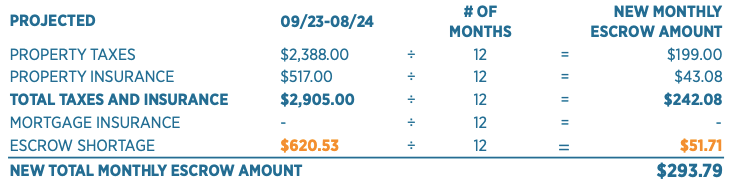
They clearly showed that the anticipated property taxes are projected at $199 per month (although, I’ll reiterate that this is based on last year’s actual outlay numbers, which aren’t accurate for the coming year). Then they show that the taxes are $43.08 per month. They then go as far to show the total of these two required outlays. There’s verbiage that explains the required minimum in the account must be twice the total taxes and insurance ($242.08 * 2 = $484.16).

There’s another detailed breakdown of each month’s escrow income and outlay (that I don’t have pictured here) that shows the month that is projected to fall below the required minimum. That month’s account balance is -$136.37. The difference between the required amount of $484.16 and the negative balance of $136.37 is $620.53 (pictured above). When that’s broken down by month, it’s $51.71. Take the total taxes and insurance payments and add the shortage amount to get the new monthly escrow amount of $293.79, a change from $222.25.

Below, they show you that there is no change in the principal and interest payment, then it shows how the current escrow payment is adjusted to the new escrow payment, along with the shortage amount.

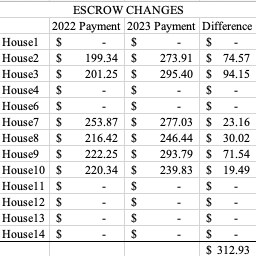
I created this table to show the differences between escrow payments over the two years. I kept the houses that don’t have an escrow because it can be compared to a future table in this post. There is no House5 in this table because we sold it several years ago (houses didn’t get renumbered because House5 still exists in terms of tax documentation).

TAX AND INSURANCE UPDATES

Each year, we see an increase in these amounts. Usually it’s across the board, but Kentucky districts had kept the housing assessments the same through the pandemic. As housing prices increase, your property assessment can be increased by your tax jurisdiction. The assessment increasing leads to an increase in taxes. This is why people getting excited that house prices in their neighborhood are selling higher than expected isn’t great if you’re not planning on selling any time soon; those increases in values means you’re paying higher in taxes.

In Richmond, VA, the property taxes are $1.20 per each $100 of the assessed value. In 2022, House2’s value $163,000. In 2023, the value was increased to $203,000. And let’s not forget that we purchased the house for $117,000. While it’s nice that the home values in the neighborhood are increasing significantly (and we knew the area was going to get better and better based on development happening), we can’t realize this gain until (and if) we sell. So in the meantime, we’re paying higher taxes on this amount. Although, I suppose the assessment could be even higher because the actual value of this house is probably more like $260,000.

Among 13 houses (don’t get confused – there’s no House5 up there because we sold it), I need to cover a total cost increase for taxes and insurances of over $4,500. This doesn’t include the higher costs of trades people if there are any maintenance calls, so this increase is the bare minimum for me to keep my same income.

RENT INCREASES

I constantly see complaints about the cost of rent, or that a landlord is increasing rent. Unless we’re looking for a tenant to move, our general philosophy is to increase rent $50 every two years. This worked fine because home assessments increased at a slow, reasonable rate until recent years. Now jurisdictions are capturing these larger increases based on those inflated sale numbers when competition was high in from 2020 through 2022.

In some cases, the rent for the area brought it in a higher amount than compared to our purchase price of a house. In those cases, we went several years without increasing the rent. Looking back, that probably wasn’t the best idea because now we’re behind on capturing how significant these last few year’s fixed costs have increased. However, the trade off to that is that we’ve kept great tenants in the house, haven’t had to pay to turnover the unit, and have minimal maintenance calls.

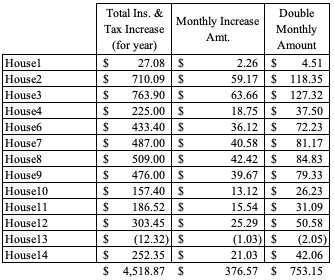
This table shows the total increase in insurance and tax payments from 2022 to 2023 in the first column. I divided that by 12 to get the monthly amount of that increase (second column). Then, since I said we typically increase our rent by $50 every two years for the same tenant, I multiplied that monthly amount by 2. I’m showing that if we want to only increase rent on long term tenants every other year, then I need to plan ahead on how much my costs are increasing.

This isn’t a perfectly accurate capturing of our cost increases since I’m not going back to 2021 to capture those changes in amounts, but it’s a general estimate. This shows that if I were to increase all houses by only $50 every two years, it’s cutting into my bottom line. Only 6 of the houses have increases less than $50 for two years.

SETTING THE RENTAL RATE

Let’s pause and talk about “bottom line.” Landlords have investment properties to make a profit. They’re looking for an income stream.

I regularly hear people say they can own a house for less than their rent, which is likely if you’re speaking only on principal and interest of a loan. However, you need to qualify for that loan. You may not have 20% down, so you may be required to pay private mortgage insurance (PMI). You may not have good credit, which means you’re probably going to pay a higher interest rate than I’m currently paying. You need to be able to cover taxes and insurance, which means you’ll have an escrow account set up, which increases your monthly mortgage payment. Then there’s all the other costs of home ownership.

That’s where people forget. When your hot water goes out, you call me. I spend $1,500 for about 2 hours worth of someone’s work to replace that. When you have a water leak, I spend $3,000 for a day’s worth of 2 plumbers’ work. When a storm drops a tree on your house, I’m the one spending hours on the phone with insurance, finding a contractor, getting quotes, and paying the contractor $3,700 before I get insurance reimbursement. Those are the big unexpected expenses. That doesn’t include all those smaller plumbing problems that cost $200 or $500 at a time.

Then in some cases, I probably put time and money into the house to even get it ready to rent to you. I didn’t always buy a house that was ready to live in. You may have projects that need to be done when you first move in also, so which costs money. Those are expenses that I’m trying to recoup through my rent rate also.

There may be other costs to my ownership that I’m trying to recoup through the rent, such as property management. I may have to pay someone else 10% of the rent, every month. I am projecting that there are going to be costs that I need to pay for also (e.g., water heater, roof replacement, plumbing issues). When I need to pay a plumber $3,000, I’m not coming to the tenant to say “I now need $3,000 to cover this cost.” Instead, I’ve set my rental rate the expect such a large payout on my part.

Not only am I trying to make sure that my rent is set at the right about to cover the costs that I’m putting into owning and maintaining the house, I’m also hoping that I’m going to make some money off owning this house so that I can live. I don’t get to pay myself for the hours I put into managing the property. Whether or not I have a property manager, there is still time that I put into managing the houses. Would you want to work for free?

BACK TO RENT INCREASES

While we manage each house individually on setting the rates (asking ourselves: do we think the tenant can absorb the increase, do we have to increase to cover actual costs now), this shows that our monthly income was increased by $475. If you look back at our total monthly increase in expenses of just taxes and insurance, it’s about $375; add in the cost increases for property management (increased rent means increased fees because fees are based on the rent price), and our fixed costs went up $415. On a whole, we’ve offset the increases.

However, you can see if we had one or two houses, some of those increases could be significant. House3 is costing us $64 more for each month, but our increases are typically about $50 at a time. We’ve had the same tenant in this house since we bought it. A $50 increase every two years hasn’t kept up with our costs. Since we have other houses, it helps cover the costs on House3.

House2 and House3 are identical in layout. House2 has been upgraded to all LVP, whereas House3 has carpet everywhere except the kitchen and bathrooms (granted, it’s new carpet two years ago). Since we purchased these two homes with tenants, rent was already set for us. House3 has been the same tenant since we bought the house, and the increases have brought us to $1200 per month in rent. House2 has been turned over 3 times: the first was a divorced lady who moved back in with her ex-husband; the second was there for several years, but we began having a lot of issues with her, and we told her the lease was up; the third was the one who flooded the house in December, and causing the need for the fourth. Now we’re renting that house at its market value of $1600. That means House3 is operating at a much lower rent than we could get if we rented to new tenants. However, the tenants are wonderful, and we’ve purposely not raised the rent on them in significant ways because we don’t want to cause them to move.

SUMMARY

Cost increases in rental properties can be significant over the years. With the rising costs of all goods and services, property values weren’t immune. The increase in property values leads to an increase in an assessment, which means an increase in taxes. That cost is relayed to the tenant, as this is a for-profit business. I’m trying to make an income for my family with rental properties.

I’m not trying to price gouge tenants, but make a fair living based on the costs of owning these houses. My first goal is to not turnover tenants, so I do what I can to make my tenants happy by taking care of the houses and not creating drastic rent increases each year. Secondly, I’m not going to set a price that my tenant can’t afford, thereby putting me in a hard position where I don’t have rent paid. Having multiple properties helps to offset the costs so I don’t have to play catch up on one or two houses worth of higher expenses, by putting my long-term tenants in an uncomfortable position where they can’t afford the rent.
Home Sale Proceeds

*This post was started in November 2022, but our son was born 3 weeks early (and on Thanksgiving), so it fell off my radar for a long time while I caught back up. Let’s dive in now.

We sold our primary home at the beginning of November to move a half hour away and closer to family. It was a new construction home, and we purposely sold when we did to avoid capital gains taxes. If you call it your primary residence for 2 of the last 5 years, you’re exempt from capital gains. Considering the market over the last two years (2020-2022), we were slated to owe a hefty penny if we sold before that 2 year mark.

Had we sold earlier or perhaps waited for the spring, we could have made more. Instead, we opted to be rid of the home, not try to rent, and be able to have that behind us. We were extremely fortunate that we were under contract by the end of the first weekend we listed. The market had cooled significantly from the multi-bid, exorbitant pricing, with appraisal waiving language days.

We only had 2 showings. The first politely let us know they wanted a walk-out basement. We had an amazing basement with 9′ ceilings and no soffits, but it didn’t have a door due to the floodplain. We don’t really understand why, but the backyard was definitely low enough for it to have been a walk out basement. It was one of the red flags that made me uncomfortable living there, along with a long delay for construction on our lot and a few around us due to extensive sink hole surveying. The second showing made us an offer 10k below asking. We sort of split the difference at $495k, and they accepted.

There were several houses listed in that neighborhood for weeks after we closed, that were listed the same weekend as us, so I am eternally grateful that the stars aligned for what we wanted/needed.

PROCEEDS CALCULATION

We purchased the home for $346,793 in November 2020. The contracted purchase price when we sold was $495,000, which was completed in November 2022. That’s a difference of $148,207, but that’s not “take away” money.

As the seller, you’re typically responsible for paying out the Realtor commissions. They’re typically 6%. We asked our Realtor if she would drop it to 5% (buyers agent gets 3%, sellers agent gets 2%) since we had drawn up our purchase contract sight unseen and this was the 4th commission based transaction she had from us in less than 2 years. She agreed. I truly don’t like asking someone to take a lower commission, but due to there being several transactions in a short period of time, many not even needing much effort (showings, phone calls, etc.), I accepted Mr. ODA’s plea to ask. That comes to $24,750 paid in Realtor commissions.

We then have to pay off any loans that used that property as collateral. We had a mortgage and a Home Equity Line of Credit (HELOC). We had put 20% down on the purchase, so the mortgage had about $266k left as the balance. The HELOC had been used for a couple of other things than just the down payment on a new home, and it didn’t require principal payments on it while we had it, so that balance was about $86k.

We walked away from the closing table with about $117,000 after tax offsets and such.

PAST DETERMINATIONS FOR WHAT TO DO WITH THE PROCEEDS

In July 2012, we purchased our first home for $380,000. We put 20% down; it was a foreclosure, but the only work we had to do was on the main floor bathroom. When we sold that home Fairfax, VA for $442,500 in October 2015, we paid off a car loan and bought our second two rental properties in Richmond, VA. The car loan was only at 0.9% interest, so it didn’t meet Mr. ODA’s requirements to pay down loans with higher interest rates, but it did alleviate one monthly payment I had to manage. The irony of that statement, now that I manage 14 houses worth of payments all year. We also used those proceeds to put 20% down on the purchase of a new primary home outside of Richmond, which had a purchase price of $359,743. We paid off House1’s mortgage because the loan had a balloon payment that we needed to be ahead of.

When we sold that Richmond home for $399,000 in September 2020, we took about $109k away. We used those proceeds to put 20% down on the purchase of our new home, at $346,793, outside of Lexington, KY. We paid off House4, House6, and House13. Since paying towards a mortgage and not paying it off doesn’t change your monthly cash flow, we focused on where we could eliminate a mortgage payment. We’ve since paid off House11 and House12. House12 had a high interest rate, so we were interested in eliminating that as fast as possible, even though we were paying for it with a partner.

WHERE DID THE MONEY GO THIS TIME

We purchased our current primary home last summer and put work into it. Since we purchased it before selling our house, we used a HELOC to pay for the down payment. That meant that when we walked away from the closing table, the money we were putting in our bank account had no distinct purpose (like in the previous cases where we had to use some of the sale proceeds to buy another primary house).

The first thing we did was open a high yield savings account. At the time, it was necessary because our savings account wasn’t paying market rate. I remember Mr. ODA complaining that interest rates on loans were increasing, but it wasn’t being shown on savings interest side. He found a high yield savings account that gave a sign on bonus (we like that ‘free’ money!). We put $50,000 into that account, earning over 4% interest. The money in that account was removed and put into our regular savings account, which is now earning over 4%.

Since the money didn’t have a purpose, we needed to get it into the market. If we put it all in the market at once, then we’re subject to a lot more fluctuation. To hedge our volatility, we planned to schedule regular investments. It seemed crazy to me, but our financial advisor and Mr. ODA decided on $5,000 per week. That would take 20 weeks to accomplish. To my chagrin, this was set up as an auto transfer. Even with a large balance sitting in the account, it didn’t hurt any less watching $5,000 every week be taken out. This plan didn’t last long though because Mr. ODA found Treasury accounts that act as short term certificates of deposit. My next post will go into this in more detail.

Not an immediate need, and we didn’t rush to buy something for the sake of buying it, but we earmarked about $20k for the purchase of a new van. I love the van we bought in 2019 (which was a used 2017), but it had a few kinks in it. I also felt pretty good about the deal I got on it. However, I didn’t put the time into test driving and looking at this van that I really should have because one of us had to stay in the show room with the kids while the other went for a drive. I also know what I’m looking for in a used car now (that was our first used car experience), versus buying a brand new car that hadn’t been driven by others. It helped that I was looking to buy the same exact van, just newer, so I know how it’s supposed to work and what to test. We ended up finding a van about 2 hours away from us in early 2023. We’re almost a year into this van, and I absolutely love it.

In the back of our minds, we’re still looking for another rental property. There’s an area in town near us that would work for short term rentals, which I’d like to dabble in. We have seriously considered a few, but interest rates have shot it down. A 1500 square foot house, with a $200,000 mortgage, comes to a monthly payment (of just principal and interest) of about $1,400. That’s just not good margins with such high interest on it. We’ll keep an open mind, but so far it isn’t panning out.

SUMMARY

Our savings account is currently earning 4.22%. Mr. ODA is also managing that balance by using the short-term Treasury bills. Since we started with the Treasury bills, we’ve made about $500, which is on top of the interest we’ve earned to date on the savings account, which is over $1600.

We started off with paying the mortgage that had a balloon payment. It was a commercial type loan, so it was amortized over 30 years, but was really only a 5 year loan. We decided to pay it off instead of re-mortgaging it at the end of the 5 years. After we took care of the balloon payment approaching, we started paying off mortgages where we could eliminate a payment (we had multiple houses with $30-60k worth of a balance), and then moved onto paying off high interest rate mortgages (for reference, a high interest rate was 5% … which is much different than today’s mortgage rates being “good” at 7.5%). We went through the process to refinance several mortgages, so we’re at a point where we’re happy with the mortgages that are left. If we wanted 100% cash flow, we’d start paying towards principal balances. However, we don’t feel that’s necessary for our current situation. We have 6 mortgages left (including our personal residence) out of 14 houses.

We definitely are more hands on with our money management than most people are going to be interested in. Now that we’re happy with our mortgage situation, we are focused on the interest side of our money working for us. With multiple Treasury bills that are reinvested for short periods of time (4 week and 8 week bills), then we’re able to earn quick interest while we don’t have a purpose for that money.

One of our houses has a balloon payment again (commercial loan). That will come due in about 3.5 years. Considering what current interest rates are, it doesn’t appear that refinancing is as enticing as just paying off the balance or selling the house. We’ll have to keep that in mind as we work on investments and having enough liquid cash over the coming years, because that loan’s balance is going to be about $173k at the end of the 5 year term.

For now, we’re in a good money management state with several short term bills and a savings account rate over 4%.

HELOC

HOME EQUITY LINE OF CREDIT or HELOC

A HELOC is a line of credit secured by the equity in your home. This is different from a loan or mortgage.

What is equity? It’s the appraised value of your home that is not mortgaged. You may have put 20% down when you bought the house, and now you’re looking to tap into that equity along with the principal of the mortgage you’ve paid down. Or perhaps your home value has increased drastically, and you want to utilize the equity.

What is a line of credit? It is a revolving account of credit. This means that when you close on a HELOC, you don’t get a check cut for that amount right then. You need to “draw” on the account, as needed, which is essentially writing checks from that account to either yourself or another entity. As you make principal payments, the amount of principal becomes available again for a future draw, as long as you’re within the draw period of the line of credit.

Do you have to disclose the purpose of the HELOC? There are no parameters on what you can use the money for when you draw it from the HELOC. You may want to pay off a credit card that has a higher interest rate, do home improvements, do other construction projects, medical bills, etc. While you’d want to utilize this for larger purchases, you can draw smaller amounts as long as you draw the minimum required by your terms (e.g., no less than $100). You earn interest from day 1, so this isn’t more beneficial than a credit card that gives you a short-term “loan” for your statement period (you don’t pay interest on a credit card balance that is paid off by the due date).

TYPICAL TERMS

The application process is similar to applying for a mortgage. A bank wants to see your credit report, along with some backup documentation (e.g., tax returns, account statements). We also had to update our homeowners insurance to show the HELOC as a mortgagee.

A HELOC will typically only cover a portion of the equity in your home, depending on the bank’s terms. If your appraisal value is $400,000, and your mortgage balance is $250,000, then the equity in your home is $150,000. While there may be instances where a bank would approve a HELOC for the full amount of $150,000, most are going to approve 80% or 85% of that amount.

There are no closing costs associated with the HELOC. Typically, the bank processing the HELOC will cover the costs associated with the line of credit initiation up front. However, they will require those fees to be paid back to them if the HELOC is closed within a certain period of time (usually 36 months). For our first HELOC, when we closed it within the 36 months, we paid back a prorated amount of the fees (e.g., if the fees were $300, and we closed it after a year, we owed $200). For our current HELOC, if we close it within the 36 months, we’re required to pay back 100% of the fees they covered, not the prorated amount.

A HELOC has a variable interest rate, which may adjust monthly or quarterly based on the lender’s terms. A variable interest rate can adjust up or down. But this is something to be aware of because it’s not like a loan or mortgage that has a fixed rate made known up front. The rate, in our case, is set at the index rate with a margin. However, there’s a floor to the bank’s rate. What does this look like? The index rate is 3.50%. The margin is -1.00%. However, the bank’s floor is 3.00%. Therefore, even though 3.5-1=2.5, the minimum interest rate they’ll lend at is 3.00%. Therefore, our current rate is 3.00%.

There is a “draw period,” which means you can only take funds from the line of credit for a certain period of time (e.g., 10 years). When you do draw from the line of credit, you’re charged interest on the principal balance. During the draw period, you must make the minimum required monthly payments on the account, which is typically the monthly accumulated interest owed, but some banks may require principal payments during this period also. When the draw period is over, it enacts the principal repayment period, meaning you have a certain amount of time (e.g., 10 more years) to repay the principal balance of the HELOC. There is no charge for the HELOC existing though; it can be there and never drawn on.

OUR PROCESS

The most recent HELOC we closed on had a different process than the first. We expressed our interest, and since they already had our documentation on hand from a commercial loan, they didn’t ask for supporting documentation (e.g., account statements). However, for some strange reason, she said she couldn’t use the credit report from our commercial loan, and she had to pull our credit again. At the time we were applying for another mortgage, so the hit on our credit counted as “mortgage shopping,” so we gave up the fight and let it happen.

This company would have given us 100% of the equity available in our home. However, two weeks after initiating the HELOC process, we told them we needed a pre qualification letter for an offer we made on another personal residence. They then told us that since we’re on record as wanting to sell our home, they would only approve 80% of the equity.

The loan officer asked for two references for each of us. There was no information given on what this personal reference had to know about us. We both handed over our people, but they were never contacted, so we won’t know the purpose.

Finally, they asked for our homeowners insurance to show them as a mortgagee on our policy, which I was able to do with one quick phone call to that office.

Typically, the process will include an appraisal. This bank had a valuation system that they used. Based on this woman’s inputs into the system (which were all wrong), she said that she could approve us for $100,000 without paying for a full appraisal. We don’t need more than that, so that was sufficient to us.

We closed the HELOC a month after expressing interest. Our process may have been slower than the typical period it would take because we were fighting the credit pull for a while (not to mention the company we were working with is notoriously slow at responding to inquiries). Mr. ODA expressed our interest in pursuing the HELOC on April 12th. We were cleared to close as of May 11th, but we chose to close on that following Friday. We went to a local bank branch, and a relationship banker went through the documents with us as we signed them.

WHY THE HELOC FOR US?

My general plan was that we’d have a HELOC initiated, so that when we found a new personal residence, we could use the HELOC for the down payment of that house without having to sell our current house first. In the past, we’ve sold our home, went into temporary housing, and then moved into a new home. Granted, all our past home purchases were in a completely different locale than where we were living, but I really didn’t want to manage storage of goods or go into temporary housing with two kids and a dog again.

We initiated the conversation on the HELOC without having any intent to move yet. Not to go into too much detail on this topic, but we need to be residents of this house for two years to avoid paying capital gains. Our 2-year mark isn’t until November, so we weren’t in a rush to move before then. A home with the same floor plan around the block from us sold for $190k more than what we bought this house for less than two years ago, so we expect there to be a hefty chunk going to capital gains if we don’t meet the two year requirement.

I was keeping an eye on the market, but clearly had no plans to move. To me, a regular check on Zillow lets me know what I can get for my money. However, there are some things related to our current personal residence that are concerning, and we had decided that this wouldn’t be a long term location for us. With the market right now, I knew we’d either be paying a higher mortgage than I ever anticipated in life, or I’d be compromising on my wish list. Well, a house that met a lot of our wish list popped up in the area we liked for less than $500k, so we jumped on it. The house needs work, so even though we’ll close on it over the summer, we aren’t in a rush to move into a construction zone.

Once we close on the new house with funds from the HELOC, we’ll start accruing and paying interest on the balance. We’re not required to make principal payments until after the draw period, which is 10 years. When we eventually sell our current home, the proceeds from the sale will pay off the HELOC seamlessly through the closing process.

Escrow Payments

A theme I stick to in this blog is that you need to watch your money. I’ve talked about ways that I’ve fought to get money back where it wasn’t billed correctly (e.g., medical bills), and today’s warning is about escrows.

An escrow account, in the sense that I want to talk about it, is tied to your mortgage. Your monthly payment includes an amount that goes into a separate account held by your mortgage company, and they manage paying out your taxes and insurance on your behalf.

The benefit of an escrow is that you don’t have to manage your insurance and tax payments. You don’t have to pay out a large sum of money once (or twice) a year because you’re paying towards this account every month that will manage that billing for you. The downside is that this escrow account requires you to maintain a balance, so it’s holding your money where your money isn’t working for you. Another downside is that your money movement is less transparent, and you just expect that the payments will be made accurately. The bank basically takes on the administrative burden of paying these bills on your behalf, in exchange for continually holding this money without paying you interest.

Each month your mortgage payment includes principal, interest, and escrow. For example, I have a mortgage payment that is $615.34. The P&I total will remain the same amount each month, but the principal portion of each payment will slowly increase while the interest slowly decreases. In my example, the total P&I is always $428.11, but the breakdown of what’s principal and what’s interest changes (e.g., October’s payment due included principal of $119.58 and interest of $308.53; November’s was $120.03 of principal and $308.08 of interest). The escrow amount each month for this mortgage is now $187.23; this number stays the same until there’s an escrow re-analysis.

An escrow analysis is conducted once per year to verify that the escrow account will have sufficient funds to pay out the bills received (typically taxes and insurance), while maintaining the required minimum balance. Sometimes the increase is known ahead of time because you can see that the estimates for the initial escrow contributions were off (or in our case, new construction uses estimates based on last year’s tax payment, which only included land value and not the final sale of the home, so we know there will be an escrow shortfall in our future). A shortfall may also occur when there’s been a drastic change in your property value assessment, causing taxes to increase more than an expected amount (like in 2021!), or when insurance costs change more than projected.

Below is an escrow analysis of one of our accounts. The highlighted row shows that when our taxes are paid, the balance will fall below the required minimum. The document says that the minimum “is determined by the Real Estate Settlement Procedures Act (RESPA), your mortgage contract, or state law. Your minimum balance may include up to 2 months cushion of escrow payments to cover increases in your taxes and insurance.” If you are projected to dip below the required minimum, they’ll offer you the opportunity to make a one-time contribution to the escrow account or your monthly payment will increase to cover that projected shortfall.

The increase is calculated in the image below. My payment to escrow at the time of this analysis was $126.18. They take my insurance and taxes owed, divide by 12, and come up with my monthly base escrow payment ($149.81). At the lowest point in my escrow balance (highlighted in yellow above), the account will be -149.43. The difference between this balance and the required balance of $299.62 is $449.05. Divide this number by 12 to get the $37.42 in the image below indicating the monthly shortage for the account.

The new escrow payment is added to my P&I payment (which stays the same), and this is my new monthly mortgage payment.

An escrow analysis showing that we’ll fall below the balance required inevitably means that my monthly cash flow will decrease (because we always opt for the change in monthly payment instead of a one-time contribution). As taxes and insurance increase, so does your requirement to fund your escrow account. While the reason for the escrow increase is to cover the taxes and insurance, which I would have to pay anyway, the escrow increase is higher because of the required minimums. One of our houses started with $766.96 as the monthly payment, and it is now $802.96 due to the escrow analysis. Another one started at $477.77, and it’s now at $537.60.

SO WHAT HAPPENED?

Honestly, the only way I’ve checked my escrow balances in the past is at the end of the year when I’m verifying the insurance and tax payments “make sense.” I’m not even verifying the details behind the numbers, just that it was similar to last year’s amount as I update my spreadsheet. Well this time, I logged in to update my spreadsheets with the new mortgage balances for the October Financial Update, and I saw my escrow account was negative by over $1000! That makes no sense because these accounts are reviewed annually through an escrow re-analysis to ensure you’re not projected to dip below their required minimum balance, and if it were to be negative, it would only be by a much smaller amount.

We had recently changed our insurance. Usually when we change insurance providers, we pay the current year on our credit card (to get those points!), and then all future billing goes to our escrow account. I don’t know why we didn’t do it this way for the most recent change, but I’m inclined to blame the fact that the process took months to get new insurance because this company hasn’t been responsive, so we just wanted it done and weren’t thinking. Since we didn’t get the new policy issued before our old policy was billed, both insurances were paid out by our escrow. Sure, that should have affected our escrow balances, but still not by $1000.

One house had a policy that cost $573.31 and the other had a policy that cost $750.06. The new policy includes both houses under one policy (this becomes annoying and it makes me uncomfortable for reasons I can’t seem to articulate to the agent) and costs $1,180.87. Each mortgage escrow paid out the original policy amounts since we didn’t execute the new policies timely. After these were paid out, the mortgage company received a bill for $1,180.87. For reasons I can’t quite figure out, the company paid $1042 from each of our escrow accounts, and then one escrow account paid $138.87 (which is the balance of 1180.87-1042). The $138.87 covers the policy fees; so someone realized that there was a separate line item for policy fees, but didn’t realize that the $1042 should have been split between two houses (even though they knew there were two houses because they took from both escrows).

I questioned the process with the new insurance company, but he didn’t take responsibility for it. He claimed that the mortgagee had to know to split it and they don’t manage any of that. I explained that I’ve had multiple houses insured by one company and have never been given one policy number for it. He acted surprised. My gut says this is wrong and isn’t going to work, both for future billing and the possibility of a need for a claim. We did receive a check in the mail for $903.13 (the difference of $1042-138.87), but we still have paid the $138.87 and want it reimbursed. I sent an email this morning explaining again that I’ve confirmed with my mortgage company that this insurance company was paid $1042+$1042+$138.87. He again responded that the $138.87 is the fees portion of the bill, and I again said that I know, but it’s been paid twice, and I’d like it back. So now I’ll stay on top of that $138.87 to make sure we get it back.

You need to fight for yourself. You need to know what companies are owed and know what you’ve paid. Then don’t back down to keep asking for an update. I recently discussed how I had to fight for medical bills (multiple times) for a year at a time to get the money reimbursed that I was owed. I even recently had to call on another medical bill that I paid before realizing it hadn’t been submitted to insurance (I would love to understand why this keeps being an issue that my medical bills aren’t submitted to my insurance before billing me). Then they submitted it to insurance and sat on my reimbursement until I called twice asking for the reimbursement (that both times they agreed I was owed and it was “in process.”). Manage your money. Especially because that $138 that I’m waiting for now could mean a big difference to a family in need or living paycheck to paycheck.

Amortization Schedules

An amortization schedule is a document that is a huge spreadsheet of numbers that tells banks and their software how to apply your monthly mortgage payment. It defines the amount of each payment going to principal to pay off the loan balance, and the amount going to interest for the bank allowing you to borrow their money.


Let’s rewind. How does the bank figure out how much your monthly principal and interest payment is going to be? This is a function of several things:

  • Loan amount (purchase price minus down payment)
  • Interest rate
  • Loan term (length)

Want to see a formula for that?

  • loan amount = x
  • interest rate = y
  • loan term (months) = z

Looks like a blast doesn’t it? I saved this formula into my spreadsheet for evaluating properties so that once I fill in the purchase price, expected down payment, loan length, and the predicted rate from my lender, it will auto-populate the monthly mortgage payment amount. I then take that number and can calculate predicted cash flow based on a rent estimate.


Back to the point of the post. Loans with long terms borrow the money for a long time. Loans with high rates borrow the money more expensively. In both cases, the early stages of the amortization schedule give much more money to the bank as your fee for borrowing (interest) than they do to pay down the loan. This is because every dollar of that loan principal is being borrowed and needs paid for.

In the first payment, the entire principal amount borrowed is in that formula above, so it’s expensive to the bank to give you that money. Fast forward 15 years of a 30 year loan and you have far less outstanding principal left, so the interest charge associated with that is less. Since your total monthly mortgage payment (principal and interest, ignoring escrows) total doesn’t change, the interest applied towards a smaller balance leaves more ‘room’ to pay toward more principal. Basically, the bank gets its money out of your monthly payment first, and what is left over can go to principal pay-down.

DAILY INTEREST

To better explain the cost of borrowing each dollar over time, it’s likely easier to break it down into daily interest. An amortization schedule calculates the cost to the borrower for giving you the bank’s money on a per day basis. So while I have access to $X for the whole month, I owe the bank for every day I’m carrying that principal. Multiply by 30 and that’s what the bank charges me for interest for the month. Then, remember that the leftover is what goes to the principal pay-down.

How to calculate. Divide your annual interest rate by 365 to get your daily interest rate. Multiply that rate by the outstanding principal to get your daily interest charge. Multiply that by the days in the month (or most banks use a standard month length = 365/12) and come up with the interest the amortization schedule charges you for that month’s payment.

We mentioned the different types of amortization we’ve seen in the House 1 post. This loan calculated your monthly principal part of the payment by the exact number of days in the month so each month’s proportion of principal to interest varied up and down. This is in contrast to what most banks do that I mention above.

THEORETICAL EXAMPLES

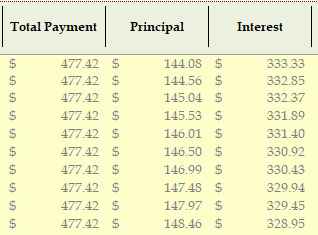
A pretty standard rate in the last decade is 4% on a 30 year fixed mortgage. Lets say the loan amount is $100k. Plugging that into my formula above, we get a monthly payment of $477.42. Above are the first 10 payments on that loan. Only about 30% of your monthly payment is actually paying down principal at the beginning. It takes 153 payments (i.e., months) before the amount of each payment going to principal is actually more than paying interest. Total interest on the full loan in this scenario is $71,869.


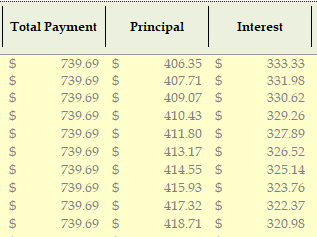
Now lets look what happens when we change it to a 15 year loan. The total payment jumps to $739.69 because you are paying the principal down twice as fast. But, the first payment you make is already $406.35 worth of principal pay down. Compare it to the first loan example in the terms of daily interest. The rate is the same. The amount is the same. So the interest due for the month is the same. But because your amortization schedule knows that you’re paying the loan off much earlier and requires a larger total payment, the leftover for principal pay-down is far more substantial.

Next, look how much quicker the interest charge drops after just 10 payments compared to the first example. $320.98 vs $328.95. This is because you are paying principal down more quickly, so the outstanding balance decreases and the daily interest is then lower too. Total interest in this scenario is $33,143.


In this example, we move back to a 30 year loan, still at $100,000, but we bumped the rate to 6%. The total payment rises to nearly $600, and the principal to interest ratio of the beginning payments is quite poor. Only 17% of the payment is going to principal pay down, which means that the daily interest is high, and stays high for many months. It’s not until month 223 (18 years later!) before the amount of principal in each payment is higher than the interest payment. Total interest in this scenario is $115,838.


Side story – Mr. ODA’s parents paid off their 30 year mortgage on their residence in 12 years. As a child, Dad would explain to me their process. They printed out the amortization schedule and put it on the fridge. Each month, based on their regular cash flow of life, they would choose ‘how many months’ they wanted to pay to the loan. So they’d make their regular payment, then they’d pay the principal portion of the next 2-3 months on the amortization schedule also. They’d make some really gnarly extra payments with weird dollars and cents, but it was a calculated decision. Then they’d cross those months off the schedule, knowing that with that extra payment, the interest that was tied to that principal portion on the schedule was simply avoided/canceled, by paying that principal early. This was a powerful tool to help me understand how the loan process worked, and one that help create the foundation for me to look at time value of money, opportunity cost, guaranteed return vs potential invested return, etc. Dad missed a lot of stock market gains by accelerating a 30 year mortgage to 12 years, but very few people ever regret owning the roof over their head free and clear – with a byproduct of NO MORTGAGE PAYMENTS for the 18 years that would’ve been remaining! Now he can make more investments with that leftover cash flow of life.


Amortization schedules are one of the largest “gaps” in understanding for the typical mortgage customer. They typically get told what to pay each month and ascribe to a “set it and forget” mantra that they know in 30 years, their house will be owned free and clear. Anytime before that, why bother understanding the background math?

As you can see in the examples, a shorter loan means faster pay down with less interest overall, and a lower interest rate means a smaller payment. When looking at loan options, understanding how the math operates to get to your options can help you determine what your priorities and goals are, and how to execute them.

In our recent refinancing post we talked about analyzing when was a good time to refinance our existing loans and which ones we’d target first. Simple advice you can find on the internet is that it’s a good idea to refinance if you plan to keep the property for longer than the result of closing costs divided by monthly payment. Most times this was about 2 years for us. You can see above that the 6% example had a $123 larger monthly payment than the 4% example (30 year term). So if closing costs are $2,000, it would only take 16 months (2000/123=16) to “break even” on a refi to go from a 6% loan to a 4% loan. No brainer!

There’s another hidden benefit there too, that gets missed to make it even shorter than 16 months. Look at the principal portion of the monthly payment. On the 6% example, it’s only $99 on payment 1, but on the 4% example it’s $144. That’s another $45 benefit! You’re paying down the principal at a faster rate. Add that extra principal portion embedded within the monthly payment to the $123 lower payment savings ($123+45=$168) and you get a “break even” point of only 12 months ($2000 closing costs/$168=11.9)!

Understand how your mortgage math works so that you can speak intelligently to a lender, ask good questions, and set yourself up with the best scenario for your finances and your future.