*I’ve been working on this post for a week, so my numbers are a week old, but I don’t want to re-update them. I’m also posting on a Tuesday just to get this ‘out the door.’*
I’m starting to pull myself out of the overwhelmed hole I felt I was in. There’s still a lot going on, but I feel better equipped to stay on top of things. I had just been so exhausted, that I didn’t have the energy to do anything extra each day, and I was just getting by. Last weekend, I was able to work on pressure washing our patio and deck furniture (which was long overdue), and then I stained our deck. That’s been a pretty good springboard to me getting a fire lit under myself to get other things done, so that’s felt really good.
Our middle child graduated pre-k on Thursday. That was a big milestone, and my poor girl is so sad that she’s going to miss her teachers. She’s really struggled with my going to work and not being home all the time (although my time not home, while she would be home, averaged about 10 hours per week). I have things better organized at work, and I’m feeling good about my tasks and role in the office, so the hours I’m spending there are dwindling. I had agreed to about 20 hours per week, but I was closer to 26/28 each week. The biggest issue was waiting for someone to be available to help me, and then that everyone else is full time, so they don’t realize I’m trying to get out of here by 2 pm each day. This week our oldest graduates kindergarten and has many events around end of school.
RENTALS
One of the mortgages has been paid enough that the balance dropped from 6 digits to 5 digits. It’s still a lot of money owed there, but that felt like a nice accomplishment when I went in to capture the balance!
June is Richmond tax season for these houses. That means I’ll be paying out large chunks of money for the houses we have no escrow on.
We had a few maintenance needs come up. One house had the water heater flood the basement. Luckily, I think we’re OK on that front. We replaced the water heater. The gas wasn’t hooked up right, so the tenant called the plumber to get that squared away. This happened while I was in a different state, and I’m so grateful it happened in a house with a handy tenant.
We had some flashing fall off a roof line. This wasn’t a priority to address at the time, but the tenant started claiming allergies were flaring up because birds were getting in the attic. Sometimes you just need to accept that’s the story you’re hearing. We had a handyman go over there and verify there are no birds anywhere. The “hole” she thought she saw was just where the soffit was hanging a bit, but there were no gaps in the wood structure itself. He tacked up the soffit, and I contracted with another company to repair the one piece of flashing.
That handyman also went out and handled a wasp nest. At that house, the tenant says a window won’t stay open when she opens it, and we let her know it’s on our radar now, but it won’t be fixed just yet as our people are spread thin and that’s not an emergency. That house had a temporary tenant in it (housing with our current tenant). To cover the tenant and us, I asked for a $500 deposit. When they moved out, I had our tenant sign that there was no damage, and I returned the deposit.
We’re still working on the major termite damage that occurred at another house. There was quite the domino effect. Leaks from bathrooms and the laundry room created a very wet environment, which created a breeding ground for termites, which feasted on our wood all over that place. The crawl space got cleaned up, but we’ve been waiting over a month for the bathrooms to get replaced and fixed. I’m hopeful that it’ll start next week, but frustrated nonetheless.
I had a leak from a toilet bolt at another house. I was frustrated because we had just been called out for water on the floor at this house recently, but it turns out this was necessary. When the house is a certain age, things just wear away and need replaced.
We also had a limb fall from a tree at another rental. The tenant explained how much of a liability it was for me. I love when tenants instruct me on my level of liability (that’s sarcasm). We have a tree guy that’s been super useful for many things and he handled it the next day with no problem.
PERSONAL
We haven’t been spending much money. Most of our money these days goes to grocery shopping. On our current statement for our main credit card, we only have 11 transactions recorded for over 3 weeks.
We paid our last month of pre-school for our second. They are closing the school and they didn’t want to add on days for the snow days that occurred, so they gave us $50 off the last month of tuition to cover the 2 days we were owed for make-ups. Since the school is closing, everyone scattered, and we ended up not getting into another preschool next year for our youngest. So at this point, that’s an extra $375 per month in our pockets next year – unless a spot opens up for the littlest.
Mr. ODA took the buy out, which I think I mentioned last month. His last day of work was April 30th. He said he’s settling into the not working concept and starting to get over the desire to know what’s happening at work and with his programs he worked so hard on. He’s done a lot of work around the house here, including treating for termites in a very intense fashion, but that was cool to see.
NET WORTH
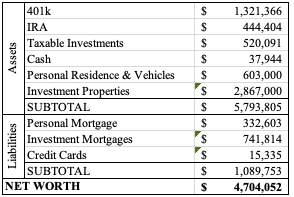
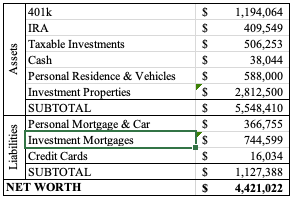
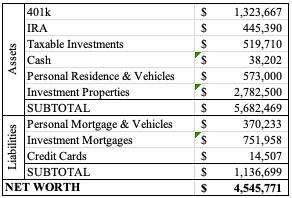
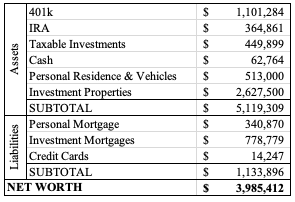
Two months ago, my job asked for my goals. It’s a specific document that I was to fill out. Someone else had mentioned their net worth goal, and our next big step would be $5 million net worth. Well, the market has been in shambles, and our net worth plummeted from where it was. I thought it prudent to not make such a goal when our net worth is completely reliant on the market actions right now (i.e., we’re not selling/purchasing or making any big moves that would drastically change our net worth outside of the market actions). We’re finally on the upswing and now at the highest net worth we’ve been, so that’s encouraging after those big dips recently.
We started getting emails about end of school year activities, and boy was that a surprise that we’re at that point. The middle one is done mid-May and the big kid is done at the end of May. Less than 2 months until summer break.
Mr. ODA took the second round of the government’s offer for administrative leave, which means he would only have a few weeks left working. I’m still working my part time job, which is taking way more hours than we had planned for. I’m enjoying it, but it’s been a juggling act with the family, which is probably why my son who absolutely loves school begged me to stay home because his belly hurt last week.
Buckle up because apparently I have a lot to share this month.
RENTALS
We received about $600 in tax payment reimbursements from one of our localities, so that was a fun surprise this month. Really helps my psyche that I have a tenant who hasn’t fully paid, didn’t tell us why ahead of time, and hasn’t been up front with when she’s going to actually pay us.
I executed 2 short term leases. Both included a rent increase for their short term period; one house is increased by $75 and the other by $25. Luckily, both are here in the Central KY area, so we can flip it between tenants. One is scheduled to leave June 30th. That house will need new carpet in the bedrooms, and it’ll need probably a whole-house paint job again. They smoked in there, even though we covered the lack of smoking rule multiple times. I’d be more upset about it if the carpet hadn’t reached its useful life years ago. The other house leaves July 31, and I can’t even tell you where we’ll need to begin with that one. She made a wood feature wall without permission. She had a giant fish tank without permission. She spent a lot of time doing things that really weren’t an improvement, so I’m definitely worried about what we’re going to uncover in that house. Mr. ODA and I are talking about fixing it up and selling it. We may look for a short term renter so that we can sell it in the Spring instead of this Fall.
I had 2 other properties accept a rent increase that will go into effect later this year. I require 60 days notice for changes so that starting at the 30 day mark I can begin advertising it if needed. One house goes up by $25 per month as of June 1, and the other goes up by $50 per month as of July 1. I also have another property that has a rent increase of $50 per month going into effect next month.
I have 4 houses that renewed another year, and I didn’t change their monthly rent rate. There are 4 more houses that haven’t been discussed. My intent is to have them renew for a year at their current rate. There are 2 of those 4 that could leave at the end of this term, but time will tell.
We have multiple maintenance issues to address. One house requires a tree trimmed off the roof, the siding cleaned, and the back deck stained/painted. We still have termite damage we’re dealing with at a house in Richmond. I have a leaking toilet that was just addressed, and then they hit me with a faulty HVAC unit during a heat wave. Then we have some houses that really need eyes on them to see what condition they’re in at some point this summer back in Richmond. It’s amazing to me how people just don’t care to tell a landlord that something is broken. I woke up this morning to a text that one of the houses here has a flooded basement due to a water heater failure.
I spent some more time fighting my insurance guy here. It irks me so much when I see him offer up his services on the local facebook group for property owners. He’s quite terrible. I sent him photos of a house that had some issues with a cluttered backyard and had the tenant clean that up. I had to fight him last month on an increase where he changed one house from a crawl space to a basement when I assure you that the vines growing through the windows solidify it should not be deemed a “basement.” When the dust settled from that debacle that he was insanely unresponsive to, I ended up owing $9.68. When I asked why my account wasn’t put back the way it was found before this mess he created, he said he didn’t know but it’s probably from the audit and changing square footage. HIs guessing and not actually answering infuriated me. I gave up and paid it, but then I ran to get quotes from other people. I hadn’t done that before because our 4 claims in a 12 months period are killing us (again, because I really wanted trees to fall on us!). I hate when people make the claim that because it’s not a lot of money, I should just give up and accept it. That’s a ridiculous way to treat people.
PERSONAL
Our electric bill is almost double what it was this time last year thanks to the vehicle charging and hot tub. Our electric bill is relatively low, so that’s not all that surprising. We also have 5 full people in this house now (as much as you can count a 2 year old as a full person… but he knows how to control light switches and eats a ton of food that we need to cook him, so I’m sure he’s a factor there!).
I’ve been working at my new part time job for over a month now. Mr. ODA was making fun of my hourly rate, but I’ll tell ya, it felt good to receive a paycheck that wasn’t $45 like it was for a day of subbing at the preschool.
I took the kids to get haircuts. My middle has had her hair cut once before, but I’ve cut the boys’ hair forever. I had family coming into town and the oldest was looking really shaggy. So I swallowed my pride and threw money at the problem, which is very out of character in this household. I just didn’t have the time to cut their hair, clean them, and clean up the mess. For $66 and 45 minutes from the time I left home until I got back, it was well worth it to me.
I had a medical procedure done this month. We haven’t met our deductible. In February, they said I had to pay my deductible to them. I said that didn’t make sense and refused to have them hold $2800 of my money for 2 months. They gave me an attitude and said I could never ever ever ask for a payment plan in the future, so that I could pay $500 to hold the date. I then showed up for the procedure, knowing I haven’t met my deductible, and they didn’t take any money from me. Another business model that bullies the customer into illogical money decisions. I also had an eye doctor appointment that was frustrating in itself, but I’ll spare you those insurance and communication details.
On top of everything else I’m juggling, Mr. ODA is coaching our kids’ t-ball team. Coaching means that I am team mom. That means that I’m responsible for communicating updates from the league (in the slow and haphazard fashion I receive information), gather value card sales that are required of every team member, organizing a basket for a raffle, and the best one – raising $350 for team sponsorship. What the heck, man?! Where did I say that my signing up of two children to play in the league means I have history or ability to gather money from businesses?? Well, I did it. I raised $350 and another mom raised $200 for the team.
No financial impact, but I’m also juggling our HOA board duties. I released our longstanding property manager and hired a new company, which took effect April 1. That’s taken a lot of time to get them stood up and make sure we stay on track for our annual meeting schedule in June.
NET WORTH
And with all of that said, that doesn’t even address the giant reduction in our investments that continues to happen. To counter some of the loss, I updated our property values for our houses. I don’t do that every month because they don’t move very much, but I can usually count on a few increases as the spring market ramps up. Our net worth did slightly increase (based on yesterday’s market closure, not today’s) from last month, which was a nice surprise.
I wonder why I’m tired and bogged down, but that post outlining what I’ve done recently made me realize all I was able to accomplish even though I felt like I was a jack of all trades and master of none. Hopefully things will settle down in our lives going forward now, even if I know there are definitely two house turnovers in my future.
There are options that give the tenant flexibility, while protecting your financial interests in a rental property. I talk about this in some fashion about once per year, but I like to give the reminder.
In January, I ran all my usual numbers to determine if any properties needed a rent increase. The last few years have really hit our margins – insurance has drastically increased, taxes have increased significantly, and the regular trades costs have increased over time as well. During this process, I determined that 5 houses needed some sort of increase in their rent. One was the responsibility of my property manager, and the other four I wrote up the notifications, put them in the mail, and then emailed them also.
I’ve had two tenants respond back that they intend to move in the next year, and they wanted month to month. We don’t agree to month to month options. Well, I should point out that for significant financial compensation, we would consider month to month. However, the expectation is that having a long term tenant renew their lease is less work month over month. If they’re on month to month, I’m constantly watching and waiting for their 30 day notice. Additionally, there’s a concern that their 30 day notice comes in October or November, leaving me with a mid-winter lease that I’m trying to get filled.
Instead, I provide a few options that protect me. I’ve done the “buy out” or “penalty” option multiple times in the past, and that has served me well. I haven’t needed a short term lease option, but since there are certain circumstances with these houses, I put that offer out there.
In both cases, the tenant said she wants to be able to leave sometime in July/August. This is manageable to me because I can likely rent it under a fairly quick turnaround.
Short-term lease While I would typically require an increase in rent to cover a short term lease, I was already in conversation about rent increases, so I let it be. I offered a July 31st or August 15th move out. In both cases, I know the house is going to require work. I’d like to have the last two weeks of August available to me for construction activities, instead of going into September and trying for an October 1 lease start date.
“Buy out” options (e.g., penalty payments) In this case, I have the tenant sign a year lease. However, the lease comes with “lease break clauses.” The penalty for breaking the lease ranges based on the time of year. In all cases, I require 30 days notice and full payment of rent through the date given as notice. If the tenant wants to leave before 8/15, then there’s no penalty.
If they want to leave between 8/15 and 9/30, then they have to pay the equivalent of one-month’s rent.
If they want to leave between 10/1 and 1/31, there’s a two month penalty. This is because finding a renter during this period is difficult. There aren’t as many people looking during the winter because most leases are spring to spring, so the turnover is fairly cyclical, and because most people are distracted with starting school and all the holidays happening during that time rather than looking to rent (or even buy) a house.
If they want to leave between 2/1 and 3/31, there’s a one-month penalty. Again, this is to cover the longer time it will take me to find someone to take over the lease period, and it provides me with a year-long lease (which most people are looking for) that ends at another inconvenient time for turnover in the next year.
If they want to leave between 4/1 and 5/31 (which is the end of their lease term), then there’s again no penalty just as there wasn’t for the first few months of the lease term. I’ll be able to get work done on the house and list it for rent, expecting a decent pool of people interested in a rental.
Lease transfer option As a final option, which was offered to us when we lived in an apartment building, a tenant can agree to a year-long lease with no extra terms. They then have the knowledge that if they want to “break” the lease agreement at any time in the next year, they are responsible for paying rent until a new tenant is found. They can move out, but they’re on the hook for paying rent until a new tenant has sign a lease.
This is risk on their end. In some cases, I may be able to get someone in just a week or two. However, if it’s the winter, it could mean that they’re paying a month or two months worth of rent while they’re also living and paying rent somewhere else.
The only time that I’ve used this option, the tenant provided notice on December 1st, which as I’ve pointed out is not a great time to be searching for a new tenant. Since he was already not living in the house (he had moved back in with his parents), he agreed to empty the house of his furniture so that we could still show it during that time. He paid rent on January 1st per our agreement, and luckily we found someone to take over the lease as of January 7th or 8th, so I refunded him the prorated amount of rent.
The “lease take over” concept was done by a management company in a fancy apartment building outside Washington D.C. It never hurts to ask for options if you’re the tenant. Just understand that managing the rental is work that the landlord has to do, and their “profit” is how they’re paying themselves for that. Especially in today’s environment, that margin is quite small. So when they tell you they don’t want to have a lease fall through in the Fall or Winter, understand how this is their investment and their income, so they need to protect themselves, even if it’s not necessarily what works for you or is your preference. And as for landlords, treat your tenants nicely and be as flexible as you can; it always pays off for me.
We’ve done a good job at enjoying time together this past month. We haven’t had a lot of expenses pop up, which was a nice reprieve. However, the market is much lower at this time this month than it was last month, so our net worth actually decreased. I keep focusing on the long term picture though, and our net worth is much higher than a year ago.
RENTALS
We have 13 rental properties. They were mostly purchased in 2016-2019, with one purchased in 2022. Most of them have sustained very little tenant turnover.
I had 4 houses not pay their full rent on time this month. As of this post, only 1 is still outstanding. They’ve had car troubles and have communicated regularly with me. While I’d prefer to see at least something paid towards rent by now, they’ve been with us for 8 years, and I know they’ll eventually be whole. They never take more than the month to get rent fully paid. Of the other 3 that were late, I only charged one a late fee. The others aren’t usual offenders and communicate up front, but this one has been more difficult to get rent paid from the time we purchased the house.
While looking back at last year’s January post, I must note that this past year has been fairly easy on the rental front. We’ve had a lot of frustrations and things to manage, but it hasn’t been as time consuming in the “people management” side of things. We had a few issues with a tenant that first moved in last winter, but they’ve been quiet since. We had 4 houses turnover tenants in 2024, with fairly little loss of rent.
PERSONAL
We have been battling snow for almost two weeks now, which is very unusual in Central KY. We’ve already taken the kids skiing twice this year. Even the baby got on skis! He’s 2, so I guess he isn’t such a baby anymore, but that’s the earliest we’ve put a kid on skis. He’ll slide down the mountain, but he doesn’t stand on the skis; he’s just squatting the whole way.
NET WORTH
Last year at this time, I was sharing that our goal was to reach $4 million. We were at $3.869 million.
Our net worth is about $66k less than last month. I don’t always update the value of our assets, so that’s a fairly static number. Everyone few months, I’ll check on the ‘zestimates’ though. Typically, we expect to see the total decrease in the winter months because there are less sales and less activity to raise the sale prices like you see in the Spring months. On top of that, all of our investment accounts (except one that increased by $22) decreased a bit.
We have a 0% interest credit card that has a balance over $12k on it. We also added a car payment, which we haven’t had since about 2015. Tesla was offering a 0% interest loan, so that monthly payment isn’t going away for nearly 5 years. Overall, our credit cards balances total more than $3k less than last month’s, which makes me happy to see.
We took a trip to Richmond, VA to work on rental properties. It was fairly last minute. I had a schedule of work at each house that I planned. However, I didn’t plan on the heat index being 113 and 112 for the two main days we were there. I was able to get everything on my list done except for staining the new deck at one of the houses. I didn’t want to risk it not applying or curing correctly because it was too hot and in direct sun. Plus, the tenant didn’t even clear it off so I could work on it.
I had multiple houses pay rent late this month. I was surprised. One let us know on the 5th that they had an emergency, so they wouldn’t be able to pay until the 17th. I had someone pay half their rent early in June, but then haven’t received an answer as to why the rest of her balance ($345) hasn’t been paid yet. Another tenant misunderstood her maternity leave pay, so she asked for more time to pay rent. She paid $800 on the 7th. I told her not to worry about it, and just pay when she can, without the late fee; she only has $150 remaining.
I’m currently working through two roof replacements. One of them will be covered by insurance, but then I’ll be paying to have vents added, the chimney torn off and capped, and the soffits repaired on top of what insurance can do. Then the other one we’re paying out of pocket for. It’s original to the house, which was built 24 years ago. There has been storm damage to it over the last year, and it’s just generally time to address the age even though it hasn’t caused any problems yet.
PERSONAL EXPENSES
Our medical insurance company had some glitches in their claim processing through the first half of the year. Now they’ve caught up, meaning I’m paying large sums of medical bills. Mr. ODA took on booking lodging for his guys trip later this month, which meant that the second half of AirBnB payments were applied to the credit card.
Mr. ODA increased each kid’s UTMA from $75 to $100 per month. That means we’re investing $3,300 each month into accounts, on top of maxing Mr. ODA’s TSP contributions and both of our Roth IRA contributions for the year.
Our contractor has ghosted us on our own deck build. We bought some new furniture for the main deck area. Once it’s not 100 degrees outside, we’ll work on doing the waterproofing of the deck ourselves so that we can start living on the patio under the deck and get that hot tub ordered this fall.
NET WORTH
I updated the valuation of the houses this month. I typically only do that 3 or 4 times per year. I try to account for the big increases we see at the beginning of the spring, and then adjust slightly around this time of year once the comparable houses have closed and sold. This update added $140k worth of equity into the equation. All of our liabilities decreased since last month, and all our assets increased since last month. That has equated to an increase of over $200k in our net worth.
We’ve hit some pretty big milestones financially. Mr. ODA casually mentioned a certain number by a certain age, but our goals were more associated with quitting our full time jobs. I quit my job in May 2019. We’re in a situation for a couple of years where we’ve been ready for Mr. ODA to quit, but we keep pushing the date back because his job isn’t preventing us from doing the things we want to do.
How did we get to the point where we replaced my income and I could quit working without scaling back anything financially? We took risks. Some of them were big ones. Some of them weren’t so big, but they felt big at the time. Most risks worked in our favor, but some did not.
RETIREMENT ACCOUNT LOAN
Mr. ODA and I both worked for the Federal government. Their version of a ‘401k’ is the Thrift Savings Plan (TSP). There were two loan options that were available: a primary residence loan or a general purpose loan. You then repay the loan back to your account with interest (the interest is paid into your account as well). When we took our loans, the rate was just over 2%. According to tsp.gov, the rate is currently 4.75%. There’s a fee of $50 to take a primary residence loan and a fee of $100 to take a general purpose loan.
While you’re missing out on the compound interest of your account when you take the loan, the ability to buy our own house, create that equity, and be at the beginning of our careers made the decision easy for us. We made extra payments during the repayment period, and we were able to adjust the regular payments up and down based on our financial needs each month. We have no regrets in our decision.
ADJUSTABLE RATE MORTGAGE
An adjustable rate mortgage (ARM) sounds scary. A variable rate. Most people are used to locking in a 30-year mortgage. I’d venture to say that most people also think they know what an ARM entails, so they don’t even consider it. We considered it. We looked into it in great detail. We couldn’t see why more people didn’t use it. We actually were very hesitant over this decision the first time because an ARM’s reputation is very negative. However, we took our time to lay out the numbers and see what would work best for us.
The first time we used an ARM, we knew we had no intention of being in the DC area for more than 5 years. By using an ARM, we saved thousands worth of interest in our mortgage payments over the three years we owned it.
There are several “fail safe” parameters in an ARM. For one, you do lock in a rate for some period of time. We considered 5 year, 7 year, and 15 year options. Then after that period of time, your rate can only adjust within the contractual terms. For example, we have one rate that can adjust 2% in either direction at the 5 year mark, and then 1% for each of the following 4 years after that, with a cap of paying a maximum interest rate of 7% (this is an old loan, clearly). The rate adjustments aren’t a given, and they’re adjusted based on the prime rate at that time, not based on the whim of the bank or the maximum it could increase.
We also ran the numbers based on the interest rates. An ARM’s incentive was that the interest rate is lower than the 30-year conventional loan rate. I don’t have the details since this post is more of an overview, but the ARM saved us money we paid towards interest. Interest is a higher percentage of those earlier payments in an amortization schedule. We either sold the house or paid the loan off early, so the ARM adjustment never came into play, and we saved all that interest cost.
BUSINESS/COMMERCIAL LOAN
A series of events had us asking a local credit union about loan options. They offered us a commercial loan. This one has a big catch though: there’s a balloon payment. Our loan is amortized over 30 years, which is how our payments are calculated. However, the balance of the loan is due at the 5 year mark. That balance is going to be about $175k. We have no plans to pay that off by that time (we aren’t even making extra payments towards it). We will refinance it. The pro here was that our interest rate for a loan closed on in 2022 was 3.625% (when mortgage rates were in the 5% range). Hopefully by 2027, interest rates are lower than they are today; this is a gamble at the moment.
PARTNER
There’s a cap in the “Fannie/Freddie” world of the number of mortgages a person can hold. That cap is 10. There was a point where we had completely leveraged ourselves and ran out of room. We had a Realtor friend interested in more rental properties, and he agreed to front our down payments, which we’d pay back with interest, and have a 50% share in the houses.
We signed an agreement with him that outlined our payments to him for the down payment he covered (which we paid off in about 3 months), and it established our 50% shares in the two houses purchased via this method. We purchased the houses in April 2018 and February 2019, and put them in a limited liability corporation (LLC). Each month, I collect rent from the houses and pay out our partner’s share. These houses don’t ask for much (one has been rented since before we owned the house and one has a tenant that has been there a few years), but if they need something, I handle coordinating the maintenance request. We should have set up a schedule where I’m paid for my time since Mr. ODA and our partner really don’t do anything for these houses, but luckily the requests are few and far between. We split all costs 50/50.
RENTERS WITH COMPENSATING FACTORS
I have several examples of entering into lease agreements with tenants that don’t have a perfect record. In these instances, we typically request some sort of compensating factor (e.g., a cosigner, an additional security deposit). We give everyone the chance to tell us about their financial and rental history before we run a background check on them (telling us doesn’t cost anything, but a background check does).
We had a prospective tenant not disclose a bankruptcy on her record. I could have immediately disqualified her and her husband, but I gave them a chance. They lived in that house for a year. They only moved because his job after grad school took them out of the area, but they set us up with a new tenant at their departure, and she stayed there for several years. Then they moved back to the area, and they requested a house of ours. We had one available, so we happily had them move into it. There’s one success story from giving someone a second chance.
I also have a couple that doesn’t have a happy ending. We had purchased a house without vetting the area. I had fully vetted a house two blocks away, but I learned my lesson that the crime of an area doesn’t need more than one block to change its ways. This house was in a bad area. The house itself was adorable. It attracted wonderful people to come see it, but they’d check the crime history of the area and decline applying (understandably). Someone came forward with a 448 credit score. That’s pretty bad. She wrote a really nice letter though. She disclosed everything up front and said she just wanted a roof over her and her son’s heads. I believed it. We then spent months and months struggling to get her to pay her rent, even offering her a payment plan several times and changing her lease structure to allow her to pay twice per month (hopefully eliminating the constant late fees she was accruing). We eventually gave her 30 days notice to vacate the premises due to lack of payment. She didn’t even make it a year. Instead of listing the property for rent, we ended up selling it. That was a whole other debacle where we entered into a contract to close by September of that year, but we didn’t close until the following January due to the lack of financial qualifications on the buyer’s end.
PAID OFF LOANS/MORTGAGES
This doesn’t appear to be a big risk. What could go wrong with paying off your mortgages? Well, if we didn’t have a cash reserve, and there was an emergency, then we paid off these loans with the cash on hand, leaving nothing to cover that emergency. However, those dooms-day concerns rarely come to life, and we had continued cash flow that replenished our accounts.
The positive here is that we freed up cash flow. Instead of having mortgage payments to make every month, we now have the cash to go into savings or towards any higher-than-expected bills. Besides the house we sold, we’ve also paid off 6 mortgages. That means that we’ve paid less interest to the banks, and that’s more money in our pockets.
We haven’t paid off any other loans because they’re all below 5% interest (they’re actually all below 4% except for 1 with our partner, and we would need his buy in the pay that off, which he hasn’t wanted to do). After payments to mortgages, our property manager, our partner, and utility payments, we have over $8,000 in cash flow per month. I will note that this doesn’t include things that I need to save up for each year to be able to afford (e.g., taxes and insurance), and it doesn’t include maintenance needs that crop up. Cash flow is important for us because if Mr. ODA quits his job, that’s less income to offset our regular personal expenses.
FINANCIAL AWARENESS
On any given day, we’re weighing several financial decisions fluidly. There are the givens that we have to pay the bills that are out there. I have to pay all the mortgages and utility bills. I weigh the best time of the month to pay each bill, which means that I may not pay them as soon as the statement arrives, but may wait until closer to the statement due date (but never carrying a balance unless it’s 0% interest). Then there are the options such as paying additional payments towards a credit card with a 0% interest rate, additional principal payments to a mortgage, or additional investment plans. We’re not looking to apply for any loans, so the $9k balance on a 0% interest credit card doesn’t have any attention of mine except the $500 I pay each month. I have it marked on my calendar when that 0% introductory rate expires, and I’ll have to pay the balance in full.
Our money is handled by a full, big picture, approach. Each day, there’s a chance that we come to a fork in the road and make a different decision because the variables changed slightly. We don’t put our money into “buckets” or “envelopes.” In my experience, people who handle their money like this end up overspending.
We hit our goal to replace my income well before our son was born, but then I kept working until he was 9 months old. While I was still working, we could have easily said, “we hit our goal, but since you’re still working, let’s put all that money into a slush fund of some kind.” When people see any “extra” money, they then look for their next splurge. They feel they deserve something for saving money instead of putting that extra money to work for you and your future.
There are those “autopilot” moments in our finances, but when it comes to making a big change, we put pen to paper and check the details. We aren’t going to take $100,000 out of our investment accounts to pay off a 2.5% mortgage. But one day, we will have to consider what to do with our loan that has a balloon payment, which shows it’s not a hard and fast rule that we won’t pay off anymore loans early (because if interest rates are still at 7.5% in 2027, it may not be worth refinancing that balance).
LIVE SMART WITH INFORMED DECISIONS
Take the time to make informed decisions and research the data for yourself. Run models with the projection of money to see for yourself if it works in your situation. Don’t spend your days listening to other people’s opinions on actions. If we had listened to opinions, we wouldn’t have taken a TSP loan or taken out ARMs.
We’re at over $4 million net worth, have a solid cash flow (which is important because if our net worth of $4 million was tied up in a retirement account, that wouldn’t give us the ability to live comfortably now), and have plenty of money going into accounts for the future (for both us and the kids). Our spending is managed regularly with an ingrained thought process. Take the small, first step for yourself without other people’s opinions weighing you down.
If you want to live differently from everyone else, you have to take action and think for yourself.
I had this post mostly written by Wednesday, but we traveled earlier this week, and I haven’t kept track of the day very well. This is the first I’ve been able to update our net worth and get this done. Ironic, considering how I started this post when I expected it to be on time. And now..
This past month has been exhausting on me. I knew March was going to be busy. We had a bunch of sports schedules to manage, lots of kids birthday parties, hosting my dad for a long weekend that coincided with 3 family birthdays and the first anniversary of my mom’s passing, an assortment of Easter activities, a trip, and random other events. On top of managing these day-to-day things for our family, our deck replacement started, and we had to work on a massive turnover of a rental property. I’m in a perpetual state of tired these last few weeks.
DECK REPLACEMENT
On July 2nd of last year, a storm blew threw that destroyed our neighborhood. Honestly, we’re surprised by how little actual structure damage there was for our neighborhood because it looked like a war zone with the amount of trees down. A couple of houses had a tree fall on their roof, but only cause minimal damage that resulted in shingle replacement. We appeared to bear the brunt of the worst, which was a tree falling on our deck, crushing our furniture, moving all the supports, and cracking the concrete blow it. Another tree missed falling on one of our cars by centimeters, but that limb ended up cracking our driveway apron. We struggled communicating the extent of the damage with our insurance company, and they eventually realized what was needed and paid out on it five months after the incident. Our construction started on March 18th.
It hasn’t been an easy process. It’s emotionally draining on me because there were communication issues with our contractor that he wasn’t taking responsibility for. Then there were minor issues, but issues nonetheless. For instance, they installed waterproofing so the patio would be a dry area, but they cut through one of the barriers. Instead of realizing that was going to be an issue and fixing it themselves, I had to point it out. Then we went out there while it was raining to check it, only to see that there are 3 spots where water is just pouring through the seams. That just takes a lot out of me to have that conversation. They cracked off the top of our sewer cleanout, which not only made a mess in the yard, also caused a backup into our basement tub and toilet once it was glued back on because of a pressurizing issue (we think).
Then there are those hidden things that take energy, such as managing how to move money out of savings (while not exceeding the maximum of six transfers) and keeping track of all the bills, while ensuring the checking account has the right amount of money to cover the bills paid.
RENTAL PROPERTIES
Everyone paid rent on time! I had two technically pay on the 6th, but I sat waiting to see if it showed up before reaching out that morning. One of our tenants bought a house and vacated as of March 31st. They actually had left the house a little early, which was really helpful to us because the house needed a lot of work. The house had been flipped before we bought it. We knew everything was going to eventually need attention, but we hung on as long as possible. The neighborhood is really nice, so it was time to bring the state of the house up to a better standard. It had been “good enough” all these years, but there were definitely some items that should be replaced. This ended up being a huge overhaul, costing us over $10k. I’ll go into all the details in a future post.
NET WORTH
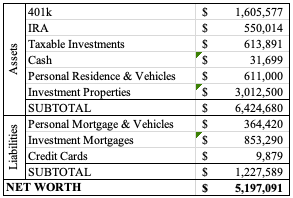
We’ve made a few substantial payments on the deck. We had been investing the money from the insurance company, while we waited for them to finish their estimates and then while waiting for the contractor to begin. Our taxable investment accounts have decreased a bit from that, and they’ll continue to decrease as this project finishes up in the next 2-3 weeks. The market is lower than it was a month ago, but our house values are starting their upward Spring trend, offsetting some of that loss. Overall, our net worth increased over the last month, but only by about $4,500 instead of the drastic increases we had been seeing month-to-month.
We’re just going to cut to the chase – $4 million net worth! I mentioned that this was a goal for this year. Unlike other years worth of large jumps because of purchasing houses, this was less in our control (granted, our market allocation decisions are what’s driving it…. and by “our,” I absolutely mean only Mr. ODA’s because I don’t do anything in that realm).
RENTALS
Well, we’ve had a quiet month. What’s going to be funny is, I’m going to list the things that we did. Quiet doesn’t mean silent or without effort, but we’ve had a rough go of it over the last year, so this was a welcomed break.
We had termites at a property. We pay $98 annually for their termite warranty program, since we found extensive termite damage and live termites when we bought the house. We’ve had to treat the house several times, so this $98 is a steal. However, I’m wondering why we keep needing to treat the house.
We paid $125 for a plumber to go out to a clogged sink. When we received the invoice, it was for 2 plumbers to go. Between the phone call that they were on their way and the tenant saying they were great, only 35 minutes had elapsed. The company charged us almost $300. Mr. ODA called to ask why they choose to send two plumbers to do a one-man job, while also charging us for it. The owner said it was for liability purposes, which Mr. ODA fought back on. They agreed to a reduced rate, but we were only charged $125, which was less than agreed upon.
We had our third tenant move in, after we unexpectedly had to turnover three houses in the middle of winter. We also were given notice by another tenant that she’s vacating by the end of March. We handled increases for two houses (one handled by a property manager to increase $50/month, and one handled by me to increase by $25/month).
We had one tenant pay on the morning of the 6th with no communication, so I did have our property manager let them know that’s not going to be ok. We also had a usual suspect pay late, with the late fee. However, their communication was frustrating. They said they’d pay on the 6th. At the end of the 6th, they said the money hadn’t cleared like they expected. No communication on the 7th. I asked for an updated on the morning of the 8th, and they said it would be that day. At 11 pm, I hadn’t received anything and reached out. I was then told that money was going into the ATM right then so that she could pay. Sometimes I wish I could do a deep dive into tenant finances so that I could help them out.
PERSONAL
Mr. ODA has a trip in July where a group of guys will hike in the Rockies. Our family is going out before that trip is scheduled to do our own exploring. We booked 4 round trip plane tickets, and Mr. ODA handled the lodging booking for the guys’ portion. That’s almost $3,000 worth of purchases, so our credit cards are higher than usual.
Speaking of the plane tickets. We purchased gift cards from Costco for Southwest. The gift cards are essentially $450 for $500 worth of purchasing power at Southwest. We bought two, therefore saving $100 on the tickets. For an extra few clicks on the computer, and the 15 minutes waiting time before the e-gift cards were delivered to my email, that’s $100 that can be used somewhere else.
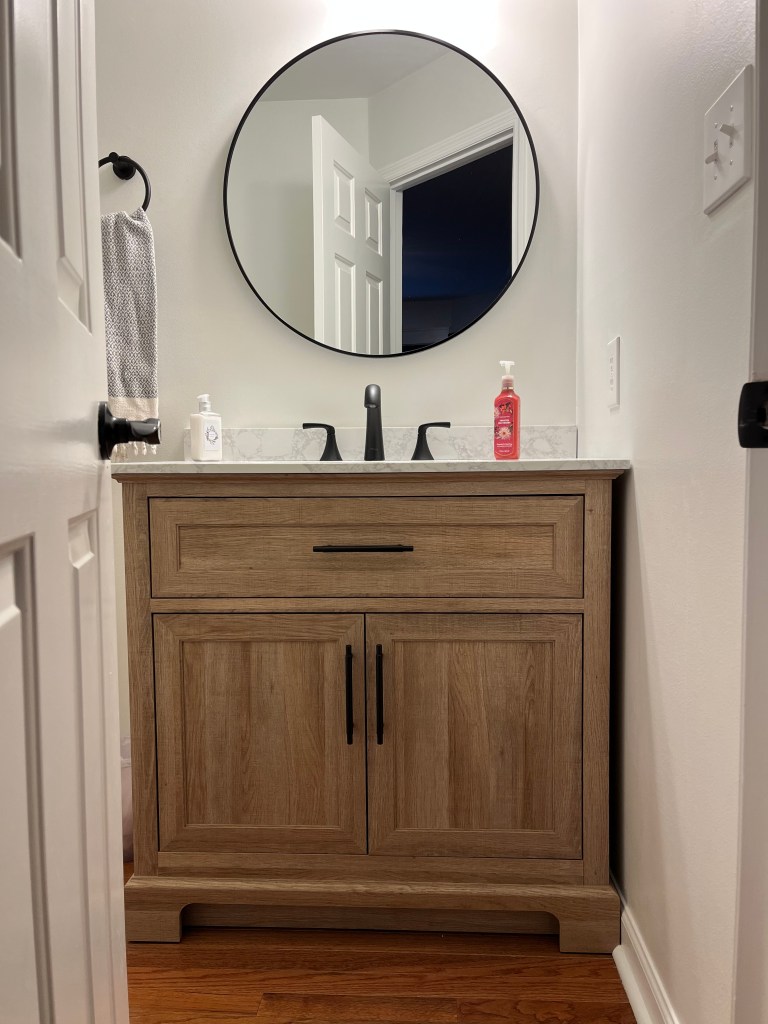
We bought a new vanity for our bathroom. That was about $700 for the vanity, faucet, toilet flusher, and mirror. I sold the old vanity (in rough shape) for $30. And because I’m proud that I did most of it on my own, here’s a picture. I needed Mr. ODA’s help with the supply lines because I lost patience with how tightly they were screwed on and my lack of progress. I cut the baseboards down to size, except I somehow measured wrong on one quarter round cut (I was cutting while it was on the wall). Mr. ODA cut and installed the replacement piece for me.
We finished up the ski season. The kids did great. I was really proud of them for sticking with it. We used our season pass well (i.e., exceeding the cost had we bought individual tickets for each visit). I took two of the three kids to the aquarium, and we took the baby for a procedure at a local children’s hospital. We’ve started tee ball for our oldest. Our March is very full and busy, so we’re getting into the swing of things and keeping track of the schedule.
NET WORTH
Well, we far exceeded that $4 million goal. The market went up big, with our biggest changes being in our retirement account, IRAs, and cash. Our cash increase is offset by the lower amount in our Treasury account. Some of the short term bonds were transferred back into our savings account, and we’ve kept that money in savings since our deck replacement is slated to begin.
The rentals were expensive this month with $4600 paid out. This doesn’t include work that’s currently under way, but not paid for yet.
I paid for a water heater replacement, which was $1,904. I had to pay insurance on a larger property ($793). I paid the balance of the window replacement at one property, which was $1,064. I also paid for a plumber to address a leaking toilet and a rotted faucet ($325). We had a new tenant move into a vacant property, so we had that cleaned before her arrival ($165).
I had to pay for a plumber’s service call ($95) for clogged drains, for them to refer me to a rooter company ($250). I emailed that tenant that preventive measures need to be taken because I’ve not had so many calls to one property. She assured me they have taken appropriate measures and it’s just old pipes. The only problem being that we have several other properties with old pipes that never call for clogs.
We’ve turned over two properties and are about to turnover another property in the dead of winter. It’s so frustrating to be in such a position. All of those stories will be elaborated on in future posts. – On one property, we charged a lease break fee of one month’s rent to cover our losses (the fee was different based on the month in which they broke the lease). Luckily, that covered our entire month of January being vacant, but we found someone for 2/1. – Another tenant asked to leave a property because he lost his job. That was handled a bit different because we didn’t know in advance that this tenant would want to leave mid-lease. We told them there’s a fee of $250 (which is what it costs us to pay the property manager to find a new tenant), and that they had to pay rent until we found a new tenant. We didn’t lose any rent on that property. – Now, we have a newly vacant property because the tenant can no longer afford it. I’m not expecting to recover her unpaid rent at this point. We approved a tenant to start 2/28, leaving us with 27 days of lost rent. However, we sent a lease over for them to sign. They’re currently dragging their feet on signing because they want to pay with their tax return. I don’t love that idea. They’ve been easy to communicate with up until this point, just slow. I’m hoping this gamble works out.
PERSONAL FINANCES
I had to transfer money to Mr. ODA’s account to cover the purchase of our new back door and a new treadmill (although that was only $400). This is an interesting concept for us. Mr. ODA had an account before we met. His account was grandfathered in to new terms and conditions at this bank. He’s kept his checking account and credit card for the rewards (I have access to the account; my name just isn’t on it). Any online purchases go on that credit card. However, that account only receives $250 every other week from Mr. ODA’s pay check (occasionally it’ll receive rent via Zelle). So sometimes, we need to transfer money from our main checking account to cover that credit card payment. All our security deposit accounts are with that bank too. So I had to then transfer from a security deposit account into his checking account, and then have him send that money to our main account. It wasn’t our finest money management moment.
Not much else happened this past month. We’ve gone skiing with the kids some more, I went on a moms’ cruise (which was amazing), took a small trip to piggyback Mr. ODA’s work trip, and have done activities around town. We’re gearing up for a procedure at a local children’s hospital next week, which I’m expecting will wipe out our deductible. Luckily that’s only $3,000, but I’m sure we’ll hit it. We’ll actually be late hitting it this year; it’s usually done in January.
NET WORTH
One of this year’s goal is to hit $4 million net worth. I thought it was going to be a ways away, but the market has been up big recently. We’re only about $14k away from that goal now!
While the housing market has cooled some since I started this post in the Spring, there are still some areas that are moving quickly and aggressively, and this information is still helpful regardless of you being in a multiple offer scenario. Over the course of 6 years and 18 properties purchased (and countless offers made), we’ve caught on to some helpful parts of contracts. Again, keep in mind that I’ve seen real estate contracts in New York, Virginia, and Kentucky; this is not all encompassing or what may work perfectly in your market. This also doesn’t include all parts of a contract since most of them are standard and/or can’t be anything but matter-of-fact (e.g., will the property be owner occupied; is the property subject to a homeowner’s association).
BASICS
Your contract is going to encompass the basics of the purchase each time. This would be the buyer and seller names, address of the property, offer price, and closing date.
Typically, the buyer’s agent draws up the contract with the information being offered. If the offer is accepted by the seller, the seller signs the contract. If there are negotiations, the buyer’s agent will adjust, have the buyer re-sign, and then submit to the seller for signature. When the buyer makes the offer (which is just filling out the contract and sending it to the seller), the buyer will typically include an expiration date of the offer. This isn’t always enacted, but it’s there as a protection so the buyer isn’t sitting idle for extended periods of time waiting for a seller to make a decision. For example, we had an expiration clause in a contract recently where our offer expired at 8 pm that night, but we knew they weren’t going to review offers until the end of the weekend; we had put it in there as a way to hopefully push the seller to make a decision with just our offer instead of waiting for more offers to roll in. We ended up getting the contract on the house, even though our expiration date had technically expired.
In Virginia, the closing date language says “on or before X date, or a reasonable time thereafter.” In Kentucky, it says “on or before X date,” and if you can’t close by that date, you and the buyer have to process an addendum to the contract with a new closing date. We had a contract, as the seller in Virginia, close 2 months after the date in the contract. We were furious about that. We could have walked away and kept the buyer’s earnest money deposit, but then we’d have to formally list (it was an off market deal) and manage that process along with the home inspection issues that may arise. We also had a contract in Kentucky where our lender messed up and delayed our closing, so we had to sign an addendum to the contract to allow us to close a week late.
EARNEST MONEY DEPOSIT (EMD)
Earnest money, or good faith deposit, is a sum of money you put down to demonstrate your seriousness about buying a home. In most cases, earnest money acts as a deposit on the property you’re looking to buy. You deliver the amount when signing the purchase agreement or the sales contract, and it’s applied to your balance owed at closing.
This is not a requirement, but it’s showing your “good faith” to purchase the property because there’s a penalty to you if you try to walk away from the purchase.
In most cases, you pay the EMD to your realtor’s office and they hold it until closing. In Kentucky, they’re on it right away, asking you to send the check as soon as the contract is signed. In Virginia, I didn’t always send the EMD. The amount is listed in the contract, so if I were to default on the contract as a buyer, I would still owe that amount even though I hadn’t paid it to my realtor’s office.
Typically, you’re looking to put 1% down. On a $90k purchase, we gave an EMD of $900. On a purchase of $438k, we gave an EMD of $5,000 (but there were other factors at play as to why we went higher than 1% on that, which I’ll cover later).
CONTINGENCIES
Some items we’ve seen in our contracts are options for the buyer to back out of the contract, or a contingency.
Financing
A sale can be subject to financing. If it’s not an all-cash offer, and there will be a loan secured to purchase the property, data can be entered to protect the buyer’s interests. Typically, it’s going to list the years of the loan to be secured (e.g., 30 year conventional), a downpayment amount, and a maximum interest rate. The interest rates hadn’t been fluctuating much, but this would play into things in the past few months. If you tried to purchase a home when the prevailing interest rate was about 4%, and then interest rates rose to 5.5%, it may affect your ability to qualify for the loan or put you outside a comfort zone for your monthly payment amount. For example, on a $250,000 loan at 4%, your monthly payment is about $1200 per month (principal and interest); if the rate raises to 5.5%, your monthly payment becomes $1420 per month.
This information does not lock you into that break down. If the contract says 80%, and you decide to put 25% down based on the rate sheet, the contract isn’t changed nor is it voided.
Appraisal
If the sale is subject to financing, then it has to be subject to the appraisal. This is a lender requirement to protect their interests. There are some caveats to this, but I will cover them later since they’re more advanced. An appraisal will cost the buyer in the realm of $450-600.
If you’re attempting to qualify based on rental property income, the lender may require you to pay for a rental appraisal as well. We’ve seen this cost at an additional $150, but we’ve typically been able to negotiate our way out of that by providing leases and income history.
Home Inspection
This is one that I almost always recommend including in your offer. This is your “out” in almost every situation. If you get a home inspection, and it finds anything, you can walk away from the contract and not lose your EMD. If a house is important enough to you (a personal residence that you want regardless of what you find on an inspection report), you may eliminate this contingency, but you’ll typically include it. You can even include that you’ll do a home inspection and decide to not do it.
If the house is being sold as-is, it doesn’t mean you can’t get a home inspection. You can still get the inspection to know whether you want to move forward with the purchase. Being sold as-is just tells the buyer that the seller is not willing to negotiate price or fixing items if the home inspection finds something.
The buyer is responsible for the cost of the home inspection. We’ve paid between $300 and $650 for it. The inspector will take about 2 hours to look through the house, including the roof and mechanical parts behind the scenes. Sometimes the inspector will say “this doesn’t look right, but you need to consult a professional in that trade,” which is usually what happens when it comes to roofing. We have done a home inspection, found too many issues to manage (e.g., stairs built out of code) and walked away from the contract. In that scenario, we don’t lose our EMD, but we did pay about $500 for “nothing” (unless you count all the savings of not throwing money into the house to make it safe and livable).
If you find items on the home inspection that you don’t or can’t fix yourself, and the house isn’t being sold as-is, you can request the seller address them. An addendum to the contract will be filed to identify what the seller agrees to fix, and professional receipts have to be supplied before closing to satisfy the requirement. A seller may say they don’t want to be bothered with coordinating the trades to fix the items and offer financial compensation (e.g., we project the cost of these fixes to be $1000, so we’ll take $1000 off the purchase price).
In the realm of “the contract can say almost anything you want,” here’s an example of an additional term that was in one of our contracts. On this particular house, we should have walked away. The closing process was a nightmare because the seller hadn’t paid the electric bill, so we should have known that them wanting a free pass on inspection items was a red flag.
Virginia has a clause to protect the seller’s ability to walk away from the contract in the event of drastic home inspection repair costs.
Wood Destroying Insects (WDI)
A WDI is basically your termite inspection (may include carpenter bees, ants, etc.). We learned with our very first home purchase that this inspection is pretty useless. You can teach yourself what outward signs to look for regarding termite damage. It’s a visual inspection of what the technician can see. But the damage caused by WDIs is behind the drywall. If there’s signs of WDIs outside the studs of the walls, you’ll see it, and that means you have a big problem. Pay the $35 for a professional to say there are signs of active termites.
Another way we found that the WDI is useless is that we had a major termite problem in our house. We were paying for treatment when we sold the house. The treatments weren’t working and the next step was pulling up all the flooring in the basement and treating under the foundation ($$$). The termite company wrote their report: There is an active infestation of termites that are actively being treated. Technically, true. Productively, not the whole picture.
‘ADVANCED’ CONTRACT OPTIONS
I don’t know that these are necessarily advanced, but they’re less common options when making an offer. Some of them come in handy at opportune times, so it’s helpful to know the options at your disposal.
Seller Subsidy
The seller subsidy is the seller’s contribution to closing costs. It reduces the seller’s bottom line based on the offer amount, and it reduces the amount of money the buyer needs to bring to the settlement table. If a contract offer is $102,000 purchase price with $2,000 seller subsidy, then the seller’s bottom line is $100,000.
There is a limit of how much seller subsidy can be in a contract, which is based on the lender’s requirements and is typically 2% of the purchase price. We have had to adjust the contract to account for this limit before we were aware of it; we kept the seller’s bottom line the same, but adjusted the numbers so that we could maximize the seller subsidy.
In Virginia contracts, there’s a boiler plate section identifying the possibility of seller subsidy. In Kentucky, it has to be written into the additional terms section.
Escalation Clause
If you’re in a multiple offer scenario, it may be helpful to offer with an escalation clause. This is an option that a prospective buyer may include to raise their offer on a home should the seller receive a higher competing offer. The buyer will include a cap for how high the offer may go. It’s essentially a way for the buyer to compete with other offers, but not necessarily pay top dollar for the house.
Most recently, our offer was $420,000 and we were told there were at least 4 other offers. We added an escalation clause to our offer. We decided to make it a strange number (e.g., increase by $1770 at a time), and we capped it around $450,000. We were basically saying that we were willing to pay up to $450,000 for the house, but we didn’t have to commit to that number by making our offer at $450,000. The highest offer outside of our offer was about $436k, so our escalation of $1770 over highest offer got us the house for about $438k.
AppraisalGap Clause
As mentioned, a home purchase with financing is going to be subject to an appraisal. With the housing market exploding purchase prices in the last couple of years, houses have been selling for well over list price. This is nice in theory, but that doesn’t mean that a bank is going to agree that your purchase price is “fair market value.” If your contract is for $500,000, but the home values in the area only support $420,000, the bank is not going to give you a loan based on $500,000. Either the seller has to agree to accept the lower purchase price, end the contract and start over with the listing, or the buyer has to agree to pay the difference in value in cash. A gap clause is preemptive attempt to address this difference between the contract price and the potentially lower appraisal price.
If the buyer believes that the area’s home prices will support a purchase price of about $450,000, but they want to make an offer of $500,000, the buyer may include a gap clause of $50,000. This means that the buyer is more attractive to the seller because the seller’s risk of the contract falling through after the appraisal comes back is minimized. This also means that a buyer would have to be able to show the lender that they have the cash to cover the gap clause needed (if needed), the down payment, and the closing costs.
We used a gap clause on our most recent purchase. The list price was $415,000. I was confident that an appraisal would cover up to $425k, but I didn’t see many comparable sales higher than that without venturing into different neighborhoods. We offered, with an escalation clause, up to about $450,000. Since we weren’t sure that the appraisal would go that high, we offered a gap clause of $25,000. Our final purchase price was $438k, and the lender waived an appraisal need, so our gap clause wasn’t enacted.
RANDOM CLAUSES
I mentioned that a contract can almost say whatever you want. Here are a couple of examples of protections we put in an offer that had to be satisfied within the term given or we could walk away from the deal with no penalty.
SELLER THOUGHT PROCESS
The seller’s comfort comes into play when you’re in a multiple offer scenario. A buyer can make an offer saying almost anything they want (within reason of a residential real estate transaction). You can manipulate your offer to show the seller how vested you are in the purchase. Sometimes a seller just cares about the bottom line numbers, but sometimes (like if you’re competing with a similar offer), a few tweaks to your offer may make you more desirable.
I mentioned that we went higher than 1% on our EMD for our personal residence purchase. We wanted to show that we were very interested in the property, so one way to do that is to show that we have a lot of “skin in the game.” If we default on this contract, we’re out $5,000 and getting nothing. Whereas, when we’re purchasing a rental property without emotion, if it doesn’t go through, it doesn’t go. Sticking to about 1% is showing that we’re “checking the box,” but not that we’ll do anything and everything to make sure this deal goes through. We would still be out some money and get nothing if we walked from a contract without enacting a contingency, so the higher EMD you include, the more serious you appear.
A seller may not understand the big picture of providing the subsidy, so that could be risky. If a seller sees that they’re contributing to $2,000 of your closing costs, they may balk at it. Hopefully, they have a realtor on their end that can explain “think of your offer as $100,000 instead of $102,000.”
Eliminating a home inspection may make a seller feel more comfortable too. They may know of some issues in the house and are waiting for the “shoe to drop” through the inspection process, so it could eliminate a stressor for them. I wouldn’t recommend eliminating a home inspection unless you’re confident there aren’t any fatal flaws in the house (e.g., quarter width cracks in the foundation, wet marks on the ceiling, warped/sunken flooring).
The housing market has slowed down, so some of the out-of-the-norm clauses may no longer be worth the buyer’s risk just to compete for a house, but these are some options out there. The general concepts still apply, like when to pay for extra inspections or to expect financing and an appraisal to go together. Know that everything is a negotiation and don’t feel stuck in a contract if red flags are flying.