Rental Work

We’ve owned rentals since February 2016. There have always been ebbs and flows on action needed by me to manage the rentals. Until this year. Suddenly we’re having a regular influx of maintenance needs; some are small like a leaking tub, while some are big like a tree falling on a house. So here’s the update of actions we’ve taken in 2023, with costs for each job (which is something I used to do and haven’t been on top of).

House 1

Roof Repairs

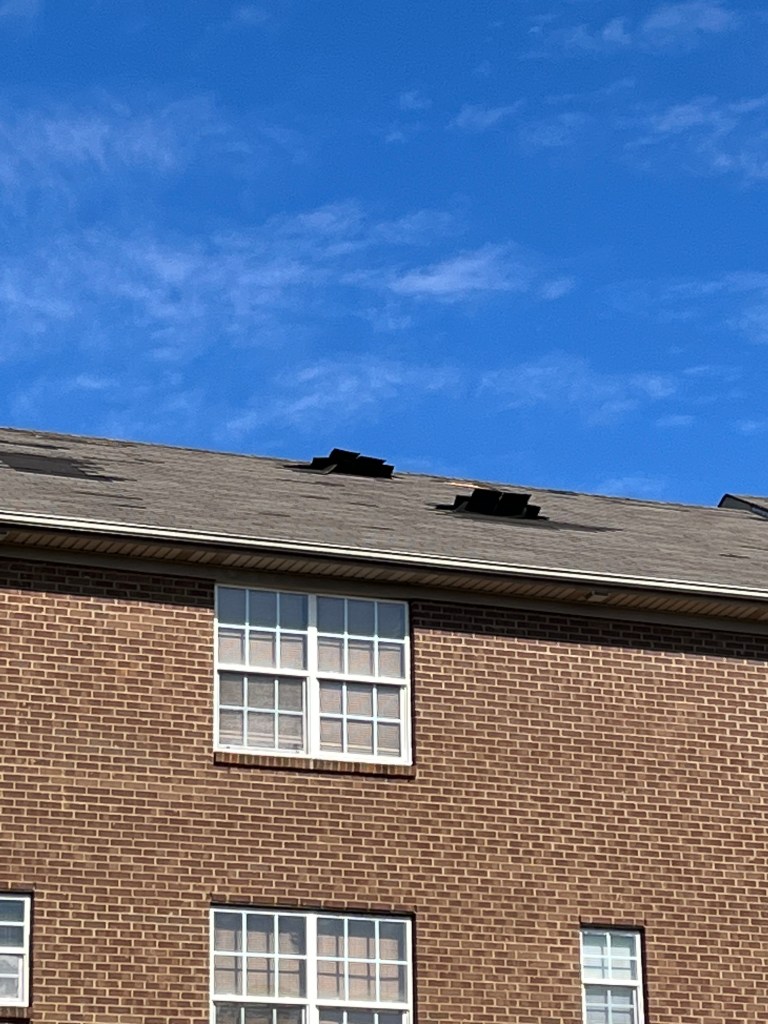
A wind storm came through at the beginning of March and caused extensive damage. There were shingles missing from this townhouse’s roof. The last update was that the roof was being repaired at the end of June, but I haven’t been by to see that yet. This is $0 to us, as our HOA insurance for the townhomes cover it.
Plumbing

The tenant called to complain that the tub in their second bathroom no longer would let hot water out. Hot water was coming out of the sink in that bathroom. I called a plumber, and he said it was going to be $600 to change the cartridge. Considering we’ve done two bathrooms and I had to buy a cartridge, I know that the cartridge is somewhere around $100. I called Mr. ODA while this man was in the house with the quote, and he agreed that was a crazy uncharge and labor charge. The man standing in the bathroom agreed with me and didn’t even charge me for the service call. ha! I called another company, and he came out to change out the cartridge for $245.

House 2

Burst Pipe

At the end of December, a pipe burst and the house flooded. This sounds like a really big deal. But it turns out, this big of a problem is handled relatively easily since insurance is covering the expense and there are companies that handle the whole ‘kit-and-caboodle.’

Our property manager had to manage the day to day activities for us. At first, it was finding a company to clean up the water. The water reached every single room of the house. The clean up of the water was about $22k.

Second step was finding someone to do the repairs and rebuild. The insurance company estimated the repairs around $40k. Our estimates came in well above that. One company said “give me your insurance agent’s contact, I’ll handle it.” That was amazing. They agreed to an amount for the work to be done, and the next we heard, our insurance agent said they’ll cut us a check for the remaining amount. The company was really easy to work with. I selected the flooring, cabinets, and paint color. Everything else was boiler plate otherwise (drywall repair, insulation, lighting installation). They quoted us to put sheet vinyl in the bathrooms, since that’s what was there, but they agreed to install the LVP all throughout the house (which was likely a cost savings to them anyway) at no charge. They also agreed to let our contractor go into the house to install new kitchen countertops (the previous tenant had burned our counters (drugs?!), but it was a hassle to replace them at that time.

We had a few hiccups along the way, but the company didn’t fight us on fixing them. For instance, they threw away the bathroom countertops, even though they were supposed to be put back in place. They painted the house with a paint bucket that was left over from our July renovation, even though I had given them a different color name to paint it (and then when I explained that in no realm would I have bought the paint for them to use when they’re charging me 10x the price of a bucket through the renovation because insurance is paying it); they repainted everything.

They allowed us to pay the first installment via credit card, so we received $340 worth of credit card rewards from that $17,000 purchase. Then our final amount paid (as reimbursed from insurance) was about $51k.

The insurance covered our increased costs for utilities (since we had to heat the house with no ceiling and insulation) and covered our lost rent for that period of time (I shared the tenant nightmare part of this in previous posts).

The cleaners the repair company used were awful. We waited to see what the new tenant thought about it, and she ended up complaining. So we called in another cleaner, which cost us $200. The refrigerator was disgusting and we ended up replacing it, for $760 (our choices were extremely limited to keep the cost down and to find something in stock since a new tenant was moving in 2 days later). We also had our handyman install new locks, new toilet paper holders, and two new blinds (none of that was covered by insurance), which was $180.

House 4

Tenant Turnover: Painting and repairs

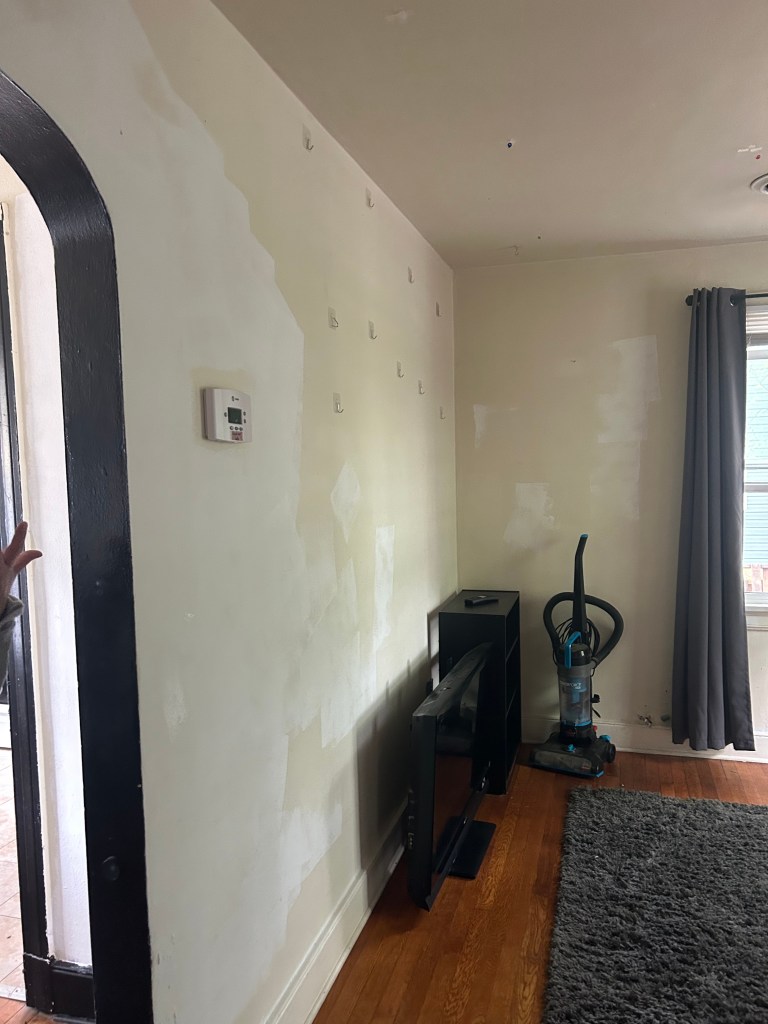
We had a tenant move out of this house. She had lived there since 2018. She finally decided she needed more space (it’s a very small house) as her toddler was growing. I checked on the house a couple of years ago, and things seemed to be in order. She had said that she never wanted to move, so she treated it like her own house. She struggled to keep a job, although always seemed to have one to move on to. Well, over the last two years, she started making “improvements” to the house that weren’t improvements (like painting half the trim in the house black). We had to put a lot of work into that tiny house, and it isn’t even to my standard really.

Our handyman had to paint two coats on all the walls (after removing an excessive number of command hooks and such), 3-4 coats on all the trim to get it from black to white, install door knobs she had removed, and epoxied the bathtub and blue tile walls in the bathroom. That was $3,732.
House 9

Water Heater

The hot water heater stopped working. We had it installed less than a year ago. We called the company to come look at it, and they agreed. Then that morning, no one showed up. When our property manager called to ask where they were, they said they don’t do that anymore. We called another company to come fix it, and they pointed out that it was installed incorrectly and the wires were rubbing, creating a short. We had that company fix it, and then I called the original company and asked for a reimbursement. They agreed, but it was a two month process before I received the check. That was $200 out of pocket, but was then paid back to us in full.

House 10

This one. Goodness. They build up their maintenance needs and then lay a bunch of problems on us at once. It’s frustrating, especially when it involves leaking water. They also pay their rent at 2 am on the late day so it’s technically late, but not worth me fighting over. They don’t maintain the house very well, and we’re just ready to be done with them.

Ceiling Fans

I have our handyman going out to fix two ceiling fans. One has a screw missing from the blade, and one has disconnected from the ceiling. I don’t know his cost for those items yet.

Plumbing

There was an issue with water leaking from one of the tubs and following the pipe system into the basement. A plumber fixed the leak from the tub faucet for $425.

There was a back up in the HVAC condensate line that we had our HVAC tech go out for, and that was $125.

House 11

Pests

We had to have pest control come out to address swarming termites, which has been a longstanding issue in this house, unfortunately. That was $98, which was truly just the renewal for the termites warranty. Then we had another issue with powder post beetles, and that was $185.

Honestly, this is where having several houses creates a benefit – we use this company for all our houses and all our partner’s houses. We didn’t pay the termite warranty for a few years on it because I actually didn’t get that paperwork (the $98 fee), and they let me pay up the years I missed to cover treatments currently). I had called at another point to schedule an inspection, and they said I had a balance so they couldn’t schedule anything until I paid the outstanding balance. Again, an issue with paperwork getting to me. The lady even said “we know you’re good for it, and we’d get in touch eventually.”

HVAC

Over the winter, the HVAC unit wasn’t heating. On March 2, the HVAC technician went out and discovered a dirty filter and had to clean the flame sensor. That cost us $223.

Then the HVAC wasn’t cooling this month. The same tech went out and discovered the condenser needed replaced. He did that, but then he left town without invoicing us, so I don’t have that invoice in hand yet. But now we’re having an issue with the house “sweating” that he’s going to look at this week.

House 12

Storm Damage: Tree removal, shingle replacement

The wind storm at the beginning of March took shingles off the back of the roof. Mr. ODA got up there and replaced about 12 shingles, which is a new skill set! As part of that storm, a small tree at the curb of the house fell over, so Mr. ODA cut that up and got it ready to be picked up. That cost us our time and $37 at Lowe’s on shingles.

Wildlife Removal

When I first met this tenant, she told me about how she had a raccoon in the attic. The property management company came to remove the animal (supposedly) and patch up the entrance point. They didn’t do a great job; the animal came back. She said she hadn’t seen it, but she has 5 cats (yes, lease violation) that are very alert. We hired a company to set a trap. After a week, they didn’t find an animal, so they patched up the hole. Setting the trap was $279, and patching the hole was $150.

House 13

Storm Damage: Siding repair

During another March storm, a piece of metal siding came loose on the house. Mr. ODA was able to go put it back in place, so this didn’t cost us anything except the mileage and time.

Electric Work

The tenant complained that one outlet wasn’t working. That didn’t add up. I had Mr. ODA go check on the electrical box while he was working on the siding, but he also saw that nothing was tripped. I had an electrician go out there. Turns out, there’s a second electric box on the house, and that breaker was tripped. You win some, you lose some. He charged me $100.

Tree Removal

The tenant had a tree fall along the back fence line. It took down some wires. We had the power company go out to check on it all, but they confirmed they’re not power lines and they’re cable lines. Since her internet/cable is working fine, it’s not a priority to remove the tree. I had a tree removal guy go out and look at it. Most of the tree is on the other side of the fence. He tried contacting that owner (there’s a rental sign outside the house) to gain access to remove the debris, but they haven’t responded. We had a huge storm come through a few weeks ago, and that has put her tree removal even lower on the list. Plus, she was rude to the tree guy, wouldn’t put up her dogs, and wouldn’t clean up the dog poop in the yard, so it’s not high on my priority list to get her taken care of either. Be a good person.

House 14

Tree on Roof

That big wind storm at the beginning of March took a tree down at this house. I struggled to get someone to help us. I finally posted on the local mom’s group, and someone spoke up that her husband’s business prioritizes trees on structures and would get there tomorrow. And that he did. He had the tree gone in a few hours and cleaned up the yard great. We then had to wait for the insurance adjuster to come out. Once they cleared us, we were able to repair the roof and gutter. For how big the tree was, the twiggy branches at the top was all that hit the house, so the damage was fairly minimal. This was all covered by insurance, so it didn’t cost us anything.

Water Leak

The tenants reached out to me that their water bill went from $50 to $400. They’re pretty self-sufficient and handy, so it was definitely a problem. I trusted that they were able to diagnose a running toilet or leak under a sink. It turns out the link was at the main water for the house. The plumber had to excavate the front yard and replace the entire pipe from the street to the house. I just got the bill, and it was $3,060.


Others – With no costs incurred yet, but will need action

House 6 has repairs that are needed, but the tenant hasn’t been available for the repairs and she has 2 or 3 big dogs, so we really need her home for us to enter the property. I also received notice from the insurance company that they want a railing installed on the front steps, so our handyman will handle that also.

House 7 has a flat roof over the laundry room. Before we bought the house, someone built a room on a covered deck – very poorly. It has leaked several times, and we have tried to find a roofer to help, but they don’t want to handle flat roofs. Mr. ODA shoved a bunch of silicone at the roof line, and it actually held for over a year. It finally leaked again recently. We started making calls and very explicitly stated that we don’t want the flat roof repaired, we want it built as an actual roof (because no one will touch a flat roof, and I had someone come out for a roof replacement and we didn’t know enough at the time to realize he wasn’t going to touch that part of the roof). We finally got two roofers to give us quotes. One seemed to completely not understand the request, and the other said $3,800. So we agreed to that quote and will hopefully have this behind us in the next month or so.

The Quiet Ones

House 3 has had to pay rent late a few times, but they always let me know in advance and I always waive their late fee.

House 8 has required zero effort. They pay rent in the final hours it’s due consistently, but they never need a reminder or follow up. This house isn’t in great shape, so it’s mildly concerning that we don’t hear from them for months on end, but I have enough to keep myself occupied at the moment.


I plan to do walk throughs and address a few issues at some of the Richmond houses later this summer. The last time I went through some of the houses was July 2021, and there have been instances that say tenants need to be checked up on. While many houses have had our handyman in it recently, I want to be more consistent on checking on them and letting them know I care what is going on.

That’s almost $10k that I’ve paid out so far this year on rental properties, with more invoices waiting to come in.

Here’s to hoping the second half of the yard is quieter than the first.
Filing Taxes

We filed our taxes. It just takes so long, but it’s easy. This year I recorded what I did and how long it took, so I wanted to share.

I’ve shared that I record transactions all year long. Inevitably, a few things slip through a crack. So I go through everything I have on file to make sure I can support a charge I’ve recorded (e.g., receipt) and that I haven’t missed entering something in my spreadsheet (e.g., I have a receipt for work, but didn’t put it in my spreadsheet).

DC TAXES

Mr. ODA works for a DC office, but lives in KY. The paperwork information got crossed, and he ended up paying taxes to DC for a little while. Apparently DC is used to this mistake. There’s a form he filled out, attached a copy of his W2, and mailed it to DC. He received a full refund within a couple of weeks! I couldn’t believe the timing of it and how it easy it was!

STEP 1

My first step was to load all my mortgage documents for the houses that we still have mortgages on. I need to know the mortgage interest for the year and what they paid out in taxes from escrow. For some reason, it never tells me the insurance payments made on the tax document, so I need to go through my email or look at the line-by-line escrow to see when and how much was paid for insurance. I estimate the mortgage interest each year, but I don’t have the final amount until January.

STEP 2

Then I go through my email files. I try to get most of my receipts via email (e.g., Home Depot and Lowes are good about tying your credit card to your email address so I keep everything filed electronically). This took me just over 3 hours. I went through each email receipt to see if I had it recorded properly. I found 2 or 3 transactions that I had receipts for, but they weren’t recorded in my spreadsheet. I also found out that I didn’t record any of my final December transactions (i.e., stormwater utility bills and property management).

STEP 3

After I go through everything I can electronically, I move on to my paper files. We have a lot of our insurance through State Farm, and they don’t email me receipts for payment, nor can I look up previous payments made on their website. So I keep a paper copy of all the insurance documents for each house. We had a huge debacle with two of our KY houses and insurance last Fall, so I had to make sure I had all of that recorded accurately. I used to rely on the paper stormwater utility bills that I pay directly, but this year I just went into our checking account and verified the amounts that I paid against what I recorded. Since most of my transactions are kept electronically (especially with having property managers, so they’re sending me the bills they receive electronically), the paper checking was only about an hour this year. It used to be longer, but I’ve streamlined my electronic filing so mostly everything is in there.

STEP 4

After just over four hours of “prep” work, we move on to the tax software.

Mr. ODA entered our W2 information, we both pulled up all our investment account statements, and then we got into the investment properties. It’s tedious, and each year we have to remember how we matched our terminology to the system’s terminology (why can’t I keep better notes on this?!). We got into a groove and knocked out half the properties in about 80 minutes before taking a break. We focused on the 3 properties that we received one 1099-MISC for first, which involved going back and forth on some screens. Then we knocked out some of the easier houses. The next night, we finished off the rest of the houses in about an hour.

We usually call it complete at that time, but we don’t submit right away. We take a few days to see if we think of something we may have missed (whether investment property or personal finance), and then we submit. We usually owe Federal and State tax every year, so we’re never in a rush to get this done and pay. Somehow, we get a refund for Federal this year, but we still owe the State.

SUMMARY

About 6.5 hours of tax work, after being pretty on top of it all year. People ask us why we don’t use someone to do it instead of putting all that time in. It’s not that easy. If we had to send our information to an accountant, we still would have to gather all our receipts and send them over. I think it’s easier to look at my receipt and record it, rather than gather all my emails and send them to an accountant (not to mention Gmail is not a great mail system in this regard because you can’t easily add emails to new emails). Then we have to field all their questions regarding the documentation that I send, which will inevitably be frustrating to me. It’s all around cheaper and easier to do it this way.

Year in Review: Part II

I have gone through all our expenses in 2021 and categorized them, which was very time consuming. I swore I’d do better this year, but it’s March, and I haven’t done anything.

In the past year, we hit a net worth of $3 million. That’s really exciting, but we have more goals. It’s important to note that the net worth is through our investment properties, retirement accounts, and other investment accounts, so it’s not liquid funds. The values on our properties have drastically increased, many of which we’ve recently refinanced and have an appraisal on file showing just how much equity we’ve gained on these. Except for the cash that we have in our savings account right now, as we prepare to purchase another property at the end of the month, we don’t typically carry a cash balance. Our philosophy is that, if there’s an emergency, there are very few things that can’t be put on a credit card, and we can liquidate investment funds within 24 hours. We don’t subscribe to “3 months worth of expenses in savings” type actions. We’ve had plenty of large expenses hit us with rental properties, fertility treatments, and other random health needs, but it hasn’t ever been something to drown us financially. So while it’s exciting to see that new net worth, it doesn’t change our spending philosophy.

DIVIDENDS, INTEREST, & REWARDS

Mr. ODA used to have our dividends get reinvested automatically, but now they are transferred into our checking account. That was over $6,500 that came in, mostly at the end of the year, but there was ~$30 per quarter deposited also. In a different time, interest earnings on accounts used to be something to be excited about. Our checking and savings account combined brought in $6.51 for the year.

Mr. ODA is set up with GetUpside. When I went to their site to get a better description, I learned that you can earn cash back through gas, grocery, and restaurant purchases; I thought it was just gas. It’s an app that allows you to earn cash back through your normal purchasing. However, it also gives you an incentive for referring people, and so when that person buys gas, you get some cash back. By checking the app for a participating gas station (and only using it if the incentive offered is a better price than surrounding gas stations), Mr. ODA deposited $32.45 for the year.

Between 5 credit cards, we brought in $4,232 worth of rewards. These are simply earned by either spending or paying the credit card, no further action. We preach and preach to have credit cards with rewards. Everything we purchase goes onto a credit card; at the end of every cycle, we pay that credit card off. We’ve developed a mindset for spending that means we’re not afraid of what we put on the credit card and whether we’ll be able to pay it off in full at the end of the month, because we’re not spending frivolously. I will caveat that this amount of rewards was possible due to sign-on bonuses that were earned in a previous year, and then the credit card changed their reward redemption options, allowing us to pay ourselves back for restaurant purchases. We had previously been using the rewards to purchase travel needs through their portal, but we were able to dwindle down our rewards with this reimbursement change.

INVESTMENTS

Every month, we each put $500 into our investment accounts as an automatic contribution to max out our Roth IRA contributions. Additionally, each kid gets $50 deposited into their investment accounts each month. We also received the child tax credit each month, so with that, we put $125 into each kids’ account. The thought process was that we received $600 for them, and so after investing in their accounts, we were left with $350 to go towards “raising” them, which was the intent of the money being sent out in advance.

EXPENSES

My categories were super broad. For instance, if we traveled, I included all the expenses (e.g., lodging, flight, activities, parking, dog-sitting) as “entertainment.” But “entertainment” also included watching horse racing, baseball game, zoo, babysitting, etc. “Home” includes any furniture purchased, decorations, cabinet knobs, pictures/frames, etc. Even with the broad categories, I still had too many.

There are 3 categories that we have more control over, so I took a closer look at them: groceries, gas, restaurants. These are the ones that we can control our actions to change if we wanted/needed.

GROCERIES

A shortfall on my tracking is that I don’t know if Walmart purchases were necessarily for groceries or for something else. I removed a $300 purchase from my list because we wouldn’t have spent that much in one transaction in groceries, but I can’t figure out what we did spend it on because it was too long ago.

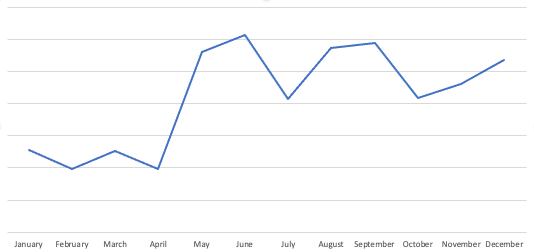
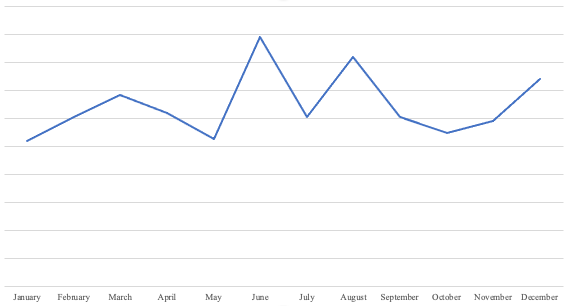
I investigated the spike in June, and I didn’t come up with anything jarring. There’s a transaction for $165 on a day with another transaction, so that may not have been food. August had several trips to Kroger. Trips to Kroger mean that we’re buying in bulk, so things purchased there are typically several of a particular deal they’re running that week versus an actual grocery shopping trip. There are 19 grocery transactions in August, which is higher than usual. August also included an emergency “find this kid some medicine while we’re on the road” that cost us $8 worth of medicine.

Lesson learned: We can do better meal planning and making fewer trips to the grocery store. We can be more deliberate about what we’re purchasing instead of stocking the pantry without a plan. We have a Sam’s Club membership and sometimes we tag along to Costco to scope out deals, so those lead to more bulk purchases, which will fall by the wayside in 2022. The Kroger deals will continue to be on Mr. ODA’s radar though.

GAS

Interesting that January through April are so much lower because we didn’t necessarily stay home. We drove about an hour away for a trip in January and a trip about 90 minutes away in March, went from our house to Lexington (about a half hour) every weekend, and went to the zoo (about an hour or so away). I guess we stayed home during the week more, which kept our gas costs low. April was when we gave up on a lake house and decided to be deliberate about going on trips, so I expected to see an uptick in gas costs at that time. I described that whole thought process and what we did in this post. Some of the uptick in certain months can also be contributed to us trying to maximize gas prices (e.g., we fill up if we’re going to be near Costco, even if we don’t necessarily need the gas at that time). In October and half of November, I was working in Lexington on the weekends, so that was 3 days a week that I was driving 25 minutes each way. Then in December, we drove from KY to Long Island, which is a whole lot of gas.

Lesson learned: We like to be active, so I don’t foresee a change in our gas-purchasing patterns in this year. As I type this, gas prices are soaring all over the country. Since we like to travel, our trips are usually within driving distance versus flying with two kids, so spending the money in gas is cheaper than 3-4 plane tickets.

RESTAURANTS

This is a funky one to track. While we’re traveling, we’re clearly eating at restaurants more often. That’s seen in the higher spending that happened over the spring and summer months. I don’t remember spending all of February in the house, but our credit card purchases seem to say that’s what we did – no gas and no restaurants. In March, we splurged on a birthday dinner ($77!), which is unusual for us. From April through August, we were traveling (and therefore eating fast food and at sit-down restaurants), Mr. ODA had work trips (so he’s going out to eat with coworkers for multiple nights), and there seems to be one or two transactions each month where we paid for a group dinner that was reciprocated (and not captured). Under the restaurants category is also when we went for drinks somewhere. We went to a winery and had a couple of drinks with friends, and that could probably be considered “entertainment” versus eating outside the home.

HOUSE WORK

We put a lot of money into our house this year, which is surprising since it’s new construction. We finished our basement, which was about $15k instead of the $75k-100k that other people have been quoted for the job. We bought a patio set, a grill, and an entryway table. Mr. ODA built a “shed” under our deck (we can’t have free-standing sheds per the HOA, so we enclosed under the deck .. not “free standing” 🙂 ). Most of our furniture moved with us from the last house without an issue, but there were a few purchases needed. Between our initial move in purchases (a kitchen table and chairs), purchases in 2021, and a few purchases that have already happened in 2022, we should be done with big house purchases.

INCOME

I quit my job in 2019. I manage our 12 rental properties as my “job” now, but I also am open to part time jobs as something to do. In April 2021, I was asked if I could help fill a position at the race track during their Spring meet. It wasn’t a job that I wanted to go back and do in future meets. I mentioned that I’d work the Fall meet if I could do something like pour beer, and Mr. ODA’s dad (who works there) made it happen. I also worked some of the days of their horse sales. I worked 22 days for the year and contributed $5k to our family’s spending for the year.

LOOKING AHEAD

I’ll try to track our expenses in real time this year, so that I can categorize them more accurately. Watching expenses month-to-month means you can also make adjustments if you see you’ve spent more than usual in one category.

Finishing our basement meant that we moved furniture around. A sections that was in our dining room moved to the basement, freeing up the dining room to actually be a dining room; I purchased a table and chairs. The “playroom” toys were moved down to the basement, and that room became the guest room. It’s nice that the guests can have their own space on the first floor and not share a bathroom with the kids. That freed up the previous guest room to be an actual office, so I purchased a desk (our old desk was in poor shape and it didn’t move to KY with us). Other than that, I don’t see any major expenses on our own house for this year.

We expect to travel a lot again this year. We already have six trips planned. They’re all driving trips, so that’ll increase our gas category. I have one trip expected to fly to my sister’s baby shower, but that hasn’t been scheduled yet. We’ll also have day trips that we’ll do around our house, which is usually an hour to an hour and a half worth of driving.

While we don’t “budget” or believe in the “envelope system,” we do watch our spending on a regular basis. We check our accounts every few days to ensure there are no surprises as well (i.e., don’t wait for your statement to come and find out there have been false charges). Keep paying attention to what’s being spent and where your money is going so that you can make informed financial decisions.

Expense Tracking

In January, I mentioned how I have a very detailed spreadsheet to track my expenses. I started this spreadsheet concept in 2012 when my husband and I started combining living expenses. We also moved from NY to PA to a VA apartment to a VA house in a matter of 22 months. I needed to have a way to make sure I didn’t miss any bills. I didn’t want to rely on receiving the bill itself in the mail or in my email before paying it. I chose to develop the spreadsheet based on our pay check dates, which were every 2 weeks.

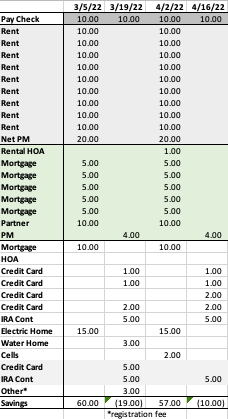
Here’s my sheet, in essence. Pay no attention to the actual numbers in this screenshot, as I didn’t take the time to make sure they were made up but still proportioned to each other. The format is exactly as I use it though. I set it up at the beginning of each year.

For the entire year, I record the pay check receipt across the top of the sheet. The dates are based on the day the money hits our account. This has changed over the years, as we used to get paid on Tuesdays, but now Mr. ODA’s pay check shows up in our account on a Saturday.

The first section, which is all gray, is the rental income. I then record all the rental income near the 1st of the month. If a pay check isn’t near the first of the month, I record it for any pay check date that shows up in the first 10 days of the month. Realistically, I receive the majority of our rent on the 5th of each month, so it doesn’t make sense to record it as a projection any earlier than the 1st, and as near the 5th as I can. The ‘Net PM’ is because I don’t collect rent on our KY houses; the property manager collects rent, removes their expenses, and then we receive the net by the 10th of the following month.

The next section is the light green, which captures routine expenses on the rental properties. I record the HOA due date every 3 months, each month’s mortgage payment, the payout to our partner (I take in all the rent each month and then pay him out his half plus our half of the mortgage payment), and then the VA property manager’s expenses.

The white section covers all our personal expenses.
– The bottom two gray lines are simply an indication to me that those affect Mr. ODA’s account and not our main checking account.
– I pay our personal mortgage near the 1st of the month (some time between the 1st and the 10th, but I typically prioritize this getting paid as close to the 1st as possible).
– Our personal residence’s HOA is only due one per year, which is why there’s nothing on that line for this particular snapshot.
– Then I have all our credit card payments. For the year, I project based on the previous year’s average bill. As I get closer to the statement end period, I update the projection. If I project that a credit card bill is going to be $1000, but as we spend through the month, we had more expenses than I thought, I update the projection on the spreadsheet to reflect that. So where it said $1000, I may put $1700 to cover my savings projection.
– I project our my utilities too. I know that I have an electric and water bill each month, and I have a cell phone bill that I pay in 3-month increments to my sister-in-law for a family plan. When setting up the sheet for the year, I simply keep the same numbers from last year for the utility lines. While I can log into my account and see the details, it’s easier if I already have it laid out like this. Then I can see, “last year, for this month, my bill was only $40; why is it $70 now?” One caveat here is that I usually keep the lines on this sheet to those items that are going in or coming out of our checking accounts. The water bill can now be paid by credit card (since we moved to KY last year). Technically, I should remove that from the sheet because I track bill due dates separately from this part of the sheet, but since I’m used to tracking the water bill’s due date like this, and I like seeing how the bill changes from last year’s amount due, I’ve kept it on the list.
– I have our IRA contributions listed as well, since that’s a big chunk that comes out each month. The maximum contribution into a Roth IRA is $6,000. We have automatic contributions twice per month, so that’s actually $500 out of each ‘pay check’ grouping.
– The “other” line is for expenses that happen every year, but they aren’t worth having individual lines because there’s only one or two payments per year. As I type that, perhaps my own HOA payment could be added to the other line since it’s only paid once per year. In Virginia, we had personal property tax that would be due each year. We also have our taxes that we owe (because we purposely plan our taxes so that we don’t get a refund because that means you’ve given Uncle Sam an interest free loan). We have vehicle registration fees due. All these ‘one off’ payments are recorded on the “other” line and then I describe the expense two lines below with the asterisk.

As for the savings projection, this is probably mislabeled. It has always said ‘savings,’ but it’s really just the net of that two-week period’s income and expenses. To know if I’m in good shape (if perhaps I’m in a position where my account balance is being kept really low), I net the two ‘savings’ next to each other (so I would add the $60 and the -$19 to know that my income from that first two-week period will cover my expenses for the second two-week period also).

In practice, as I receive the income or I pay a bill, I change the text from black to gray. This tells me that it’s paid and accounted for. I also update to actuals as I go. So if I projected a credit card payment to be $150, but the actual payment was $147.34, that’s what gets put in the sheet when I make the payment. This helps me track actual amounts through the year, as well as sets myself up to create projections for the next year.

I have a separate tab in my workbook that tracks additional income for the year. For example, when I was working part time, I recorded that income on that other spreadsheet. Each time we get money from our credit card rewards, it gets recorded on my income spreadsheet. By keeping track of our additional, unplanned, income, I have the ability to identify our actual savings net for the year. I take the ‘savings’ bottom line from this spreadsheet and add all the additional income we’ve brought in from the other sheet.

While I’m not budgeting the details of our expense categories (e.g., $300 per month for groceries), I’m tracking my income and overall expenses based on bill payments. Last year, I had tracked my expenses by category to see if overspend in one area in particular. I didn’t keep up with it though because the billing cycles didn’t line up with when I’d be running my financial update, but I hope to get in a better grove this year. This set up makes me feel comfortable that I’m not missing a bill. If I get to the end of a 2-week period, and I haven’t grayed out an amount, then I know it’s time to investigate why I didn’t receive mail or an email prompting me to pay a bill. Usually what happens is I’m tracking Mr. ODA’s credit card payment and wondering how much longer he’s going to wait to pay it until the due date. 😛

I hope that was easy to follow. I don’t want to put all our exact numbers in there, but I wanted to share how I “budget.” If you have any questions, don’t hesitate to reach out!

Rental Property Management

Every once in a while, I like to share what I’ve been doing to manage the properties. There was a lot of activity needed over the last two months.

RENT INCOME

One of our usual suspects for late rent payments was late again. We seem to only have a one-month streak for on-time payments with them. She at least communicates with us that they’ll be late and gives a projection on when we’ll see it. She ended up paying rent on the 14th, and said she needed to pay the late fee on the 21st.

Two other houses haven’t paid rent, but they’ve applied for rental assistance.

RENT RELIEF PROGRAM

House2 applied for rent assistance in September, and we still haven’t received that from the State. I did finally get a tracking number on the 19th that it’s on its way. She paid $400 worth of January’s rent on a Friday and said she’d have the rest on Monday. Well, as she has a history of not communicating and not upholding her word, I wasn’t taking a chance with her. I served her the default notice on Saturday to indicate that she didn’t pay rent in full and had 14 days to remedy that. She remedied that by applying for rental assistance again. She said that she only applied for January assistance, so hopefully we’ll have February rent on time. I wish I could dig into her finances and find out how she didn’t have to pay any rent for September, October, or November, only had to pay $600 towards December because she had a credit from a payment plan previously in place, and then can’t pay January rent in full.

House3 had to apply for rent assistance. They’re great tenants and have been with us since we purchased the house. In November, she applied for December, January, and February assistance. The application expires 45 days after it’s sent, as a means to protect the landlord from floating the expenses on the property indefinitely. This tenant ended up paying December’s rent, but hasn’t paid anything towards January. Luckily, we did receive approval for their application on January 11. Hopefully we’ll receive that money in less than 3 months time like the last time this program was involved. What she paid in December will be counted as March’s rent (2021 income for tax purposes, but she won’t pay March rent because she has that credit now).

REFINANCES & MORTGAGES

We had to provide several post-closing documents on the refinances. It was horrendous. They asked for new types of documentation. Clearly, whoever is purchasing our loans didn’t like the lack of due diligence done pre-closing. Except for the new request, everything else they requested could have been ascertained by looking at the documentation already on hand, so we didn’t appreciate that. Then the new request was to explain how we paid off a mortgage, which was paid off 4 months prior to us establishing a relationship with this company to refinance the other loans. I had to provide proof that it was paid off, and then I had to provide the funds used to pay it off. The balance was $3,100. Paying a $3k bill hardly touches our finances. I want to become an underwriter so I can understand how they need so much detail and are sticklers for the type of detail, but they don’t need to know how to read the details they request.

We had an escrow analysis done on House7. It said that our mortgage was going to increase by $183 each month, but the increase should have been just about $60. I’ll explain details in another post, but that took some time. Mr. ODA called and walked the representative through the error. He said it took a while for her to get there, and we’re awaiting an update.

Since our refinances occurred at the end of the year, and all our city tax payments are due in January, I was nervous about the right amounts getting paid. The initial closing disclosures had the old tax payment amounts on it, but every one had increased. I was able to catch it and request that they be updated before our closing, but it was a day or two before closing. I was afraid it wouldn’t catch correctly. I had to stay on top of the payments and make sure they were all paid in full, and I had to pay the property taxes for those that aren’t escrowed. I was most worried about the three properties that were being refinanced, but then the issue ended up being one of our other houses. The escrow check was sent on 12/21, and it still hadn’t processed as of the tax due date of 1/14. I sent an email to the finance office hopefully showing that I had done my due diligence timely. Luckily, when I checked on 1/20, the taxes were processed by then.

LEASE MANAGEMENT

We require action from the tenant no later than 60 days from the end of their lease. There are 3 properties that have an April 30 lease term expiration. One tenant already reached out and asked to renew their lease. They’ve already been there for two years, and their rent has remained steady at $1300. We have precedent of increasing long-term tenant rent every 2 years by $50 (but we also have precedent of not actively managing houses and not increasing the rent at all.. oops). I explained to this tenant how there have been several increases in our expenses over the last two years. They’re really great tenants, and they hardly ever ask for anything from us. I felt guilty, but we’re trying to run a business, so we need to take care of that side too. Plus, if we didn’t increase slightly this coming year, it’ll be hard to manage future increases. It’s a lot harder to keep a good tenant if you don’t raise their rent and then hit them with $100-$200 increase down the road, so it’s best to keep with inflation. I did the cash-on-cash analysis for this property and discovered that the $50 increase falls slightly short of our expenses and keeping our rate of return the same.

I have to work with two other houses (via a property manager on those) to determine their new rent amount. One house negotiated a lower rent for a longer lease term at their lease initiation, which was October 1, 2019. This property in particular has had the highest jump in taxes. We grieved them to no avail. They’re claiming our neighborhood is part of a more affluent neighborhood and refuse to see how their district lines aren’t accurate for the type of house and street it’s on. I plan to push for an increase of $75 on that one, since their original lease amount is based on a discounted rate. One the other house, the tenants wield a lot of power to our property manager. We tried to increase rent last year, and the tenant flipped out on us about it. We’re already below what we thought market value was on the house, so 2.5 years without an increase is insult to injury. I’m going to request an increase from $875 to $950 on the house and see what the property manager says. If she agrees to a $50 increase, that’d be acceptable, but it’d be nice to recoup some of the other expenses too.

EXPENSES

We have a tenant in one of our houses that is amazing. He treats the house as if he’s the owner. He’s quick to take care of problems, and only seems to let us know when it gets to be a certain level of problem. This house has always had a mice problem. One tenant, who we evicted, created a really big problem that involved several mice making this house their home. She refused to do her part in cleaning up food messes, be it old food sitting on the counter or in the sink, grease splattered all over, or just general mess left behind. We got it under control, but the occasional mouse still rears its head. He sent us an email saying he’s been having an issue, and he’s tried really hard to address each individual mouse appearance. He said it has gotten to the point where he wants to do something more drastic, but wanted our permission. I said that it was absolutely at the point where it’s our issue to deal with, not his, but we thank him for his efforts. I called our pest control company, and we’ll see if that helps. One or two mice is one thing, but for him to say he’s caught 9 in a year, that’s a bit much. The pest control was $165.

One of our KY houses has a bunch of little and weird expenses pop up. This month’s explanation on my report from the property manager simply said “Repaired door by adjusting door to fit opening and resetting stuck plates.” I don’t know what door or how the plates got stuck, but I threw in the towel on that $60.

We were also informed that a toilet at another property stopped flushing. When asked for more detail, we were told that she presses the handle and nothing happens. My response? “Please don’t tell me I’m going to have to spend $125 for someone to reconnect a chain.” Our property manager’s husband said he’ll go look at it, for $80. That’s a downside to not living near the property and being able to check on the issue yourself. We got a text later saying that he talked the tenant through the issue, and it turned out that the flapper was just stuck. So luckily it’s nothing at the moment, but it could be an expense down the road.

SUMMARY

So that was a lot for one month. Luckily, our expenses themselves were low (225), even though we’re missing some rental income ($1,900 and $145 worth of a late fee) and we had to do more management than usual. By having 12 properties, late rent payments or non-existent payments don’t create a strain on our finances. For example, if we only had House2, who paid $1550 worth of 5 months of rent because of the rent relief assistance program, then we’d be floating those mortgages each month. By having more houses, those other rents are covering the expenses on the one house.

In 4 weeks time, a ‘full time job’ would be 160 hours of work. I estimate that all the action that I took this month (and the phone call Mr. ODA had to make to our bank on the escrow issue) comes out to about 6 hours. There’s the perspective. Even when it seems like a lot, because it’s more than nothing, it’s still hardly anything.

Budgets and Overspending

I’ve rewritten this several times over the last two months, constantly afraid of who I’d offend. Instead, I’m just going to share my raw observations and hope it makes sense to the people who need it. Plus, what’s a better time to discuss budgets than the first post of the year? I actually have quite a few posts related to budget planned. So we’ll start with why I believe budgeting leads to overspending.

I don’t like budgets in the sense of the word’s common understanding. A literal definition of the word is, “an estimate of income and expenditure for a set period of time.” In this context, I’m all for a budget. I have a detailed (over-the-top, probably unnecessary) spreadsheet that I use to manage our money. In any given two-week period, since 2012, I can tell you my projection of money-in and money-out. I make sure my expenses are covered.

ENVELOPE SYSTEM

The extreme version of budgeting (in my opinion) is the ever-popular “envelope” concept. It’s simple: you decide on your monthly spending categories, and then you put your cash* in the respective envelope to pay your bills. (*Please don’t pay for everything in cash!) When you run out of money in a given envelope, that’s it for the month. There must be a way that this works for enough people that it keeps getting touted as a great idea, but I’ve seen it fail. You’re creating a dependency on these envelopes instead of an understanding of your finances.

What happens with any leftover money in the envelope? The articles I’ve read about this system literally tell you to celebrate if you come in under budget. No. How does taking your extra money and spending it frivolously get you to your goals faster? Or it tells you to add it to next month’s envelope (e.g., if you have $50 left over in this month’s envelope for groceries, put it in next month’s envelope and now you have $350 instead of $300 to spend on groceries). How are you creating discipline and an understanding of budgeting if you can splurge next month? Now you’ve spent an extra $50 in month 2, but you need to scale back to $300 for month 3. That’s not creating a routine.

I want you to create a relationship with money.

RELATIONSHIP WITH MONEY

We don’t budget in the colloquial sense. We have a relationship with money. I make sure that my mandatory expenses are taken care of (e.g., mortgage payments, utility bills). Everything that can, goes on a credit card. When it comes to paying off the credit card every month, it goes back several steps.

My thought process is cemented in whether or not the value of an item is worth it to me. When I’m about to buy something, I take the time to think:
1) Is this item worth the price I’d pay for it?
2) Will this item serve a need (not a want)?
3) If it’s a want, will this item bring me enough happiness that I’m willing to spend this amount of money on it?

Want to know something I recently struggled with? For years, I’ve wanted a desktop tape dispenser. Years. I don’t even think about it until I’m wrapping Christmas gifts. So once a year, I have tape, but I wish I had a desktop tape dispenser. I never bought it. I thought, I can struggle through needing two hands for my tape dispensing needs for a couple of days out of the year. I thought, if I buy a desktop tape dispenser, then I need to buy a different kid of tape than I already have on hand. Every year, I just dealt with it because it wasn’t worth the cost to me to invest in something that would make things marginally easier for me for a few days of the year. This year, after wrapping more than half the gifts, I decided enough was enough. I purchased 6 rolls of tape for 9.99 and a dispenser for 4.22. I’ve been wrapping gifts outside of my parents’ house (where there were tape dispensers) for more than 15 years. I’ve struggled with the decision to purchase a dispenser every single year, and it finally got to the tipping point this year. All that thought process, over all those years, to spend less than $15.

That’s my thought process for every non-routine purchase. Instead of putting cash in an envelope marked “something for me” each month, I’ve trained myself to manage our money from the purchase point instead of an envelope full of cash that I mindlessly spend down. I can make an informed decision on whether or not I need or want something. I’m taking the time to decide whether this is going to bring me long-term happiness, short-term happiness, and whether the cost of the item is worth it. Had that tape dispenser been $15, plus new rolls of tape for $10, I probably wouldn’t have bought it. Because at that point, I’d be happier with a new shirt or new pants for $25. So I would have decided that my $25 is more valuable to me than to spend it on tape. That doesn’t necessarily mean that I go out and buy a shirt arbitrarily; it just means that I’ve decided that the value of that money is worth more to more towards something else than this item I’m currently contemplating.

OVERSPENDING

I see it over and over: people who budget seem to be the ones buying things they don’t really need. Instead of changing your mentality to be whether a purchase is necessary or is worth the price, the decision becomes “I have $300 left over, what can I do with it?” I see people have their sights on a product that they want. They build it up in their mind that it becomes unattainable, so when the extra money is there, they splurge on it. But did they ever step back and ask if it was really necessary or if their money could be put to better use in their overall wellbeing?

There’s a time and place for splurges. I understand that buying something you want makes you happy, in that moment. What if you thought: does my happiness in buying this gaming console outweigh the anxiety and frustration that I can’t pay my bills in a couple of weeks?

If you struggle to pay your rent month-to-month, then a large influx of money should be earmarked for future bills, not to splurge over and over again. An envelope system creates a reward-driven desire to your spending. The goal should be a more comfortable lifestyle where you’ve set yourself up for success instead of a groundhog-day-struggle to make ends meet.

There have been several instances that I’ve seen in the last couple of months, but the one that really has been weighing on me happened in October when I was working.

I was working at the racetrack. It’s temporary work – working during the race meets and possibly during their horse sales. The Fall meet was 17 days. Depending on where you’re working, you can make some really good money. I happened to be placed in one of those locations, and next to me was a young girl. She complained of having to work two jobs and not getting a day off all month because she was working two jobs. She also shared that she struggles to “make a decent living,” and that she borrowed money from a friend to be able to pay rent on October 1.

The first day, we made over $400 in tips. The second day, she asked how we celebrated making that amount. I bought the Hatch sound machine. I’m going to assume that most of our readers have no idea what that is, but it’s a sound machine and a light that can be programmed for different needs (for instance, I wanted it to give our toddler the signal that it was OK to get out of bed). It’s $60. I had already looked into several options, and I had already determined that I was in a place in life where it was worth it to me to spend the money on the original than to attempt to buy a knock-off that doesn’t work great for $40. Personally, I was going to buy this thing regardless of what I made while working, but I used that as my example on what I splurged on with our unexpected earnings. She shared that she took her boyfriend out for a steak dinner. One celebration isn’t going to break the bank, but it became a routine. It wasn’t until the middle of the month that she said she had paid her friend back for helping her pay rent. That $150 you spent on one meal could have been prioritized to keeping a roof over your head, or being a good friend and paying your debt.

So often, I see someone else blamed for one person’s mistakes. It’s the greedy landlord’s fault that you need to pay rent. It’s the government’s fault for not increasing minimum wage. What if you stepped back and looked at your decision making? Did you buy the new gaming console and then struggle to pay rent on the first of the next month? Did you go to Costa Rica and then struggle to pay rent on the first of the next month? Did you buy that new gaming console, and not add to your savings for future planning? The televisions in our house aren’t huge, but they work. I don’t have a need to replace a working television simply so that I can have the newest technology and the biggest screen.

If you don’t create a relationship with money and an understanding of how to make informed decisions, you may end up with unnecessary expenses with money that could have been more productive. It’s time that you step back and look at your entire spending picture to know whether you’re truly budgeting and learning, or you’re mindlessly spending money because you’ve accepted that’s the cost.

2020’s Expenses and Activity

When people talk about having rental properties, usually the first thing we hear is, “I don’t want to hear about a clogged toilet at midnight.” Does your toilet clog at midnight? No. So why do people think that tenants have issues that you wouldn’t typically see in your own house? A tenant can’t expect service faster than you’d get on your own property.

Even when there’s a month that requires a lot of our attention to be on rental properties, it’s still always worth the income/expense ratio. 2020 was a year of big expenses. However, I kept the perspective that we had several properties that we didn’t even hear from, and this was just one year of 4 so far.

Here’s a look back at what happened with our rental properties in 2020.


House #7 required a roof replacement. We have dealt with leaks since we purchased the house, and the time finally came that the replacement was more cost effective. This house also required HVAC repairs and plumbing replacement. Since we purchased the house, we had issues with the upstairs bathroom sink not draining properly. After several attempts to unclog it, our plumber finally made the call – it wasn’t a matter of cleaning a clog, it was time to replace corroded copper pipes… from the second floor to the crawl space. And so we did that. We then had to pay someone else to repair the drywall. All together, this house cost us $7,600. However, about $4k of that was the roof, which has to be depreciated over 27.5 years, so we only claim about $75 of that cost this year.

House #1’s roof has also troubled us from the start, but it’s under HOA control. We had a leak that was bad enough to require the HOA’s attention. It was a multi-week process to get them to even acknowledge me, and I have no intention to ever own a townhome again. I like having more control over my property than being in a position to hound an HOA to address a water-related issue as I watch more rain in the forecast. In the end, they repaired it, but we’re responsible for the drywall repair, which was $76.

House #6 required the main sewer line from the street to the house to be replaced, which was $4k including the scoping trip to put a camera in the pipe and see how deteriorated it was.

We had quite a few HVAC issues this year, after only having 1 issue on all our houses (well 2, but that second one was someone driving over our unit and insurance covered it). We had House #3 require a new fan, which was $635. House #9 had an entire HVAC replacement at $5k, depreciated 27.5 years. House #12 required HVAC work at $500.

We had to replace a dishwasher, stove, washing machine, and refrigerator among the properties as well. These were the major purchases and don’t account for several smaller plumber and electrician trips that were needed among the properties.


On the positive side of things, we paid off one loan, paid $23,500 paid towards another, and refinanced a property (reducing our monthly payment by $104).


Of 12 properties, we had to turnover 3. Turnover is the most time consuming to us personally because it requires our attention to touch up paint, fix things, order appliances, and coordinate any other maintenance issues. Then we need to handle listing the property and showing it when we don’t have a property manager, which was the case for 2 of our properties.

In March, we had the tenant at House #11 request a renewal of their lease. A couple of weeks after signing the renewal, they requested to be released from the lease because they were moving to another state. We worked with them, for a fee, to be released from the lease, and they vacated the house as of April 30. I had to repaint, clean the bathrooms and kitchen, fix a few things, and clean the carpet (which was only a year old at this point). We listed the house, had several inquiries, and had it rented on May 7.

In September, we had the tenant at House #7 request to be released from her lease because she was buying a house to take advantage of low interest rates. The Fall isn’t a good time to be listed a house for rent, but it’s hard to not help someone help themselves like that! We agreed to release her from the lease for 2 months worth of rent. Shortly after that agreement, an old tenant of ours reached out asking if we had something coming available in October or November, and this house fit her request perfectly. I met her to show her the house and had a November 1st lease signed the next week. We asked the new tenant if she could move out before October 31st, and we would refund her for the days she left early. We spent two days touching up paint, fixing an old water leak patch (the roof had since been replaced by the drywall work in the laundry room hadn’t been addressed), and cleaning the house. Our paint touch up was far from perfect, but we didn’t have time to repaint the whole house. I offered the new tenant an incentive of $50 per room and $25 per paint can if she wanted to paint herself, and she actually did 3 rooms so far.

The final house that had turnover is managed by a property manager. Our house was the first the tenants had rented, and they didn’t quite understand all the details of having to give notice that they were leaving. We worked with them while they went back and forth deciding if they wanted to renew or leave. While our lease stipulates that we require 60 days notice if they plan to leave at the end of the lease, we wouldn’t typically post the house for rent more than 3 weeks out. They eventually decided they wanted to leave the house, but then at the last minute asked for more time. We had a lease lined up for two weeks after they were going to vacate, so we were able to give them an extra 10 days in the house. Once they left, we had the carpet and house professional cleaned, and I touched up some paint. The property manager handled the listing, showing, and background checks. The new tenants haven’t asked for anything since they moved in back in July.


We were not heavily impacted by the pandemic. We hadn’t realized it until the Spring, but nearly all our tenants work in health care, which is just an interesting coincidence. During 2020, we only had one tenant that we had to constantly keep up with regarding her employment and ability to pay rent. She didn’t always pay on time, but we would have all the month’s rent before the end of the month each time. Then we had a tenant here or there that needed another week or two to pay rent in full, which we had no problem allowing. We didn’t collect any late fees in 2020.


While a year of several big expenses can be overwhelming, it’s helpful to know that this has not been our norm and the issues were centralized to a few houses. It also helps that 5 of our houses have long term renters (renewed more than once). Having a tenant renew their lease saves us time and money.

Doing Your Own Taxes: Set Yourself Up for Success

I manage all the financials for my family. Mr. ODA makes the maneuvers, and I record them. Excel is where our organization lives and dies. Sure, I have a degree in Finance and Information Technology Management (i.e., Excel), but it doesn’t need to be complicated or difficult to make tax prep easy for you.

This level of organization allows us to do our own taxes. After the first year of purchasing rental properties, we thought we’d have to hire someone to do our taxes because it would be complicated. It’s not any different than filing your own personal taxes. The software systems available online walk you through the entire process. Each property’s income and expenses have to be entered separately, which is time consuming if you have several properties, but it isn’t difficult.

The most important thing to be ready for your taxes is to make it a whole year activity. If you record income and expenses as they occur, it’s less of a hurdle when the year is over. By recording the activity all year, it then becomes a verification process when the year is over, thereby reducing the possibility of missing something or recording something wrong.

At the beginning of each year, I create a projection of income and expenses, which helps Mr. ODA adjust his W2 tax bracket throughout the year so that we break as close to even or owe very little when it comes to tax filing. Let me dive into that aside quickly.

Go back to Mr. ODA’s tax posts:
TAXES! Part 1 – What are Marginal Tax Brackets?
TAXES! Part 2 – Is Your Bonus at Work “Really” taxed more?

Taxes Part 2 is what I’m particularly referring to, but you may need the lesson in Part 1 to know what that means. There are IRS penalties if you fail to pay your proper estimated tax (when you don’t pay enough taxes due for the year with your quarterly estimated tax payments, or through withholding, when required). Title 26 of the United States Code covers the penalties. Essentially, the IRS is saying, “You have to estimate your annual taxes owed, and you’re not allowed to only pay us taxes on April 15th every year, but you have to pay the taxes over the course of the year.” People get excited to receive a refund from their taxes, but really that’s just an interest-free loan you’ve given the government. Perhaps some people do need that forced savings, but wouldn’t it be nicer to have that extra money in your pocket throughout the year?

Back to the point…

I create a new workbook every year with each house having its own spreadsheet. Schedule E is going to require you to put your income and expenses, per property, not as a whole, so it’s important to have expenses assigned to a particular house. I set up each spreadsheet in an Excel workbook to identify all known costs for the coming year. Not all of these apply, but these are typically the categories of my known costs for each year: property management, HOA, utilities (City of Richmond bills the owner (not tenant) for sewer fees), property taxes, insurance, annual mortgage interest, cost basis depreciation, and prepaid points depreciation. There’s also a chance that you’re carrying appliance depreciation costs (meaning, the purchase of a washer, dryer, refrigerator, etc. aren’t recorded as an actual expense in the year purchased, but are required to be depreciated over its useful life).

As the year goes on, I record any mileage (record the actual miles along with the mileage cost) and maintenance costs. The IRS posts the standard mileage rate for each year here. If a roundtrip to a rental property is 40 miles, then the expense is calculated as 40 miles multiplied by the standard mileage rate, which is $0.56 for 2021. I’ve learned over the years that the software systems just request your miles and do the calculation for you (which is smart and safer on the calculation side), but we want to know what the calculation is going to be, so I enter it as $22.40 in my spreadsheet.

You’ll be expected to input the days your property was vacant, so record that once it’s known.

Each spreadsheet is linked to a master sheet at the beginning of the workbook that shows the net income and expenses for each property. The difference of these amounts are what Mr. ODA uses to adjust his W4 deductions.

I personally assign costs month by month so I can keep track of them, but it doesn’t even need to be that fancy. A running list of these expenses are enough.

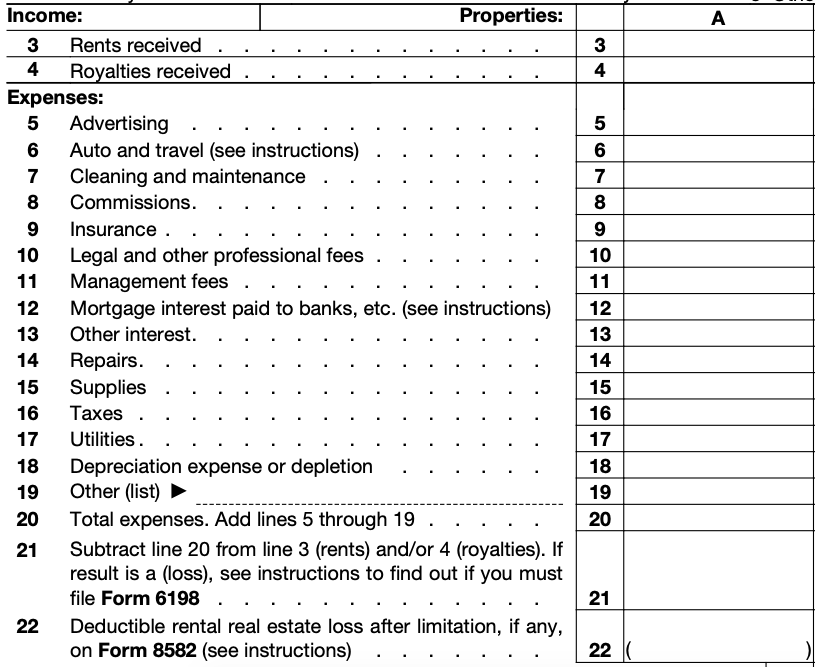
The categories are based on what’s going to be requested through Schedule E.

Then in January/February of the following year, I go through my filing cabinet and my email to ensure I’ve captured all of the expenses that I have receipts for, and vice versa to ensure that if I’ve recorded an expense, I have a receipt for it. Having already captured the expenses throughout the year serves as ‘checks and balances’ and doesn’t make the task feel too overwhelming.