House 5: Bought and Sold

This was a mess. I learned my lesson to research each property individually and not to make any assumptions. I also learned my lesson to hold true to our standards and expectations for a renter. We owned this house for a year and a half, but we learned a lot about tenants and the selling process. Hey, every struggle is a learning opportunity for next time, right!?


Mr. ODA showed me House 6 first (5 and 6 closed at the same time, and on my numbering list, this one came second… so try to overlook this awkward numbering!). I researched the area and the house’s history in detail, and I decided that it was worth pursuing. Very shortly after that, he approached me about House 5. The house was in better condition than House 6 and was literally only half a mile away. I assumed it was in the same neighborhood. I was wrong, and that’s where things went downhill fast.

LOAN

This house was so cheap that we needed an exception approved to get a loan. The purchase price was $60,000, which means a loan with 20% down is $48,000. The cutoff for even approving a loan with our regular lender is typically $50,000. Since we were below that threshold, we were ‘penalized’ by the rate.

I covered the closing snafu in the House 6 post, which also highlights the decision-making on the loan terms. Since this house was below that $50k threshold, our options were: 5.125% with a $200 credit or 5% with no credit. The higher interest rate would cost us an additional $1300 in interest, which isn’t offset by the $200 credit, so we chose the 5% rate. Hindsight: If we had known we would sell it just 18 months later, the credit would’ve been the better choice!

We purchased the house in July 2017. We immediately started aggressively paying towards the mortgage since it was the lowest balance and the highest interest rate.

We rented the house for $775, which far exceeded the 1% Rule.

WORK ON THE HOUSE

We did a lot of work in the yard. Here’s what the house looked like at some point before we owned it. It’s cute!

While it was under contract, the house sat vacant, so there were a lot of overgrown bushes, flowerbeds were filled with debris and no remnants of flowers having lived there, the lawn hadn’t been cut in a long time, and the tree in the front left had been removed at some point, leaving behind a mound of a stump and mulch that also collected debris. It’s a shame, and I kind of wish we had brought this little 2 bed/1 bath house back to life like it was in this picture. But I digress. Although this picture shows that the previous owner took care of the property, and that’s what attracted us to the purchase.

The floors were in immaculate shape, and the kitchen was quaint, but in decent shape. We purchased a new refrigerator before we could list for a tenant.

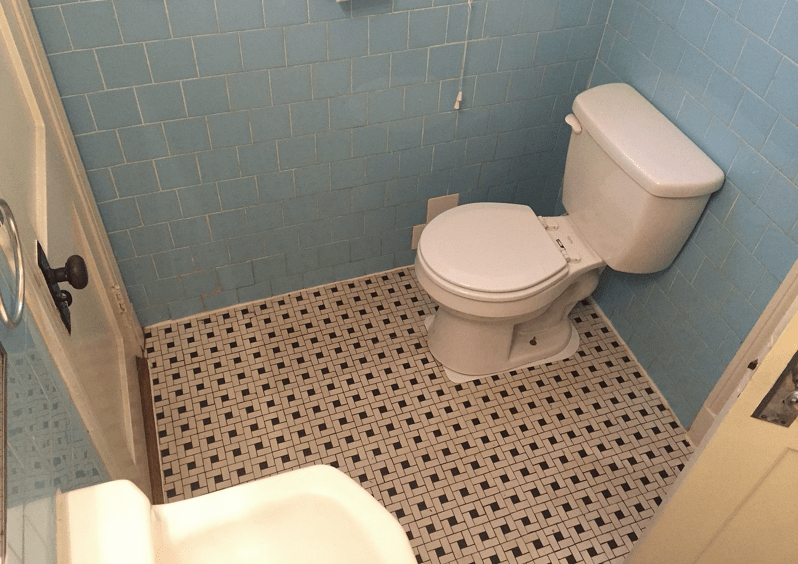
The bathroom needed a lot of help, but we didn’t want to overhaul it. The medicine cabinet wasn’t working anymore and the glass was cracked, so we wanted to replace it with just a mirror that covered the old medicine cabinet hole. Interestingly, we found a stash of 100s of razors behind it! (Apparently this is a thing from times gone by. You finish your blade and then you shove it behind the medicine cabinet for it to reside in the wall for all eternity.) We had several plumbing issues in the house. The drain pipe for the tub had multiple kinks in it, which caused the water to drain slowly and be more easily clogged. This would have been a major overhaul to get new plumbing installed in a way that was more direct.

The electric in the house was in need of work. We fixed quite a few electric-related-things while we owned it, but re-wiring the house was a major expense that would’ve come due in a few years.

TENANT ACQUISITION

The house was in great condition, had a big lot, was in a located close to the downtown area, and was on several bus routes (I even had a bus driver stop and ask me what the rent was on the house while I was working out front). It seemed like a great investment. We had several showings to qualified individuals….. who then went home, researched the house, and saw that it was in the highest crime area on Trulia’s crime map.

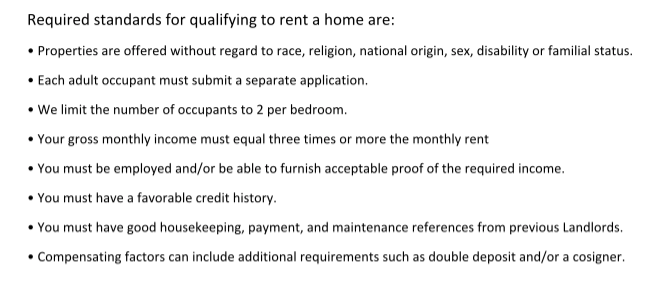
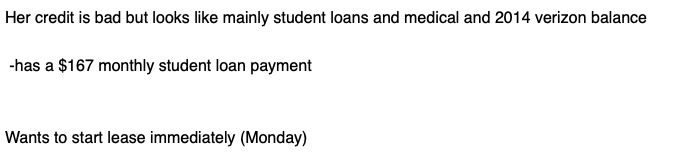
After sitting on the market for 5 weeks, we lowered our standards. There’s a reason you have standards as a landlord – it’s because if you select the right tenant, you’re saving yourself time, money, and headaches in the future. Here’s the email from our property manager. There are multiple red flags, and yet we gave her a chance.

The prospective tenant provided us with an employment verification letter showing that she had just started a new job, her most recent pay stub corroborating the employment verification letter, and wrote a decent introduction in her application. Between it being 5 weeks with no tenant and it now being mid-August (with it harder to rent in the Fall), we overlooked her credit score of FOUR HUNDRED AND FORTY EIGHT (448) and SEVEN (7) accounts sent to collections. I don’t recommend you do this. Oops.


EVICTION

This is the fun part to recount. It’s detailed, but I think it’s interesting.

RENT COLLECTION

She moved in August 2017. By December 2017, we already had enough issues that she wasn’t going to be trusted going forward. We’re very flexible landlords, and we’re happy to work with you on any issues as long as they’re communicated up front and timely (meaning, if we have to continuously reach out to you for rent, you’re not in a position to ask for favors).

We had allowed PayPal to be used to pay rent, but every month there was an issue. She either sent it in a way that incurred fees (after being told that she would be responsible for such fees) or it was sent in a manner that caused PayPal to hold the funds and not immediately release them. After December’s rent was late, the late fee wasn’t paid in full, and there were fees taken out by PayPal, we cut her off from electronic payments. Our property manager informed her that going forward, all rent had to be received by her office (either by mail or drop off) before the 5th.

Speaking of flexibilities – we noticed that she needed to send us rent based on each pay check, versus having all the rent money at the beginning of the month. She was paying us a late fee every month. Her rent was $775, and her late fee was $77.50. That meant every month, we were collecting $852.50, which really wasn’t necessary. We offered a change to her lease terms – rent was due on the 1st and 15th. As compensation on our part, rent would be increased to $800, split into two $400 payments. However, if rent was late, the late fee was now 10% of the late payment ($40) or up to $80 if she was late on both installments. She agreed to this, as it saved her money each month and set her up for success by being able to set up a system with each of her paychecks. We didn’t like that our relationship with the tenant had come to us hounding her over money, so we thought this was the best path forward for both sides of the party. Here’s the addendum to her lease.

And yet this didn’t change anything!! The addendum was signed at the end of January 2018. She paid February’s 1st $400 late. Then she didn’t pay February’s 2nd $400, and we had to reach out to her several times before even getting a response… after she also didn’t pay March’s 1st $400.

Our property manager filed unlawful detainer (eviction) with the court, and that got the tenant’s attention. She then had to pay the balance due, as well as the court filing fee, before March 30th (court appearance date) to dismiss the court action. She showed up to court with the cash to pay and then everyone just went home. You can’t evict someone who has paid in full, even if the process of collecting rent was unnecessarily burdensome.

And then came April. There was another story about a medical emergency and a new job on the books. We had agreed to a new one-time schedule for April’s rent payment, and she missed those deadlines and was incommunicado. We sent her another default notice on April 25. Note that this medical emergency was for her “husband.” This is the first that she had implicated herself that someone may be living in the house other than her and her son. She paid her balance owed on May 4th.

On May 8, she was given another eviction warning notice for lack of May rent (the 1st $400) and gave no response to requests for information on when to expect rent. After continued lack of payment after that notice, she was served with another eviction notice. On May 17, she was given 30-days notice to vacate the premises by June 17, 2018 at 5:00 pm. But then she paid in full and on time. We then changed her lease terms to state she was on a month-to-month basis and she would be granted 30 days notice when we (or she) decided to terminate the lease agreement. It was signed on July 16.

Guess what? She didn’t pay September’s rent. At this time, we also addressed her husband.

She was married when she applied, but we didn’t know. Just now as I was looking back through our files to write this post, I saw that her pay stub she used for employment verification said that she was filing her taxes as married. I hadn’t seen that before. In all our visits to the house, there were always other people there. There was one man that seemed to be around 90% of the time. We overlooked it, but our lease did stipulate that anyone who stayed for more than 2 weeks was required to pass a background check and be on the lease. I strongly suspect that this individual was not going to pass a background check, which is why it was never disclosed to us that she was married and another adult was living there. Our property manager informed her that only she and her son were on the lease, and that if anyone else was living there, they had to be on the lease. She asked if we were referring to her mother-in-law visiting, our property manager said that it appeared to be her husband was living there, and then she ignored us.

We gave her our 30 days notice on October 5 to vacate, meaning she had to be out by November 5. Our property manager reached out to her on October 26 to see if she would be out earlier and set a time for key pick up. The tenant nonchalantly stated she wouldn’t be able to make it out by the 5th and she’ll be out by the 9th. Umm, excuse me, ma’am, but that’s not how this works. We held strong to the 5th and she lost it. Our property manager said that her lease is over on the 5th, and if she was not gone by then, the court fees would be her responsibility for us to get the court and local police department involved for her removal. She got angry and claimed that we didn’t handle the rental well at all, that we couldn’t charge her any court fees, and that she should charge us for not being able to use her tub because it was clogged (guess what on this one? The plumber removed things like a dental floss pick from the drain, immediately making it her fault (and at her cost) for said clog). She then said: “Lets just hope your (sic) as speedy with my deposit as you all were with terminating the lease.” I laughed out loud on this one just now. We should have terminated her lease an entire year before this discussion happened, but we kept working with her! Hysterical! Gosh, and to think this wasn’t our worst eviction process (more to come :)).

SELLING

A friend-of-a-friend was attempting to purchase a house in the same neighborhood as this house, and they ran into multiple issues causing them to walk away from other deals. Mr. ODA approached him with an opportunity to sell this house, which had similar specs to the one that they were pursuing. The buyer spoke to his wife and father about the deal and agreed to move forward. Of course, this deal was not easy.

The contract was ratified on October 31, 2018. We didn’t close until January 8, 2019. Our typical close time on our purchases is 4 weeks. We’ve done faster, and we may have done a bit longer if the time of month lined up better for our finances, but over 2 months was horrendous. Since our tenant was moving out on 11/5, and the closing was expected to be no later than November 30th, we didn’t pursue finding a tenant.

The appraisal was late being ordered, which was somehow allowable. Then it came in at the beginning of December at $65,000; our contract was for $68,000. We split the difference ($1000 from the buyer, $1000 from the seller, $1000 from the agent who was dual representing).

On December 18, our Realtor finally pushed back on the buyer’s side of the transaction to get things done. But it was Christmas time now. With so many offices closing for the end of the year, we weren’t able to get a closing date until the first week of January. The buyers were signing paperwork from Pennsylvania, which caused more delays because of having to send the paperwork back and forth for everyone’s signatures.

We sold in January 2019 for $67,000, after having purchased it for $60k just 18 months earlier. While this seems like a great deal, it’s not an automatic $7k in our pockets. You need to account for our closing costs from the purchase and sale (about $6,500), loss of rent for two months while trying to close the sale and the 6 weeks of no tenant when we purchased it, utility costs associated with vacant times, and costs to fix things around the house during our ownership. However, during that time, we had a tenant paying our mortgage (covering the loan interest and paying down the principal), and we were collecting more rent than projected because of her continued late payments.

1031 EXCHANGE

We made the decision not to pursue a 1031 exchange on this house. A 1031 continues to defer the depreciation to the next property, and it allows capital gains to be deferred. Based on current tax law, it can be done infinite times. However, there are extra lawyers and fees that come into play, so it becomes worth it when you have big dollars at stake, and that you have another property to purchase quite quickly after selling the first one.

The appreciation on the house was minimal given that it had only been 18 months since purchase, we had two sets of closing costs to add to the cost basis, and we hadn’t earmarked a place for that money to go upon selling. Plus, the cost of an intermediary would continue to eat into the “profit” versus tax paid, so we just went ahead and planned to pay capital gains taxes on it. Unfortunately, since we had depreciated the structure and the fridge over the prior 18 months, that paper money had to be brought back into the fold when calculating our taxes the following April. That’s several thousands of hidden money that is easy to forget about.

Depreciation is a great tax break when you own the property. The IRS assumes the value of your asset is being reduced by wear and tear and father time. This is true. It’s why if a landlord neglects the property and isn’t active with maintenance, renovations, and other replacements, the property will turn into a trash-heap in time. However, when you sell the property, you show the IRS that it in fact did not do that. If someone is willing to buy my property for more than I bought it for, then it obviously didn’t depreciate to a lesser value. I have to pay the IRS back for the depreciation assumptions that I was allowed to make over the time I owned it, plus pay the tax on the actual profits. Bummer, but logical.


In summary, we bought a cheap house and got a poor tenant. We had a TON of headaches with that tenant. We had to do a few house/yard projects over the ownership life of the property, but nothing worrisome and not already built into our numbers. Somehow, we made it work that eventually the tenant always paid up and then some (late fees). We made mistakes, we learned lessons. We figured out a set of streets to avoid for future purchases, learned how to sell an investment, and learned how to file taxes on an investment property sale. The story is fun to look back on. I’m glad we experienced what we did. But I don’t want to do it again.

House 6: Easy Peasy

This is probably our easiest house to own; the closing process was the hardest part here. We closed on House 5 & 6 at the same time, so I’ll cover the closing story here because House 5 has a lot else to be said when I write out that whole saga.

TENANT

This property has a property manager on it (10% monthly rent). She processed a couple of applications at the onset, and it took 2 weeks to find the tenant. The lease started on August 18, 2017, and that’s been the same tenant in the house to date.

Rent is $850 per month. She pays on time, and it’s usually early. She just asked about her renewal, and we decided to keep her rent at the same price, even though it’s the start of her 5th lease term. Our cash-on-cash return was ahead for the last 4 years, so even though our taxes have increased by $400 since we purchased the property, we decided it was best to keep the tenant than to get a few more dollars per month.

She asked if she could paint the kitchen cabinets that were definitely old, and we figured they couldn’t be made any worse. When a tenant wants to make your house their home, it’s most often is a sign they make taking care of the property their priority, and that they want to stick around for a while.

We had to treat the house for ants over this last year, but the only real issue we’ve had on this house is that the main sewer line had to be replaced due to corrosion and tree stump intrusion into the pipe. The poor tenant had her toilets backing up into her house. It was $4,000 to replace the line from the street to the house. Honestly, I expected it to be more.

LOAN DECISION

Option 1 – 20% down payment – conventional 30 year fixed at 4.95% with 0 points
Option 2 – 25% down payment – conventional 30 year fixed at 4.7% with 0 points

We weighed these two options for our loan (purchase price of $66,000). The difference is an increase of $3,300 in down payment to save $5,700 worth of interest over the life of the loan. Being that we closed on several houses in a short period of time, we chose Option 1. Having cash for the down payments and closing costs of the other houses was more important than the marginal savings in interest of putting 5% more down.

We’ve been paying down this mortgage. At the time of our decision on which house to pay extra principal towards, this was the smallest loan amount with a relatively high interest rate. We started paying extra towards this mortgage in October 2020. To date, we’ve paid an additional $35,500 towards principal, leaving a balance of just under $14k.

CLOSING

During the Spring and Summer of 2017, we saw a lot of houses. We also made offers on a lot of houses that didn’t end up going anywhere, either because there was no consensus on a purchase price or because the home inspection was unsavory. We closed on House 4 at the end of June, walked away from a deal on one house due to a home inspection issue, and then closings on House 5 & 6 got lost along the way by the attorney’s secretary. We worked with a specific attorney who we had a great relationship with, and who eventually helped us with a difficult purchase (see the story for House 8), but this was a hiccup.

The attorney’s office let us know they were unaware of these two closings around June 20th (in reality, they just missed the ‘all clear’ to move forward with a title search, but they were definitely made aware of them), which left us scrambling. Our rate lock expired July 7, and the secretary responsible for filing all the paperwork was taking her vacation the week of July 2. Since she was taking the week off, our attorney scheduled a surgery of his for the same time, so the office was closed. She said she would find a way to make it work, but then we didn’t hear from her and had to reach out to the attorney himself. Here’s that email, outlining all the details.

It wasn’t until June 30th that our attorney confirmed he was able to hand off our closing to another attorney’s office. We had a few questions about their fees, since we explicitly stated that we didn’t want it to cost us more because we had to change our closing location, and then the secretary there got defensive and gave us an attitude. I was quick to call her on it, explaining that we just wanted to better understand the break down of what they put on our closing disclosure. She backed down, and then we had an awkward interaction a few days later when we showed up in her office to sign the paperwork. It’s interesting how people don’t understand that writing in capital letters can come across as rude. Turns out this other firm was an old law school friend of the attorney we normally use, and they worked out a favor among themselves on the fees to ensure they didn’t lose any future business from us.

At the end of the day, we closed on the houses on time and without costing us anything extra, but it wasn’t a stress-free path to get there.


Luckily, this house has been easy to manage and the tenant has worked out perfectly. Our rent at $850 far exceeds the 1% Rule; with a purchase price of $66,000, our monthly rent goal would be $660. Tax assessments have recently risen given that the local market has appreciated substantially, so we will consider a rent increase in the future. However, at this time, having a long-term tenant on a house that has hardly any issues is more important than risking a rent increase and having her leave.

Mortgage Evaluations

Rate Sheet Options from your Lender

When reaching out to a loan officer, there are a lot of options to choose from. I’m hoping to break down the decision-making here. I’ll share how we ended up with several different options, too.

Basically, it boils down to: 

  • Put enough down to avoid paying Private Mortgage Insurance (PMI)
  • Don’t pay more than 20% unless there’s a decent incentive. 
  • Don’t pick a loan term shorter than 30 years unless there’s a decent incentive. 
  • Carefully evaluate any Adjustable Rate Mortgages (ARMs).

PMI

I broke down PMI in a previous post: PMI – Private Mortgage Insurance. We suggest doing whatever you can to meet the requirements to avoid paying this. The cost of PMI can be a couple hundred dollars per month, which is money that can be put towards the principal balance of your loan or other bills, rather than in the bank’s pockets. There are also hoops to jump through to remove PMI early, which may include paying for another appraisal on the house ($400-$700!).


LOAN TERMS

A conventional loan will likely require 20% to avoid paying PMI. There are some loan options out there that may allow a smaller down payment without a ‘penalty’ (e.g., PMI, higher interest rate), but 20% is the standard, and is usually required when purchasing an investment property.

There may be an option to put down more than 20% or you may think you can afford to pay a higher mortgage each month, so you’re interested in a shorter loan term. Unless there’s an incentive (e.g., lower interest rate, better closing costs), stick with the bare minimum to get the loan.

If there is an incentive, you’ll need analyze the math and your goals to determine if committing extra money to a higher down payment or a larger monthly payment is worth it. If you have extra cash each month, you can pay more towards your principal rather than pigeon holing yourself into a higher monthly payment. Plus, if you have more cash liquid, you may be able to purchase another rental property, which will increase your monthly cash flow.

While we evaluate the loan terms on every house purchase, I’ll share the details of the two most “unconventional” options we chose. Two things to note: 1) lenders add a ‘surcharge’ to the rate for it being an investment property, typically around 0.75%, which means the rates aren’t going to be the great, super-low, rates being advertised; and 2) the term “point” means a fee of 1% of the loan amount.

HOUSE #2

For House #2 (purchased in 2016), we were informed that if we put 20% down instead of 25%, the rate would increase 0.25% on average. If we assume a 30 year conventional loan, 20% down at 4.125% equates to about $69,700 paid in interest (assuming no additional principal payments); 25% down at 3.875% equates to about $60,800 paid in interest. By putting an additional $5,850 as part of our down payment, we saved about $9,000 in interest over the life of the loan.

Once we determined that we’ll put 25% down, we then had to figure out the appropriate loan length. On this particular offer, 30 year amortization wasn’t an option for us because we would have had to pay a point to get a competitive rate. We chose a 20 year amortization because the house already came with a well qualified tenant, we didn’t expect a lot of maintenance and repair costs due to the house’s age, and we didn’t have an immediate need for a higher monthly cash flow based on our place in life at the time.

While our long term goal was to have rental property cash flow replace our W2 income, this house was early in our purchasing. At the time, we were focused more on paying off House #1 (higher rate and a balloon payment after 5 years). Frankly, we didn’t truly understand the power of real estate investing at this time, and didn’t know how much it would accelerate the timeline for us to meet our goals. By decreasing our loan length, we increased our monthly payment, but also lowered the total interest paid over the loan’s life by over $22k. Since more of our monthly payment is going towards principal reduction than had it been a 30 year amortization, this loan isn’t on our priority list to pay off early.

HOUSE #3

For House #3, we evaluated the rate sheet for the loan term, interest rate, and down payment percentage again. This house was purchased a few months after House #2, so those rate decisions were fresh on our minds. We were quoted several options: 1) 20% down at 4.25% for 20 or 30 years, 2) 25% down at 3.75% for 20 or 30 years, or 3) 25% down at 3.25% with 0.5% points for 15 years.

As you can see, there’s no incentive to pick the 20-year term because it’s the same rate as a 30-year term. If we have additional cash, we can make a principal-only payments against the 30-year term rather than unnecessarily tying up our money.

At first, we thought paying points was an absolute ‘no.’ However, points aren’t a bad thing. Paying down your rate up front can save you an appreciable amount in interest. Plus, points are tax deductible.

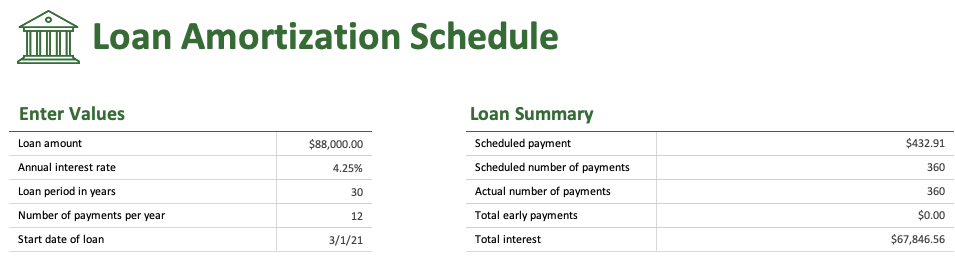
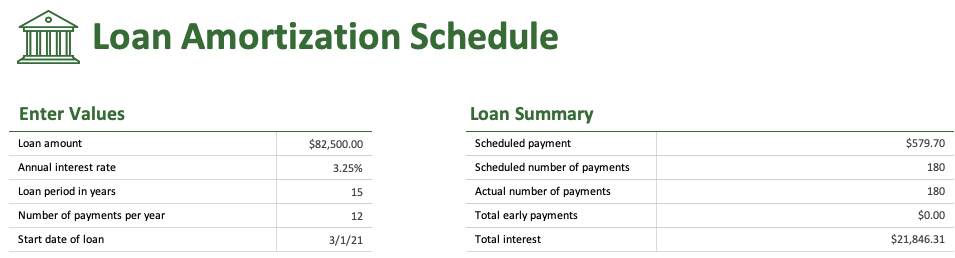
Now for the breakdown of each options. Let’s say the house purchase was $110,000 (because it wasn’t an exact number, and it’ll just be easier to use a ‘clean’ number like this). Microsoft Excel has an amortization template where you can plug in the loan terms and see the entire amortization schedule. 

Option 1: 20% down payment equates to a loan amount of $88,000; the annual interest rate is 4.25%; the loan is for 30 years, with 12 payments per year. If we make no additional payments, this totals about $67,800 worth of interest paid over the life of the loan.


Option 2: 25% down payment equates to a loan amount of $82,500 at 3.75%. If we make no additional payments, this totals $55k worth of interest paid over the life of the loan. This requires an additional $5,500 brought to the closing table, but saves almost $13k in interest. It also decreases our monthly principal and interest payment (i.e., not including escrow) from Option 1 by $50.


Option 3: 25% down payment, 3.25% interest, and 15 years (instead of 30 years) equates to just under $22k paid in interest. To obtain the 3.25% rate, it required “half a point.” If a point is 1% of the loan amount, that would be 1% of $82,500. This rate only required 0.5%, so that meant paying $412.50 as part of closing costs along with the additional $5,500 of down payment required for 25%. However, the shorter loan length means that monthly payment is increased (between Option 2 and Option 3, the difference is $197.63).

For about $6k, we pay a higher monthly payment, but we also save a significant amount of interest over the life of the loan. The short loan term of 15 years means this one is also not on our radar to pay off while we focus on paying down other, higher interest and higher balanced, mortgages. In this case, the benefits of the big picture math outweighed the increase in monthly payment.

We are five years in on this mortgage and are already seeing significant reduction in the outstanding principal due to the amortization schedule becoming favorable more quickly. In 10 short years more, our house will be fully paid for, through rent collection, without a single dollar of extra principal payments from our other financials. What a great feeling.


ADJUSTABLE RATE MORTGAGES (ARMs)

An adjustable rate mortgage can be beneficial depending on the terms and how long you expect to own the house. For us, we expect to hold our investment properties for a long time, so it wasn’t worth the risk of an ARM. Many times lenders won’t even offer an ARM on an investment. However, when we purchased our DC suburb home, we knew we didn’t expect to be there for more than 5 years, so we chose a 5 year ARM.

After a positive experience with that decision, we also chose an ARM on our second primary residence. We chose a 5 year ARM, even though we expected to be there longer than 5 years. We figured we would either accept the new rate, if there was one, at the end of the 5th year, or we would refinance when necessary. As a result, Mr. ODA monitored rates and refinance options over the last year or so. Unexpectedly, we sold that house 3.5 months shy of the end of the initial ARM term so we didn’t have to do anything.

I break down all the details of an ARM and our decision making in a recent post.


SUMMARY

When I reach out to my lender to ask what the rates of the day are and begin the process of locking a rate on a new loan, I ask for options. These options are in the form of a “rate sheet.” When you ‘lock’ a rate, you’re actually locking the ‘rate sheet,’ not the individual decisions of loan length and percent down. For every house, we evaluate the rate savings that can come from doing something less “conventional” than a 30-year fixed at 20% down mortgage. Our decision is based on what’s best for our goals and our cash in-hand.

As shown above, in our early decisions, we favored shorter loan terms for rate savings. but since House #3’s purchase, we noticed how much more we cared about low monthly payments and low down payments to allow us to buy more properties along the way. Every investment property loan since House #3 has been the ‘standard’ 30-year fixed at 20% down. Because of this perspective shift, we were able to buy six properties in 2017, which gives us about $2,000 in monthly cash flow that we can then use to pay down mortgages.

House 3: Quick story

Quick post about our 3rd investment property purchase. After we closed on House #2, the seller said he was interested in liquidating the house next door, which was a mirror image of the house we just purchased. The story here is how the offer was made.

We agreed to purchase for the same bottom line as House 2. There was some confusion about what “bottom line” actually meant, where we meant it should account for our side of the transaction not using a Realtor. It took us over a month to go through the financials and have an agreed upon purchase price.

We purchased House 2 for $117k with $2000 back in closing costs. Our first offer on House 3 was $113,400. The selling agent countered that he came up with 117,000-2,000-1,170 (commission to our agent on that house) = $113,830, but he had to forward the offer to the seller. Then we received this from the seller:

The selling agent agreed that Mr. ODA’s math was closer to accurate than the sellers, and that if it came down to a few hundred dollars difference, he was willing to eat that from his commission since he didn’t have to pay to take pictures and list the house.

And so here’s the final response from Mr. ODA, and a view into how his brain works. He never fails when it’s math.

He paid 4% commissions to agents on the last purchase. That 4% was derived from a $117k sales price, which equals $4680. That $4680 gets subtracted from my funds at sale, or $115k. $115,000-$4,680 = $110,320. Thus his “net” that he “walked away with.” If that “net” were to be matched on this price, you would take $110,320 and divide it by 0.97 which would equal $113731. As a check, if you take 3% of $113731 it is $3,411. Subtract $113,731 from $3,411 and you get $110,320 – the same ‘take’ as he got from 1718. An arbitrary reduction in price of just Krissy’s portion of the commission is incomplete, as your 3% is no longer equal in each transaction. The way your math works, his walk away is $113830 less the 3% = $110,415. That is more than he took from 1718. Since I know that Mike is willing to “walk away with” $110k, I offered a purchase price that, when reduced by your 3% commission, comes to $2 shy of $110,000, his stated in writing goal for this transaction. 

We paid $113,732 for the house. 🙂

TENANTS

This house has had the same tenants since we purchased it in 2016. We raised their rent by $50 in 2019, and we expect another $50 increase upon their renewal in a few months. The house has appreciated greatly since we purchased it, which has caused our taxes to increase from $750 twice a year to now $870 twice a year), which we need to account for in the rental income of the property.

They take good care of the house, and they actually border on being too cautious about maintenance needs. We’ve had several issues with the plumbing, which has culminated in it being their children putting things where they shouldn’t be, which means the cost is on the tenant because it’s not routine maintenance.

The tenant replaced a stove and refrigerator, at their expense and with the understanding that either they leave those behind or replace them with reasonable, working appliance. For the stove, they sought approval from us to upgrade their stove to something that’s more conducive to his culinary expertise. We told them that they could replace the stove there, but that a working stove must be there upon their vacating the unit. About a year ago, we were there for a maintenance call and noticed an upgraded refrigerator, which they didn’t tell us about. We again told them that since we provided a refrigerator with the unit that a working one must be put in its place when they vacate.

This is the house that we installed a backsplash in the kitchen. The tenant said that he cooks a lot and there’s been grease splatter that’s been hard to keep off the flat-painted wall. We agreed that a backsplash is better for the longevity of the house. There were several options available, so we even let the tenant pick from a few samples. We did the peel and stick style, so we saved on cost and labor, but accomplished the goal of an easy-to-clean surface.

Twice, they’ve reached out to us about a rent-to-own offer. We aren’t interested in selling because our financial goals require a month-to-month cash flow, this house is newer and still in good condition, and we have a low rate mortgage on it; but knowing how much the house has appreciated, we may be interested in a 1031 exchange option if the offer is right.

House 2: The Exclusivity Agreement

House 1 was purchased from a family member because we saw an opportunity when they were getting ready to sell their townhome. House 2 was purchased because we were looking for a way to make our profit from the sale of our first home to get to work for us. While in the process of purchasing House 2, the seller said he was interested in liquidating the house next door, which was a mirror image of House 2, and so that became House 3. Both House 2 and House 3 came with tenants, which was a big advantage, but delayed a few lessons in rentals for us.

After we sold our house outside of DC, we moved just outside of Richmond, VA. We spent a few months looking at the neighborhoods and analyzed the markets available in Richmond. I was more interested in the college area, where it’s a market I knew well, having been a college kid who rented in an old house that was sectioned into apartments. Mr. ODA was more ambitious (in my opinion), looking into neighborhoods that families would rent in. Many investors are looking to rent in areas of Richmond that fit the quintessential Richmond mold (e.g., walkability to restaurants and shops, bike routes). However, these houses don’t come close to hitting the 1% Rule.

We’ve purchased several houses on the east side of town, and they’ve worked out very well and most don’t have turnover. The value of House 2 since we purchased it has increased by about $70k as the neighborhoods in the area continue to decrease crime and increase value. Both houses are about 13 years old, 1200 square feet, and have 3 bedrooms and 2 baths. All of the rooms except bathrooms and kitchen are carpeted, which is something we’ve since tried to stay away from.

THE EXCLUSIVITY AGREEMENT

After we saw House 2 and wanted to make an offer, our Realtor relationship went downhill. We had a Realtor for our home purchase when we moved to the area, and we continued the relationship to have access to the MLS. After we purchased our home and started looking for rentals, we soon learned that our Realtor 1) had an agenda to get the most commission, regardless of the best deal or our interests, and 2) kept pushing areas she knew versus areas we were interested in. We had made it known that we wanted to buy several properties, and I believe by the time we wanted to make an offer on a house, she realized we weren’t looking to further this relationship after this deal. Since she had shown us a few houses, we expected to see this deal through with her. That’s when the straw broke the camel’s back. We received the offer to review, and it came with an exclusivity agreement.

An exclusivity agreement is a contract established by the Realtor to protect their interests. If the client signs it, then it means that the client is committed to that agent for the terms in the agreement (e.g., a single purchase, a period of time). We hadn’t needed one in Fairfax, and the one we had for our personal home contract covered a month’s time. When we received the contract for House 2, the exclusivity terms were until October 4, 2016, from the date of the contract, which was May 4, 2016. We requested the date be changed to match the “close no later than” terms in the contract, which was June 17. That’s when the bs-ing commenced. I’m sure the average buyer wouldn’t have noticed nor cared. We saw right through it, and she kept digging in deeper with holes in her story and guilt.

First, she claimed that she made it 6 months (although it was 5 months) so that it gets through closing and we didn’t have to sign again. We countered with three pieces of logic: 1) the field can accept an address, so change it to the house’s address to cover us for the entire time it took us to get to closing, whenever that may be; 2) the exclusivity period on our personal residence’s contract expired long before we actually closed (because it was a new build, and the contract was signed before construction began), but we never had to re-sign an agreement; and 3) we never experienced a 6-month closing on a routine purchase.

Instead of addressing that the field could accept the house’s details rather than a period of time, she said: I’m committed to helping you guys look for houses and make offers, are you committed to working with me? Red flag. When we said we wanted it changed to the house address, and that we didn’t mind signing on for each property we made an offer on, she furthered the guilt with: We have know each other for almost a year and I honestly didn’t think it would be such an issue. If you are not willing to sign it I am not going to be able to work with you. If it’s not supposed to be a big deal for us, why is it a big deal for you/your broker?

One of the first things we learned in the real estate market was to not sign an exclusivity agreement. It eliminates your rights as a buyer and ties you unnecessarily to an agent. On the Realtor’s side, I understand that a lot of time and effort goes into working with clients, and there is a possibility that one Realtor shows a client a house, but that client uses a different Realtor to sign the contract, which causes the agent who showed the property to lose the commission. However, I believe that if there’s a good relationship with the Realtor and client, it shouldn’t need to be in writing that they’re committed to each other. I also don’t believe that it’s routine that a Realtor shows several houses to a client, and then that client finds someone else to make an offer. I was also surprised that it’s at the contract stage in the process, and not at the showings stage.

When she wouldn’t write the offer without us signing an unnecessarily long exclusivity agreement (again, we were willing to sign it as associated with this offer/property), we called our old Realtor and asked if she could write the offer for us even though she didn’t cover that area. (An Agent’s license covers the whole state, but typically their access to the MLS is confined to local metro areas unless they want to pay for other regions.) She wrote the offer for us. She also introduced us to a loan officer who we have used for every property purchase since then, and recommended to others.

EXPENSES

This house is relatively new, so we haven’t had any major expenses. We had a couple of HVAC service calls, one was a legitimate concern and one was a misunderstanding by the tenant on how it works in extreme temperatures. What we haven’t paid for in physical house repairs, we’ve made up with in learning new things about tenants.

TENANTS

We had a tenant move in right before we closed on the house. She had gone through a divorce and was living on her own. At the end of the year, she got back together with her ex-husband and moved out. We touched up the paint, cleaned the carpet, cleaned the kitchen and bathrooms, and then listed the house for rent. We chose two ladies, one of which had a criminal record for forgery a few years prior. Other than that, they were the best qualified financially.

Our only issue in the first year was that they had a ‘friend’ look at our HVAC unit. We told them that it’s not their property, and had anything been wrong, it would have been on them to fix because we didn’t authorize tinkering with our very-expensive property. The issue was that it was 100 degrees outside, they had the thermostat set at 60, and it wasn’t getting to that temperature. That’s not surprising. Our technician went out, checked the unit, and explained to them that when it’s that hot, you can’t expect it to get to such a different temperature in the house. He suggested using fans.

They moved in June 1, 2017 and one of the ladies is still there.

At the end of their second year, we increased their rent by $50/month to $1100. This is still under market value for the house, but not having to turnover the unit was more important than a drastic increase in rental income.

In February 2020, we learned a new aspect of the law – domestic disputes. One of the ladies reached out to us and requested to be released from the lease because she had a restraining order filed on her roommate. We researched the requirements associated with restraining orders (because the two she gave us were expired) and then her rights as it related to being a tenant. She had paid her portion of the rent each month, so we weren’t aware of issues. We released her from any responsibility immediately and notified the roommate. Per Virginia Code, the remaining tenant is responsible for the entirety of the lease from then-on. We gave her the opportunity to vacate the property within 30 days if she could not pay the full lease amount going forward, but she chose to stay on the property.

The world shut down a month later. Other than an issue here and there with our other properties, this one has been the most affected. She doesn’t communicate up front anymore when she won’t be able to have rent on time. We received a letter from her stating that she had been furloughed, but things in the letter didn’t look professional and piqued my interest (recall the forgery charge). I called her employer who informed me that her hours were cut, but she was not furloughed; the woman who answered the phone sounded exasperated and indicated she had explained this to our tenant several times. I informed the tenant that I had done an employment verification and that we could be flexible, but rent was still expected. Then a few months later, after she didn’t pay rent or tell us what was happening, she claimed she couldn’t pay rent because of an issue with a check showing up. We requested her employment information again, and I verified she was fully employed. When I asked her what was going on, she stated that she wasn’t required to tell me where her rent was coming from and whether she was employed didn’t mean she could pay rent. Fun.

Then, a few months later again, I received an email from the Commonwealth of Virginia asking me for my tax identification number and other information because our tenant had applied for rent assistance. I was confused because the rent assistance program was for unpaid rent balances, and she was fully paid. I watched the rent assistance program training and attempted an application myself so that I could see how the process works before I questioned anything more. I verified that the program was indeed for past due rents and couldn’t be requested for future rent. I contacted the State office to gather more information, and the tenant had submitted that she didn’t pay January 2021’s rent, which she had. The State made a note in her file. I informed the tenant that the program was for past due rents, which she had none, and that she was not qualified for such a program, but we were willing to work with her if she had any problems paying rent timely in the future.

Each time she’s not paid full rent by the 5th of the month, she has paid rent in full before the end of the month. After she took full responsibility of the property’s rent and lease, we had her sign a new lease with just her name. That lease ends on June 30 this year, and we’re currently decided whether we’ll offer her another year at an increased rate (last increase was 2 years ago) or we’ll request her to vacate the property.

2020’s Expenses and Activity

When people talk about having rental properties, usually the first thing we hear is, “I don’t want to hear about a clogged toilet at midnight.” Does your toilet clog at midnight? No. So why do people think that tenants have issues that you wouldn’t typically see in your own house? A tenant can’t expect service faster than you’d get on your own property.

Even when there’s a month that requires a lot of our attention to be on rental properties, it’s still always worth the income/expense ratio. 2020 was a year of big expenses. However, I kept the perspective that we had several properties that we didn’t even hear from, and this was just one year of 4 so far.

Here’s a look back at what happened with our rental properties in 2020.


House #7 required a roof replacement. We have dealt with leaks since we purchased the house, and the time finally came that the replacement was more cost effective. This house also required HVAC repairs and plumbing replacement. Since we purchased the house, we had issues with the upstairs bathroom sink not draining properly. After several attempts to unclog it, our plumber finally made the call – it wasn’t a matter of cleaning a clog, it was time to replace corroded copper pipes… from the second floor to the crawl space. And so we did that. We then had to pay someone else to repair the drywall. All together, this house cost us $7,600. However, about $4k of that was the roof, which has to be depreciated over 27.5 years, so we only claim about $75 of that cost this year.

House #1’s roof has also troubled us from the start, but it’s under HOA control. We had a leak that was bad enough to require the HOA’s attention. It was a multi-week process to get them to even acknowledge me, and I have no intention to ever own a townhome again. I like having more control over my property than being in a position to hound an HOA to address a water-related issue as I watch more rain in the forecast. In the end, they repaired it, but we’re responsible for the drywall repair, which was $76.

House #6 required the main sewer line from the street to the house to be replaced, which was $4k including the scoping trip to put a camera in the pipe and see how deteriorated it was.

We had quite a few HVAC issues this year, after only having 1 issue on all our houses (well 2, but that second one was someone driving over our unit and insurance covered it). We had House #3 require a new fan, which was $635. House #9 had an entire HVAC replacement at $5k, depreciated 27.5 years. House #12 required HVAC work at $500.

We had to replace a dishwasher, stove, washing machine, and refrigerator among the properties as well. These were the major purchases and don’t account for several smaller plumber and electrician trips that were needed among the properties.


On the positive side of things, we paid off one loan, paid $23,500 paid towards another, and refinanced a property (reducing our monthly payment by $104).


Of 12 properties, we had to turnover 3. Turnover is the most time consuming to us personally because it requires our attention to touch up paint, fix things, order appliances, and coordinate any other maintenance issues. Then we need to handle listing the property and showing it when we don’t have a property manager, which was the case for 2 of our properties.

In March, we had the tenant at House #11 request a renewal of their lease. A couple of weeks after signing the renewal, they requested to be released from the lease because they were moving to another state. We worked with them, for a fee, to be released from the lease, and they vacated the house as of April 30. I had to repaint, clean the bathrooms and kitchen, fix a few things, and clean the carpet (which was only a year old at this point). We listed the house, had several inquiries, and had it rented on May 7.

In September, we had the tenant at House #7 request to be released from her lease because she was buying a house to take advantage of low interest rates. The Fall isn’t a good time to be listed a house for rent, but it’s hard to not help someone help themselves like that! We agreed to release her from the lease for 2 months worth of rent. Shortly after that agreement, an old tenant of ours reached out asking if we had something coming available in October or November, and this house fit her request perfectly. I met her to show her the house and had a November 1st lease signed the next week. We asked the new tenant if she could move out before October 31st, and we would refund her for the days she left early. We spent two days touching up paint, fixing an old water leak patch (the roof had since been replaced by the drywall work in the laundry room hadn’t been addressed), and cleaning the house. Our paint touch up was far from perfect, but we didn’t have time to repaint the whole house. I offered the new tenant an incentive of $50 per room and $25 per paint can if she wanted to paint herself, and she actually did 3 rooms so far.

The final house that had turnover is managed by a property manager. Our house was the first the tenants had rented, and they didn’t quite understand all the details of having to give notice that they were leaving. We worked with them while they went back and forth deciding if they wanted to renew or leave. While our lease stipulates that we require 60 days notice if they plan to leave at the end of the lease, we wouldn’t typically post the house for rent more than 3 weeks out. They eventually decided they wanted to leave the house, but then at the last minute asked for more time. We had a lease lined up for two weeks after they were going to vacate, so we were able to give them an extra 10 days in the house. Once they left, we had the carpet and house professional cleaned, and I touched up some paint. The property manager handled the listing, showing, and background checks. The new tenants haven’t asked for anything since they moved in back in July.


We were not heavily impacted by the pandemic. We hadn’t realized it until the Spring, but nearly all our tenants work in health care, which is just an interesting coincidence. During 2020, we only had one tenant that we had to constantly keep up with regarding her employment and ability to pay rent. She didn’t always pay on time, but we would have all the month’s rent before the end of the month each time. Then we had a tenant here or there that needed another week or two to pay rent in full, which we had no problem allowing. We didn’t collect any late fees in 2020.


While a year of several big expenses can be overwhelming, it’s helpful to know that this has not been our norm and the issues were centralized to a few houses. It also helps that 5 of our houses have long term renters (renewed more than once). Having a tenant renew their lease saves us time and money.

Doing Your Own Taxes: Set Yourself Up for Success

I manage all the financials for my family. Mr. ODA makes the maneuvers, and I record them. Excel is where our organization lives and dies. Sure, I have a degree in Finance and Information Technology Management (i.e., Excel), but it doesn’t need to be complicated or difficult to make tax prep easy for you.

This level of organization allows us to do our own taxes. After the first year of purchasing rental properties, we thought we’d have to hire someone to do our taxes because it would be complicated. It’s not any different than filing your own personal taxes. The software systems available online walk you through the entire process. Each property’s income and expenses have to be entered separately, which is time consuming if you have several properties, but it isn’t difficult.

The most important thing to be ready for your taxes is to make it a whole year activity. If you record income and expenses as they occur, it’s less of a hurdle when the year is over. By recording the activity all year, it then becomes a verification process when the year is over, thereby reducing the possibility of missing something or recording something wrong.

At the beginning of each year, I create a projection of income and expenses, which helps Mr. ODA adjust his W2 tax bracket throughout the year so that we break as close to even or owe very little when it comes to tax filing. Let me dive into that aside quickly.

Go back to Mr. ODA’s tax posts:
TAXES! Part 1 – What are Marginal Tax Brackets?
TAXES! Part 2 – Is Your Bonus at Work “Really” taxed more?

Taxes Part 2 is what I’m particularly referring to, but you may need the lesson in Part 1 to know what that means. There are IRS penalties if you fail to pay your proper estimated tax (when you don’t pay enough taxes due for the year with your quarterly estimated tax payments, or through withholding, when required). Title 26 of the United States Code covers the penalties. Essentially, the IRS is saying, “You have to estimate your annual taxes owed, and you’re not allowed to only pay us taxes on April 15th every year, but you have to pay the taxes over the course of the year.” People get excited to receive a refund from their taxes, but really that’s just an interest-free loan you’ve given the government. Perhaps some people do need that forced savings, but wouldn’t it be nicer to have that extra money in your pocket throughout the year?

Back to the point…

I create a new workbook every year with each house having its own spreadsheet. Schedule E is going to require you to put your income and expenses, per property, not as a whole, so it’s important to have expenses assigned to a particular house. I set up each spreadsheet in an Excel workbook to identify all known costs for the coming year. Not all of these apply, but these are typically the categories of my known costs for each year: property management, HOA, utilities (City of Richmond bills the owner (not tenant) for sewer fees), property taxes, insurance, annual mortgage interest, cost basis depreciation, and prepaid points depreciation. There’s also a chance that you’re carrying appliance depreciation costs (meaning, the purchase of a washer, dryer, refrigerator, etc. aren’t recorded as an actual expense in the year purchased, but are required to be depreciated over its useful life).

As the year goes on, I record any mileage (record the actual miles along with the mileage cost) and maintenance costs. The IRS posts the standard mileage rate for each year here. If a roundtrip to a rental property is 40 miles, then the expense is calculated as 40 miles multiplied by the standard mileage rate, which is $0.56 for 2021. I’ve learned over the years that the software systems just request your miles and do the calculation for you (which is smart and safer on the calculation side), but we want to know what the calculation is going to be, so I enter it as $22.40 in my spreadsheet.

You’ll be expected to input the days your property was vacant, so record that once it’s known.

Each spreadsheet is linked to a master sheet at the beginning of the workbook that shows the net income and expenses for each property. The difference of these amounts are what Mr. ODA uses to adjust his W4 deductions.

I personally assign costs month by month so I can keep track of them, but it doesn’t even need to be that fancy. A running list of these expenses are enough.

The categories are based on what’s going to be requested through Schedule E.

Then in January/February of the following year, I go through my filing cabinet and my email to ensure I’ve captured all of the expenses that I have receipts for, and vice versa to ensure that if I’ve recorded an expense, I have a receipt for it. Having already captured the expenses throughout the year serves as ‘checks and balances’ and doesn’t make the task feel too overwhelming.

Two Years of Changes

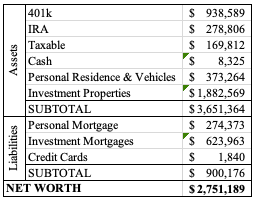
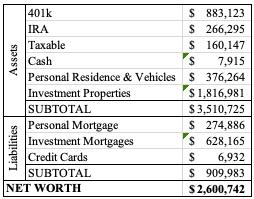
On the surface, a jump of $1.1 million in just over 2 years seems impossible, but here’s the break down of how things changed in our finances during our child-rearing hiatus.

The highlights:
– Mrs. ODA left her job;
– We purchased three new properties;
– We sold one property;
– We paid off two mortgages and significantly paid down two others;
– Our investments grew based on market fluctuation, as well as our continued investment; and
– The value of the properties we own appreciated.


401K

Since I met Mr. ODA, I maxed out my Thrift Savings Plan (TSP, the Federal government’s 401k) contributions each year. Before that, I had been putting money into the TSP, but hadn’t maxed it out. I left my career position in May 2019, at which point I stopped contributions to my TSP. However, we put in as much as we could for the year before I quit (if Mr. ODA has his way, we’d have maxed out my contributions); I contributed $13,070 over the first 4 months of 2019. My balance on June 30, 2019 (it’s a quarterly report) was $300k. I have gained $127k over 19.5 months based on my investment strategy for the account with no new contributions. Mr. ODA continues to max out his contributions of $19,500 per year. His account balance has increased due to annual contributions, a loan repayment, and market fluctuations.


IRA AND TAXABLE

A Roth IRA has maximum contribution limitations per year. For 2019, 2020, and 2021, that amount is $6000. We each put $500 per month into the Roth IRA to max out the contributions. We have maxed out the contribution limitation every year we’ve known each other (10 years), and Mr. ODA had done so before Mrs. ODA knew such a thing. We don’t time our contributions throughout the year because we don’t want to stress about when the perfect time is and then possibly end up throwing five grand in when December rolls around. We have taken the ‘set it and forget it’ (essentially dollar cost averaging) approach to the Roth IRA investment.

Dollar Cost Averaging – Since we know we want to put $6,000 in for the year, we break it down into $500 a month and contribute on the 30th of every month regardless of individual pricing. This eliminates the need to pay attention to, and the effect of, volatility in the market. Some may say that dollar cost averaging is not a prudent idea because the market always goes up over time (essentially you’re setting yourself to pay higher and higher per share as the year progresses, on average), but I just can’t handle the psychology of dropping $6k on January 1 and not having anxiety for the rest of the year that it was the right decision.

As for the taxable accounts, this includes accounts we have set up for our children – UTMAs (however, the growth of these funds are not taxable to us because they are taxed at the minor’s rate – 0% for us). An UTMA is the Uniform Transfers to Minors Act. It allows an account to be set up in the child’s name without the child carrying the tax burden of the money. The IRS allows an exclusion from the gift tax up to $15,000. We put $50 per month, per child, into the account. This is also ‘set it and forget it’ with automatic deductions from our checking account.


CASH

Our cash balance really has no meaning. We bring in income and we pay our bills. We don’t purposely keep a savings account balance (as I shared in the Leveraging Money post, we’re not interested in maintaining 3x our monthly income in a savings account at 0.01% interest rate). We don’t purposely project how much to put towards mortgage principal.

We currently have a larger-than-normal cash balance, which is left over from selling our primary residence in September. It hasn’t been dwindled lower yet because we have a fence install that needs cash and we were paying down the last of our large credit card. Now that most of these things have happened, we’ll put more of our cash balance towards the investment property mortgage we’re currently paying down.


PERSONAL MORTGAGE

In October 2018, we had been living in our previous house for just under 3 years. In January 2021, we had only made 1 mortgage payment on our new home. While our current home cost slightly less than our last home and we put 20% down for each house, we had more years of principal pay down in October 2018 than we currently have.


PERSONAL RESIDENCE AND VEHICLES

We sold our Virginia home for $400k in September 2020. The valuation of that home rose significantly over the 2019-2020 years due to lower inventory with high demand in the Central Virginia area (probably all over the country, but I don’t know those details).

Also in September 2020, I traded my vehicle in for a van (and I couldn’t be happier :)!). That increased our vehicle valuation since the van is 3 years newer and a higher cost than my previous vehicle.

Even though my vehicle value rose slightly, Mr. ODA’s vehicle’s value continued to decline, and we purchased a home in a lower cost of living area, therefore having a lower value.


INVESTMENT PROPERTY VALUES

Since October 2018, we’ve purchased 3 properties, increasing the total property value of our portfolio. Additionally, all of our properties continue to increase in value. The Virginia homes have increased significantly over the last two years. In the table below, I’ve provided each property’s change in value from January 2020 (oldest snapshot per property I have) to February 2021.

Note that this is a projection based on the internet’s valuation and not an exact science. The only house that we have a recent appraisal on is the one that we refinanced in January 2020. That house’s appraisal was $168,000; we paid $112,500 in July 2017.


INVESTMENT MORTGAGES

Of the three most recent purchases, one was purchased with a partner, split 50/50, and the other two were the last two KY houses purchased. These three added $215k of new debt. However, you see that our mortgages on investment properties have only increased by $27k, which doesn’t exactly say “we bought 3 new houses.” That’s because we’ve paid down (and sold) about $150k of mortgages in addition to 2+ years worth of mortgage payments going towards these loans.

In May 2020 and January 2021, we refinanced two properties. Quick tidbit – we signed the refinance papers in May under a tent in a parking lot, and we signed the January refinance at our kitchen table with a traveling notary. While the interest rate and monthly payment decreased, the loan balances increased because we rolled closing costs into the principal and took $2,000 cash out (the maximum allowed) in each case.

We sold one property that we had been paying down the mortgage on; in October 2018 it had a balance of $11,142, and we sold it in January 2019. We had been paying down the mortgage because it was our lowest balance. When we made that decision, selling the house wasn’t in the immediate future. An opportunity presented itself, and we sold it.

We’ve paid off two mortgages during this period. One was in January 2019 with a balance of about $44k, and another was in April 2020, which also had a balance of about $44k in the October 2018 calculation. Our intent to paying off mortgages was two-fold. It increases our monthly cash flow that helps Mrs. ODA stay home with the kids, and it gets Mr. ODA closer to being able to leave his job. Plus, due to Fannie/Freddie requirements of having no more than 10 conventional loans, it creates the opening for us to get a new mortgage if the opportunity arose. The downside is that it de-leverages the house’s financials and creates a smaller cash-on-cash return for the property.

We have also paid down 2 mortgages over the last two years that aren’t completely paid off.
– One of those properties is the one that we purchased after October 2018 with a partner. It has our highest mortgage rate. The affect on the numbers here just shows that the principal balance of that mortgage is smaller than it was originally, thereby not increasing the mortgage total ‘fully,’ if you will. The principal pay down on that mortgage has been $44k total, but we’re only responsible for half of that.
– On the other mortgage, we’ve paid almost $28k towards principal between October 2018 and now.


CREDIT CARDS

We open new credit cards with 0% interest for an introductory period when we have large purchases looming. Not only is the 0% interest beneficial to us for an introductory period of 12-15 months, but we strategically choose new cards that come with a welcome bonus (points or cash) when you reach a moderate spend level in the first several months. Given the strategic timing of a new card before a large purchase, this bonus is easy to achieve. When we have large balances on credit cards, it’s because we’re purposely carrying a balance month-to-month at 0% interest. We have never paid interest on a credit card balance.


LIFESTYLE

Despite Mrs. ODA leaving the workforce, our net worth increased for all the reasons listed above. The one unmentioned piece, because its not directly tied to any accounts, is lifestyle. While our net worth, rents, and investments have increased, our lifestyle has not creeped. We still make strategic decisions, spend money mainly on needs, look for wants that provide our happiness without breaking the bank, and generally keep our financial future at the forefront of our daily lives. We live like no one else does so eventually we can live like no one else can.

Living intentionally allows us to get to where we want to be.