July Financial Update

RENTAL EXPENSES

We took a trip to Richmond, VA to work on rental properties. It was fairly last minute. I had a schedule of work at each house that I planned. However, I didn’t plan on the heat index being 113 and 112 for the two main days we were there. I was able to get everything on my list done except for staining the new deck at one of the houses. I didn’t want to risk it not applying or curing correctly because it was too hot and in direct sun. Plus, the tenant didn’t even clear it off so I could work on it.

I had multiple houses pay rent late this month. I was surprised. One let us know on the 5th that they had an emergency, so they wouldn’t be able to pay until the 17th. I had someone pay half their rent early in June, but then haven’t received an answer as to why the rest of her balance ($345) hasn’t been paid yet. Another tenant misunderstood her maternity leave pay, so she asked for more time to pay rent. She paid $800 on the 7th. I told her not to worry about it, and just pay when she can, without the late fee; she only has $150 remaining.

I’m currently working through two roof replacements. One of them will be covered by insurance, but then I’ll be paying to have vents added, the chimney torn off and capped, and the soffits repaired on top of what insurance can do. Then the other one we’re paying out of pocket for. It’s original to the house, which was built 24 years ago. There has been storm damage to it over the last year, and it’s just generally time to address the age even though it hasn’t caused any problems yet.

PERSONAL EXPENSES

Our medical insurance company had some glitches in their claim processing through the first half of the year. Now they’ve caught up, meaning I’m paying large sums of medical bills. Mr. ODA took on booking lodging for his guys trip later this month, which meant that the second half of AirBnB payments were applied to the credit card.

Mr. ODA increased each kid’s UTMA from $75 to $100 per month. That means we’re investing $3,300 each month into accounts, on top of maxing Mr. ODA’s TSP contributions and both of our Roth IRA contributions for the year.

Our contractor has ghosted us on our own deck build. We bought some new furniture for the main deck area. Once it’s not 100 degrees outside, we’ll work on doing the waterproofing of the deck ourselves so that we can start living on the patio under the deck and get that hot tub ordered this fall.

NET WORTH

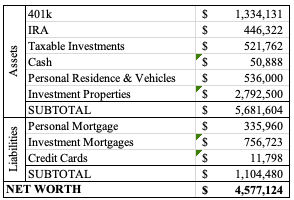
I updated the valuation of the houses this month. I typically only do that 3 or 4 times per year. I try to account for the big increases we see at the beginning of the spring, and then adjust slightly around this time of year once the comparable houses have closed and sold. This update added $140k worth of equity into the equation. All of our liabilities decreased since last month, and all our assets increased since last month. That has equated to an increase of over $200k in our net worth.

Social Security Benefits

Social security was signed into law by President Roosevelt in 1935. One of the intents of the program was to provide income for retired workers aged 65 or older. The purpose of the Social Security Act was to help destitute aging individuals who were not receiving regular income. The program calculations have changed a bit over the years, but the purpose has remained the same: provide a minimum income to aging individuals, not to provide a source meant as your sole income stream.

Today, most of the United States workers pay into social security through a 6.2% payroll withholding; such withholding ceases once you make $160,200 or more (in 2024). An individual’s year of eligibility is based on their birth year, rather than being exactly 65 years old like it was originally, and is called the normal retirement age. Additionally, there are penalties for filing early and bonuses for filing later than your normal retirement age. The year you file for social security has implications on your income, which I’ll cover later.

CALCULATING SOCIAL SECURITY RETIREMENT INCOME

Social security benefits are computed based on an individual’s highest 35 years of indexed income. The income is indexed, or adjusted, to account for inflation over the years. If you made $10,000 in 1985, that equates to making about $25,000 in 2022. I mention that it’s in year 2022 and not today because indexing applies to all income older than the last two years, while the most recent years are taken at face value. Indexing ensures that your future benefits account for inflation to make them fair and equitable in the year you need that income, and makes all of the annual salaries of your working years comparable.

Once the indexed total is known for all working years (up to the highest 35 years worth), the totals are added together and divided by the total number of months worth of earnings. The average monthly earnings amount is then used to calculate the primary insurance amounts (PIA). The PIA is the amount paid out monthly if an individual waits until their normal retirement age, which is a table published by the Social Security Administration (SSA) and is based on birth year.

According to the SSA website, an individual who first becomes eligible for old-age insurance benefits or disability insurance benefits in 2024, or who dies in 2024 before becoming eligible for benefits, his/her PIA will be the sum of: (a) 90 percent of the first $1,174 of his/her average indexed monthly earnings, (b) 32 percent of his/her average indexed monthly earnings over $1,174 and through $7,078, and (c) 15 percent of his/her average indexed monthly earnings over $7,078. The percentages are based in law, but the dollar amounts, which are called ‘bend points,’ are updated annually based on the national average wage index. These bend points ensure the program weights benefits to lower income earners, and phases out benefits as an individual’s income increases.

Here’s an example that shows how the bend points are used to calculate the PIA, which is the monthly benefit amount that would be paid out to someone who retires at their normal retirement age and is eligible to receive 100% of their PIA. The monthly indexed earnings over the life of their 35 year career was $10,000. The bend points are applied to each bracket of income up to their max of $10,000, and then the bend points are added together. The total is rounded to the nearest dime though.

If you draw before the normal retirement age, but no earlier than 62, the PIA is reduced by as much as 30%. If you draw after your normal retirement age, the PIA is increased by 8% per year, until you reach 70. In the above example, the earner who made $10,000 a month average over the course of their career will receive ~$3,383 a month if they file for social security benefits at their normal retirement age (in 2024 numbers). If they chose to draw at 62, they’d receive 30% less of their PIA, equating to approximately $2,368 per month. However, if they chose to draw later than their normal retirement age, they would receive more than their PIA (with the amount depending on their normal retirement year).

As you can see, social security is not intended to replace your pre-retirement income. It is meant as a safety net to ensure some level of financial security. If you’d like to live a more lavish retirement, you need to plan ahead with additional sources of income/savings to draw from (e.g., retirement plans like a 401k, Individual Retirement Account (IRA) contributions).

WHEN TO DRAW

We recently heard a conversation where someone told another person that they should definitely claim as soon as possible. However, if you’re not in a situation where you absolutely need that income per month, it’s best to wait. Once you draw, you lock in that dollar amount, save for cost of living adjustments as authorized. Cost of living adjustments for inflation, or COLAs, are based on the Consumer Price Index and announced annually in October.

The year you draw is based on your outlook on your life expectancy, your income need based on lifestyle, and your other income sources. This isn’t a decision you need to make at 35, but you should be watching and planning this over the course of your life. If you’re in good health and active at 62, and have saved enough to live off other funds or are still working, it likely wouldn’t be in your best interest to claim social security benefits.

If you’re born in 1960 or later, your normal retirement age is 67. At 67, you get 100% of your PIA. If you file at 62, which is the earliest you can file, you get 70% of your PIA. If you wait to file until after your normal retirement age, then you get 8% each year until 70. On the graph above, I used a PIA of $3,500 to determine the values for the example. You can see that if you were to file at 62, your cumulative income line over the rest of your life time is a flatter line. You’re receiving a smaller benefit, so it’s adding up slowly. Where the lines intersect is how you’ll determine your break-even draw year. For instance, if you think you’ll live until at least 77, then it’s not worth doing an early draw at 62 because a draw at normal retirement age will provide you more income over the course of your life. If you think you’ll live past 81, then deferring your social security filing until 70 yields the most lucrative scenario.

RETIREMENT AND WORKING

There are stipulations associated with claiming benefits and still working, which is another factor to consider when drawing social security. If you’re 62 and still working, then it may not be in your best interest to collect social security. While you can still work while claiming social security, the SSA may reduce your benefits. The SSA reviews income earned against benefits paid out, and may adjust if there was employment income in the previous year (i.e., income based on pensions or other retirement benefits does not constitute current employment income).

If you are under normal retirement age for the entire year, the SSA deducts $1 from your benefit payments for every $2 you earn above the annual limit, which is $22,320 in 2024. In the year you reach normal retirement age, the SSA deducts $1 in benefits for every $3 you earn above a different limit, which is $59,520 in 2024. It’s likely you don’t “need” that money because you’re still working, your benefit isn’t increasing like it would if you deferred, and you’re actually receiving less money in benefits than based on the normal formula.

SUMMARY

There is no hard and fast rule on when to draw these benefits. The point is to be educated on your options. We don’t recommend you rely on someone else’s opinion on the matter or how it worked for them, as each person’s variables are different. Generally, if you’re in good health and still producing income, drawing on the social security benefits earlier than normal retirement age isn’t going to be your best financial move.

As is the case with most personal finance topics, having diversified income sources in retirement, regardless of what age that is, will set you up to make decisions absent emotion and desperation, and for the betterment of your entire financial picture. Utilize your 401k and all available match, your IRA, your taxable savings, and perhaps your pension, so that Social Security is just one more tool in your financial picture, rather than the only one.

June Financial Update

Welcome to summer, where we’re traveling and I’m not posting on time. This time it was because I had to figure out a few things with bills and health before I had the time to get to the update. I can schedule content in advance, but not this post where I need the most up to date numbers when talking about our net worth.

We’ve been busy with baseball and activities around the house, so our spending was lower than it had been. However, this time of year is typically where we see a lot of our rental property expenses come through. We purchased many houses around this time, which puts their insurance payments due now. Then the City of Richmond’s tax payments are due in June and December also. The City of Richmond doesn’t post our escrow payments timely, and it drives me crazy. Every 6 months, I get notification that I have unpaid taxes and it’s the due date. I have then go through every escrow and prove to myself that they were in fact paid out over 3 weeks ago, and then I have to go back and check that Richmond posts them eventually. I stopped sending checks into them for the accounts that aren’t escrowed because it took too long to monitor, so I pay the $0.95 fee to pay via their ACH option online.

Mr. ODA had been in a relationship with a financial advisor, which was $35 per month. Over the last 3 months, Mr. ODA has been working to become his ‘apprentice.’ He passed his Series 65 exam and will begin working on this guy’s team. Not that $35 is a huge amount, but that’s one less ‘subscription’ that we’re paying monthly.

Speaking of subscriptions, we did something that I’d venture to guess other people wouldn’t put the effort into. One of our credit cards (that we rarely use) had a promotion for a $15 statement credit if we had at least $100 worth of subscription and/or utility payments go through. Most of our utilities can’t be paid with a credit card without paying a fee. The fee for our internet service was low enough that we went ahead and switched that one over for one month. Then I went into our Y membership and switched the credit card on file for that payment. With a few button clicks in May and then later this month to switch everything back, we made $15. It doesn’t seem huge, but it’s the compound of that thought process and awareness that makes a difference in your finances.

The ‘bigger’ expenses of the month were one kid’s school registration fee ($175), purchased baseball tickets (the Oriole’s don’t charge for 2 kids per paying adult!), got an oil change ($65 ugh), paid two homeowners insurance policies that aren’t escrowed ($1,371), paid for pet sitting for a coming trip ($155), paid car insurances ($567), and built a few steps in a new walkway ($275). Our deck isn’t complete because the waterproofing isn’t waterproofed. We haven’t paid out the last $3,500 on that, but we also haven’t heard from our contractor in several weeks.

We initiated a homeowners insurance claim for one of our properties. The tenant wasn’t complaining about the house/roof, but we knew the roof and soffit were in rough shape. I was hesitant to contact a roofer because I wanted the job done right. I expected the house is really old, and there would be decking problems to fix. I dragged my feet on finding someone, but I did click with someone finally. He went out and actually suggested we go for a claim to cover the replacement. We’re in the process of that now. An adjuster has been out to see the damage, and now we wait for the estimate. In the meantime, another property had water spots on the ceiling show up. I had the roofer go out there to check it out, but he didn’t see anything glaring. That roof also needs replaced, but I’m going to get at least one more quote on that job since it’s not through insurance.

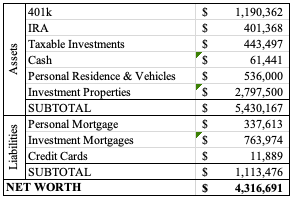
All the good things (assets) went up and all the bad things (liabilities) went down! Our net worth increased by $60k over the last month.

April Financial Update

I had this post mostly written by Wednesday, but we traveled earlier this week, and I haven’t kept track of the day very well. This is the first I’ve been able to update our net worth and get this done. Ironic, considering how I started this post when I expected it to be on time. And now..

This past month has been exhausting on me. I knew March was going to be busy. We had a bunch of sports schedules to manage, lots of kids birthday parties, hosting my dad for a long weekend that coincided with 3 family birthdays and the first anniversary of my mom’s passing, an assortment of Easter activities, a trip, and random other events. On top of managing these day-to-day things for our family, our deck replacement started, and we had to work on a massive turnover of a rental property. I’m in a perpetual state of tired these last few weeks.

DECK REPLACEMENT

On July 2nd of last year, a storm blew threw that destroyed our neighborhood. Honestly, we’re surprised by how little actual structure damage there was for our neighborhood because it looked like a war zone with the amount of trees down. A couple of houses had a tree fall on their roof, but only cause minimal damage that resulted in shingle replacement. We appeared to bear the brunt of the worst, which was a tree falling on our deck, crushing our furniture, moving all the supports, and cracking the concrete blow it. Another tree missed falling on one of our cars by centimeters, but that limb ended up cracking our driveway apron. We struggled communicating the extent of the damage with our insurance company, and they eventually realized what was needed and paid out on it five months after the incident. Our construction started on March 18th.

It hasn’t been an easy process. It’s emotionally draining on me because there were communication issues with our contractor that he wasn’t taking responsibility for. Then there were minor issues, but issues nonetheless. For instance, they installed waterproofing so the patio would be a dry area, but they cut through one of the barriers. Instead of realizing that was going to be an issue and fixing it themselves, I had to point it out. Then we went out there while it was raining to check it, only to see that there are 3 spots where water is just pouring through the seams. That just takes a lot out of me to have that conversation. They cracked off the top of our sewer cleanout, which not only made a mess in the yard, also caused a backup into our basement tub and toilet once it was glued back on because of a pressurizing issue (we think).

Then there are those hidden things that take energy, such as managing how to move money out of savings (while not exceeding the maximum of six transfers) and keeping track of all the bills, while ensuring the checking account has the right amount of money to cover the bills paid.

RENTAL PROPERTIES

Everyone paid rent on time! I had two technically pay on the 6th, but I sat waiting to see if it showed up before reaching out that morning. One of our tenants bought a house and vacated as of March 31st. They actually had left the house a little early, which was really helpful to us because the house needed a lot of work. The house had been flipped before we bought it. We knew everything was going to eventually need attention, but we hung on as long as possible. The neighborhood is really nice, so it was time to bring the state of the house up to a better standard. It had been “good enough” all these years, but there were definitely some items that should be replaced. This ended up being a huge overhaul, costing us over $10k. I’ll go into all the details in a future post.

NET WORTH

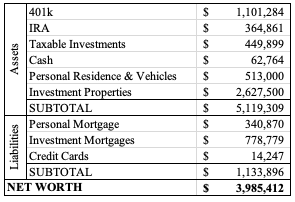
We’ve made a few substantial payments on the deck. We had been investing the money from the insurance company, while we waited for them to finish their estimates and then while waiting for the contractor to begin. Our taxable investment accounts have decreased a bit from that, and they’ll continue to decrease as this project finishes up in the next 2-3 weeks. The market is lower than it was a month ago, but our house values are starting their upward Spring trend, offsetting some of that loss. Overall, our net worth increased over the last month, but only by about $4,500 instead of the drastic increases we had been seeing month-to-month.

March Financial Update

We’re just going to cut to the chase – $4 million net worth! I mentioned that this was a goal for this year. Unlike other years worth of large jumps because of purchasing houses, this was less in our control (granted, our market allocation decisions are what’s driving it…. and by “our,” I absolutely mean only Mr. ODA’s because I don’t do anything in that realm).

RENTALS

Well, we’ve had a quiet month. What’s going to be funny is, I’m going to list the things that we did. Quiet doesn’t mean silent or without effort, but we’ve had a rough go of it over the last year, so this was a welcomed break.

We had termites at a property. We pay $98 annually for their termite warranty program, since we found extensive termite damage and live termites when we bought the house. We’ve had to treat the house several times, so this $98 is a steal. However, I’m wondering why we keep needing to treat the house.

We paid $125 for a plumber to go out to a clogged sink. When we received the invoice, it was for 2 plumbers to go. Between the phone call that they were on their way and the tenant saying they were great, only 35 minutes had elapsed. The company charged us almost $300. Mr. ODA called to ask why they choose to send two plumbers to do a one-man job, while also charging us for it. The owner said it was for liability purposes, which Mr. ODA fought back on. They agreed to a reduced rate, but we were only charged $125, which was less than agreed upon.

We had our third tenant move in, after we unexpectedly had to turnover three houses in the middle of winter. We also were given notice by another tenant that she’s vacating by the end of March. We handled increases for two houses (one handled by a property manager to increase $50/month, and one handled by me to increase by $25/month).

We had one tenant pay on the morning of the 6th with no communication, so I did have our property manager let them know that’s not going to be ok. We also had a usual suspect pay late, with the late fee. However, their communication was frustrating. They said they’d pay on the 6th. At the end of the 6th, they said the money hadn’t cleared like they expected. No communication on the 7th. I asked for an updated on the morning of the 8th, and they said it would be that day. At 11 pm, I hadn’t received anything and reached out. I was then told that money was going into the ATM right then so that she could pay. Sometimes I wish I could do a deep dive into tenant finances so that I could help them out.

PERSONAL

Mr. ODA has a trip in July where a group of guys will hike in the Rockies. Our family is going out before that trip is scheduled to do our own exploring. We booked 4 round trip plane tickets, and Mr. ODA handled the lodging booking for the guys’ portion. That’s almost $3,000 worth of purchases, so our credit cards are higher than usual.

Speaking of the plane tickets. We purchased gift cards from Costco for Southwest. The gift cards are essentially $450 for $500 worth of purchasing power at Southwest. We bought two, therefore saving $100 on the tickets. For an extra few clicks on the computer, and the 15 minutes waiting time before the e-gift cards were delivered to my email, that’s $100 that can be used somewhere else.

We bought a new vanity for our bathroom. That was about $700 for the vanity, faucet, toilet flusher, and mirror. I sold the old vanity (in rough shape) for $30. And because I’m proud that I did most of it on my own, here’s a picture. I needed Mr. ODA’s help with the supply lines because I lost patience with how tightly they were screwed on and my lack of progress. I cut the baseboards down to size, except I somehow measured wrong on one quarter round cut (I was cutting while it was on the wall). Mr. ODA cut and installed the replacement piece for me.

We finished up the ski season. The kids did great. I was really proud of them for sticking with it. We used our season pass well (i.e., exceeding the cost had we bought individual tickets for each visit). I took two of the three kids to the aquarium, and we took the baby for a procedure at a local children’s hospital. We’ve started tee ball for our oldest. Our March is very full and busy, so we’re getting into the swing of things and keeping track of the schedule.

NET WORTH

Well, we far exceeded that $4 million goal. The market went up big, with our biggest changes being in our retirement account, IRAs, and cash. Our cash increase is offset by the lower amount in our Treasury account. Some of the short term bonds were transferred back into our savings account, and we’ve kept that money in savings since our deck replacement is slated to begin.

February Financial Update

RENTALS

The rentals were expensive this month with $4600 paid out. This doesn’t include work that’s currently under way, but not paid for yet.

I paid for a water heater replacement, which was $1,904. I had to pay insurance on a larger property ($793). I paid the balance of the window replacement at one property, which was $1,064. I also paid for a plumber to address a leaking toilet and a rotted faucet ($325). We had a new tenant move into a vacant property, so we had that cleaned before her arrival ($165).

I had to pay for a plumber’s service call ($95) for clogged drains, for them to refer me to a rooter company ($250). I emailed that tenant that preventive measures need to be taken because I’ve not had so many calls to one property. She assured me they have taken appropriate measures and it’s just old pipes. The only problem being that we have several other properties with old pipes that never call for clogs.

We’ve turned over two properties and are about to turnover another property in the dead of winter. It’s so frustrating to be in such a position. All of those stories will be elaborated on in future posts.
– On one property, we charged a lease break fee of one month’s rent to cover our losses (the fee was different based on the month in which they broke the lease). Luckily, that covered our entire month of January being vacant, but we found someone for 2/1.
– Another tenant asked to leave a property because he lost his job. That was handled a bit different because we didn’t know in advance that this tenant would want to leave mid-lease. We told them there’s a fee of $250 (which is what it costs us to pay the property manager to find a new tenant), and that they had to pay rent until we found a new tenant. We didn’t lose any rent on that property.
– Now, we have a newly vacant property because the tenant can no longer afford it. I’m not expecting to recover her unpaid rent at this point. We approved a tenant to start 2/28, leaving us with 27 days of lost rent. However, we sent a lease over for them to sign. They’re currently dragging their feet on signing because they want to pay with their tax return. I don’t love that idea. They’ve been easy to communicate with up until this point, just slow. I’m hoping this gamble works out.

PERSONAL FINANCES

I had to transfer money to Mr. ODA’s account to cover the purchase of our new back door and a new treadmill (although that was only $400). This is an interesting concept for us. Mr. ODA had an account before we met. His account was grandfathered in to new terms and conditions at this bank. He’s kept his checking account and credit card for the rewards (I have access to the account; my name just isn’t on it). Any online purchases go on that credit card. However, that account only receives $250 every other week from Mr. ODA’s pay check (occasionally it’ll receive rent via Zelle). So sometimes, we need to transfer money from our main checking account to cover that credit card payment. All our security deposit accounts are with that bank too. So I had to then transfer from a security deposit account into his checking account, and then have him send that money to our main account. It wasn’t our finest money management moment.

Not much else happened this past month. We’ve gone skiing with the kids some more, I went on a moms’ cruise (which was amazing), took a small trip to piggyback Mr. ODA’s work trip, and have done activities around town. We’re gearing up for a procedure at a local children’s hospital next week, which I’m expecting will wipe out our deductible. Luckily that’s only $3,000, but I’m sure we’ll hit it. We’ll actually be late hitting it this year; it’s usually done in January.

NET WORTH

One of this year’s goal is to hit $4 million net worth. I thought it was going to be a ways away, but the market has been up big recently. We’re only about $14k away from that goal now!

January Financial Update

As an intro for newbies: I write a monthly finance post. These posts started out as a way to manage our dollars spent per category. It evolved to show insight into my monthly money management and thought process. It’s also meant as a way to remind people that they should be looking at their money regularly.

Every month, I’m looking back at my spending, looking at trends on the higher level (e.g., why is my credit card higher than I expected), and sharing the rental property expenses and activities that I’ve accomplished.

I typically post on Thursdays. Unfortunately, life got in the way. I had 98% of this written, but I hadn’t updated our accounts until 10 pm, so this is now posting off-schedule, on Friday morning. Sorry about that!

RENTALS

I suppose with 13 houses, it’s inevitable that I’ll have to keep track of one.. or a few.. to collect their rent. One tenant is set up to pay twice per month (they pay a premium for this). They paid both parts of December late, and the first part of January late. They pay a late fee with that. I had two other tenants pay late by a few days, but they communicated this up front, and I didn’t collect late fees.

I’ve been sharing that I have a tenant who has been behind on rent since October 1 and has communicated very poorly. By the end of December, she was caught up with rent due, but no late fees. We’re now 11 days into January without any payment. My frustration with her was that she didn’t communicate at all for the first two months, and didn’t keep her word on anything that she said she was going to do, but didn’t tell us that something would change. I always say that I’m willing to help and work with you, but you have to talk to me. If I have to beg you to tell me what the plan is, I can’t help.

I paid a carpet cleaner $250 and paid a painter $2000 for a house that we’re turning over. The carpet was new before the last tenant, but they were there for over 3 years, so it had to be done. They didn’t damage the walls, but my property manager said that all the walls looked like different colors, and I didn’t trust “touching up” 4 year old paint. The paint looks amazing, so I’m happy I went for the whole house.

I paid just over $1000 as a deposit on 3 new windows for a house, which are scheduled to be replaced on Monday (a couple of weeks for new windows far exceeded my expectations!). We had replaced the majority of windows when we bought the house. However, at the time, the kitchen and bathroom windows were considered an irregular size, and we were told they were going to be $2000 just themselves, when we were paying $2000 for all the other windows. I don’t know what pricing scheme changed in 5 years, but now all sizes are the same price, and the 3 of them are $2000 now.

We had a tenant ask to be released from his lease, which we concurred to. We had terms associated with that, which I’ll share in a separate post. We were able to get a couple into that house with no loss of rent, which has been appreciated.

We’re under contract with our handyman to do work on a house, so that’s over $5,000 of cost that is waiting to rear its head out there.

PERSONAL

This was a month of spending in activities. I signed up for a 5k in August with “early bird” pricing, our daughter’s acro class had semester tuition due, and the kids’ monthly school tuition was paid as usual. Mr. ODA bought a new battery for his car and installed that. On somewhat of a whim, we replaced our back door, which was over $1100 added to Mr. ODA’s credit card.

Just before Christmas, we took a trip. It was just to Cincinnati, which we regularly do as a day-trip. However, we wanted to accomplish a few things this time around. We went to Top Golf for 90 minutes and lunch, let the baby nap at the AirBnB, went to Zoo Lights, spent the night, and then went skiing the next morning (the kids’ first time!). We already purchased season passes (and equipment) for skiing for 4 of us, and had already purchased the zoo annual membership. Without the cost of those two things, our trip cost $330 for Top Golf, lodging, parking (we stayed in the city), a ski lesson for our 5 year old, and food. Our lodging for 1 night was nearly $200 and was significantly more than we’d typically spend on lodging. However, we’re still in a phase of life where the baby needs the be in a space by himself so he sleeps for a nap and through the night. That means we look for a place with at least 2 bedrooms and 2 bathrooms, or 3 bedrooms and 1 bathroom (bonus points for master-sized closets or an extra bathroom with no windows for me to black out). We then made 2 day trips since then, and the kids are doing awesome on skis.

NET WORTH

Our cash has decreased, but that was offset to taxable investments because of our Treasury Direct accounts. Even with our extra spending, our credit card balances are comparable to last month’s. The increase in net worth from last month is mostly due to increases in our investment accounts.

This year’s goal is to hit $4 million net worth. Mr. ODA said that to our financial advisor via Instagram, and he didn’t share that publicly because it wasn’t relatable. The point in sharing here is that, well it’s January and people set goals, and to note that even if this goal specifically isn’t attainable to you in the short term, know that we also once had an account balance well below where we’re currently at. Consistent investing in the market (maxing out the 401k, maxing out the Roth IRAs, and establishing regular investing and watching the market) is a large contributing factor to where we are 10 years later. If I take the investment properties out of the equation, we’re still over $2 million net worth. That doesn’t happen overnight, and it’s something you can start working towards today.

New Year Organization

I had a couple of posts teed up to reflect on last year’s finances and activities, but having some conversations with people made me realize that things that I find basic, aren’t for others. I thought I’d share some things that I do that help me be more successful (calm) in my day. I’m not an organization expert. I’m not the “lazy genius” that gets touted (although, I don’t see people executing what they learn there). I’ve found things over the years that have helped me keep my brain straight. This particular post isn’t financial related, but part 2 will be (but next week will be the monthly financial update, so come back in week 3 this month).

Even though I broke this up, it’s still long. Skim the middle, unless it’s pertinent to you, but the summary ties it up at the end.

I have my own home’s finances, thirteen rental properties, three kids with two in school (and they go different days of the week), investments (and Mr. ODA’s constant moving of money!), and whatever other ad hoc bills show up to manage. I don’t have the ability to think in a quiet and distraction-free environment after 7:30 am. I adapted so that I don’t feel stressed because I’m trying to pay bills while the baby is nipping at my heels and the 3 and 5 year olds are asking me for endless snacks.

Please note that I’m a stay at home mom that manages our rental properties part time and works ad hoc as a substitute. I fully acknowledge that all of this isn’t relatable to someone who is out of the house from 7 am until 5 pm, but I will point out that getting systems in place will make your shorter time at home less stressful.

For a real-time, real-life example, I’m frustrated because my writing of this post has bled into Mr. ODA and two kids being awake, and so I’m trying to finish my thoughts here while Kid #1 tells me about his 14 stuffed animals he brought down from his room, Kid #2 is telling me about her puppy and two babies, and Mr. ODA is asking me to meal plan for my dad’s visit. So here’s why I wake up before anyone else. 🙂

START YOUR DAY RIGHT

I wake up around 6:15 everyday. The kids are in preschool, which starts at 9. When my oldest starts school next year, I’ll start setting an alarm to be awake around 5:15 because I think he needs to be out the door at 6:45.

I know people who even say “I’m not a morning person,” who set an alarm and agree that starting your day without distractions from what you want to achieve makes for a better day.

I start my coffee and make something small for breakfast. I’ve learned that if I don’t eat something, then suddenly it’s 9:30, I’m frustrated by being asked for second breakfast by the kids while I haven’t eaten anything for myself (because if I make any move towards food, suddenly the kids NEED food right then also, even if they just ate). I eat something small, and then around 10 I have … I guess … “second breakfast.” I also learned that if I take time to actually sit and eat a bigger breakfast first thing in the morning, then I’m anxious to get to the other things that I want to do, so it doesn’t help me feel successful to the start of the day.

I empty the dishwasher. If you have young kids, maybe you’re lucky that they don’t see something and then immediately need that thing they wouldn’t have otherwise asked for, but I’d venture to say that’s not the majority. If I’m emptying the dishwasher and laying out their cups, waiting for their matching straw or lid to also get unloaded, they suddenly need milk in that specific cup. Therefore, I unload the dishwasher before anyone is awake and there’s no distraction.

I then make each kid their own water bottle. This was a surprising step to a few people recently. Sometimes this means just filling up the same water bottle as the day before, which is probably sitting on the counter from yesterday. Sometimes their water bottle was washed, so it was just unloaded from the dishwasher. I have specific water bottles that are our “everyday use” water bottles. They’re leakproof. They have a handle. This is what gets carted around when we leave the house. Having a full water cup means that I’m not in the middle of doing something and being asked for water. I refill the water at lunch and dinner, but sometimes there’s a request for more in between.

I set their water bottle and their respective vitamin on the table. When the kids wake up, they go to the table, eat their vitamin, and put their breakfast request in. Sometimes, I’m really on top of things, and I make a breakfast before they wake up (e.g., not cereal). If there’s a plate of food in their “spot,” then they typically just sit at the table and eat it. Most mornings, I’m giving a list of a few options and letting them pick.

I prepare their snack and water for school, if it’s a school day. Again, if I start rummaging through the pantry while they’re awake, they suddenly have preferences and questions. It’s better if I just have it done. As a compromise, I offered my oldest the ability to pick out his own snack every Friday. He wakes up before anyone else, so I have him pick it out before #2 wakes up (who wants everything #1 has or is doing).

If it’s a day that I want to pay bills and/or update our financial tracking spreadsheet, then I also make time for that before anyone wakes up. I can run through our finances in about 10 minutes without distraction. Sometimes, my son wakes up before I get to it, and then for 30 minutes I’m fielding questions about stuffed animals while also trying to keep track of what I’ve already updated.

I know a lot of people lay out their kids clothes the night before. Perhaps this will become part of my routine when my oldest needs to be out the door at 6:45, but at this point, we have plenty of time in the morning to get dressed and ready.

MIDDAY RESETS

I’ve consistently used a child’s nap time to reset the house. Pick up toys that are out (not everything, but most of what hasn’t been touched for a few hours). Clean up any dishes that have been left out. This started with my first’s nap time, and was really because I couldn’t physically sit and relax while I saw toys scattered around the floor or dishes piled on the counter. It has evolved over the years as we’ve had more kids, but the general gist is the same – give it a quick reset, but not a perfect clean up. It’s going to get messed up again before bed time, but it’ll be less items to manage at that time.

Now that my kids are a little older, I task them with it too. Since tidying our house has always been something they’ve seen, they do it well. While I put the baby down for a nap, it indicates that it’s time for them to straighten up. If they put their “morning toys” away, they get to watch a couple of episodes of a show.

I’m a stickler for pieces of toys to stay with each other, so this helps manage that toys don’t have pieces go missing. It also gives everyone a fresh slate to pick out new toys to play with, and it helps no one feel overwhelmed by the state of the room.

I clean up anything left over from lunch, wipe down the table and high chair, and at least get the dishes to the sink, if not the dishwasher. I used to fight anything being left in the sink, but I’ve let go of that.

I then use the baby’s nap time and the bigger kids’ tv time to make any phone calls needed, catch up on any financial things I didn’t get to in the morning, or clean a room.

END YOUR DAY RIGHT

Reset your house.

The two big kids go to bed around 6:30. After they’re in bed, I pick up most toys and clean up after dinner. When I clean, I focus on one room at a time. I start in the living room because rarely am I going to find something in the kitchen that belongs in the living room, but I’ll have items in the living room that need to go to the kitchen.

From the living room, I put any toys away that belong in that room. If a toy is meant to be in the basement, it gets put at the top of the stairs. If there’s a bedroom-related item that got left behind, it gets put at the bottom of the stairs. In both those cases, when someone walks to that area, they’re supposed to bring that to the next floor; in reality, I’m the only one who really does that. If there’s a cup or a plate, it gets put on the kitchen table (because that’s the closest to the living room). The point here is to work in phases. Don’t exert the energy to carry one toy all the way to the basement, to then see that another toy got left under the kitchen table and needs to go to the basement. This makes the task overwhelming.

Once everything is picked up, I move to the kitchen table area. All plates and cups (including whatever I’ve added from the living room), get moved to the kitchen peninsula. The baby’s high chair gets wiped clean, the table and chairs get wiped cleaned, and the dog’s food and water bowls get filled.

In the kitchen, I clear the counters first. Everything goes where it belongs – refrigerated items go to the fridge, any spices left out are put in the cabinet, leftovers are stored away. The goal is to get all the counters cleared off, leaving the dishes in the sink for last. If the stove needs wiped down, I do that once the counters are cleared because the grates need to be placed on the counter. Then I load the dishwasher from the sink and rinse out the sink. I can either rinse the sink after I’m done clearing it, or I can scrub hardened on food in the morning. Put the effort in to do it right so that it’s not a bigger task later.

The baby goes to sleep around 8, so after his bedtime, there’s usually more toys to pick up and a few more dishes that were used.

Then the dishwasher is turned on before bed. Our dishwasher runs for 2 hours. While sometimes it’s overflowing and needs to be run mid-day, it’s more likely that we run it every other night, after we’ve cleaned up the last of our things that need to be loaded from the day.

If I don’t do these things at the end of the night, then they bleed over into my morning chore list. I usually don’t have any “extra” time for my morning chores, so I prefer to focus on my night time to-do list as often as possible.

WEEKLY TASKS

There are things that need to be done, but they’re not done daily. For one, the bathrooms need to be cleaned. I knew someone who said “Sunday is for bathrooms.” She knew that every Sunday, she’d tackle cleaning the bathrooms. I loved that there was a system. I can’t say I’m consistent in that though. I try to remember to vacuum upstairs once a week, but the first floor probably gets vacuumed every other day. One thing that I did that has helped me clean bathrooms more often is that I keep a glass cleaner, all purpose cleaner, and a roll of paper towels upstairs. This means that I’m not thinking, “I should clean this bathroom,” but having to walk downstairs to get supplies and carry them back upstairs.

I change the kids sheets every two weeks. I try to do laundry in order of how it’ll go back on the bed. If I need to wash their blankets and comforter, then I wash the sheets first (since it all doesn’t fit in one load), this way I can get that step done while the blankets are being washed. If I wash the comforter first, then I have to do the entire thing all at once when the sheets are ready (note: my daughter will take any sheets on her bed, but son only wants his Paw Patrol sheets, which is why this system is complicated).

As for laundry, I don’t have any perfect answers, except that piled of laundry do not overflow our hampers. I used to wash our clothes separate from the kids’ clothes because I’d prefer to fold our bigger clothes than theirs, but now it’s a crapshoot. One thing that I have found helpful is that I sort the clean laundry into piles per person. Then I carry the pile into the respective kids’ room, fold it in there, and put it away right then. While my laundry may sit in the dryer for a day or two, this at least gets it folded and put away a lot faster than it used to be. Sometimes I force myself to fold by putting a load of towels in behind the clothes. This means I need to clear the dryer, but it won’t be as daunting because I’ll have the “reward” of “just” towels behind it. Ha!

SUMMARY

The goal here is simple: eliminate stressors that I have control over. I get things done when I don’t have to also manage 74897 toddler questions and a crying baby. I get my house organized before I go to sleep so that I am not overwhelmed by clutter and tasks first thing in the morning.

I’ve seen multiple articles over the last few years that talk about reducing clutter in your house to make yourself feel better. That when your house is cluttered, it makes your brain feel cluttered and exhibits a physically negative reaction. There are distractions everywhere you look that are taking brain power and exhausting you. If you come up with a system that gets kids’ toys out of plain view, that gets your kitchen counter cleared off and the dishes into the dishwasher when dirty, and eliminates piles of papers that will take you an hour to go through and organize, you’ll physically feel more calm and be able to tackle more.

Additionally, just staying on top of little tasks in a “system” you create that works for you and your household makes each day feel more manageable. I do a quick 10-minute reset of the house at nap time. This means that I’m not left with all toys and dishes and mess to deal with at the end of the day when I’m tired. I clean up room-by-room, creating piles of items that need to go to a different room, rather than putting each individual item exactly where it goes as soon as I touch it.

I’ll also point out that even though I use “I” throughout this, it’s a team effort with Mr. ODA. He cooks, cleans up the kitchen, straightens up, etc.