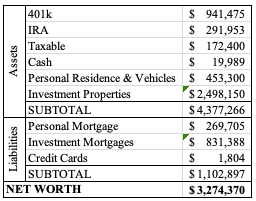
I reviewed our figures, but that’s the extent of what I’ve done for this last month. We’ve had travel, sick kids, routine doctor visits, and managing both houses (as has become the norm) with projects in the new house. All this while pregnant, so my energy levels are not what I wish they’d be for how much we have going on.
We did host our first garage sale though. Impressively, the time flew by, we got rid of a lot of what we put out there, and made about $185. I have plans on newborn/family pictures for that money though. 🙂
We listed our house on 9/22 and were under contract in a couple of days. We have moved beyond our contingencies (as far as we know) and are slated to close on 11/9. We’re really grateful that we got a contract right away and that we’re moving along because a lot of houses are sitting for weeks and having to reduce their list price multiple times. At the last minute, our Realtor ordered an appraisal measurement of the house because we couldn’t find clear information on how big the house was. We were between 3600 and 3800 sf with the finished basement, but the appraisal came in at 4,179! We still didn’t feel comfortable listing at more than 500k, so we went for $499k and accepted the offer at $495k.
RENTAL PROPERTIES
Last month I mentioned the taxes that come due in October. I’ve either paid out or scheduled a pay out of about $6,200 worth of taxes on 4 properties at this point. I have $300-400 more to pay out at the beginning of November for local taxes on two of the properties.
I paid out $345 worth of HVAC repairs from September on a property (that I completely forgot about, and this company is usually a month or more behind on invoicing). We had another service call charge from our KY property manager that made no sense, and I’m ready to release them.
We have a November 1st court date for the girl that destroyed our house. I submitted the charges to her, and even though she questioned one of the line items, she didn’t respond on time. Our property manager is now managing the court appearances for that. We asked for an address for her, and the lady at the address she gave us said she’s never heard of her (basically exactly what I expected from this girl).
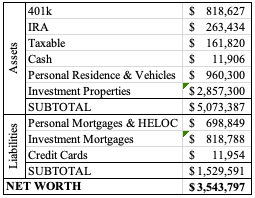
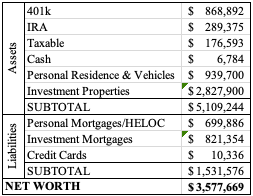
NET WORTH
Home values are steady or slightly higher, while the stock market has been abysmal.
Whew, we’ve been busy. Son turned 4. Lots of traveling. Kids started school. Managing two houses. Managing the rentals. Being 7 months pregnant.
We’ve been working on our old house to get a lot of the things moved to the new house, while keeping enough there to live. A slow move sounded great in concept, but dragging this out for 3 months now, with another 6-8 weeks to go probably, has been rough. We unload the car, put it in the new house dining room, and then I need to unpack all that and find it a home. Then we come with another dump of things right after I clear that out. It’s been exhausting. Meanwhile, I’ve been painting almost all of the new house, changing out light fixtures, changing out some electrical switches/outlets that were dated, etc. Mr. ODA has started working on the rebuild part of the bathroom renovation, so we happily have gotten all the electrical work that we wanted to do done (we need to hire an electrician to run a line for the dryer), and then got the shower framed. He’s also been working on the yard and landscaping, which is a big project because the original owner of the house put in a lot of landscaping, and then the people who owned the house for about a year before us didn’t maintain any of it.
We’re listing the house this week, and we’re hoping for a reasonable offer ASAP and a closing at the beginning of November. That closing will pay off our mortgage (~$265k) and our HELOC (~$82k).
RENTAL PROPERTIES
October brings a lot of rental bills. KY’s property taxes are due in October and November, and none of the houses we have here are escrowed, so I need to plan on about $6,500 outlay. Right now, we have a HELOC on our last primary residence, so I have that to fall back on. Typically, I project out 2 months of expenses, and I know how much I have “left over.” The “left over” usually is paid towards a mortgage or, currently, our HELOC balance; in the Fall, I plan to have that “left over” go towards the taxes. Luckily, our houses in Virginia that aren’t escrowed have the tax payments due half in December and half in June.
While our credit card balances are high (we’re carrying a large balance on one that’s 0% interest), we didn’t have a lot of expenses this past month. Mr. ODA’s work trip hotels and restaurants are on the credit cards that will get paid this week, and we’ve had higher gas expenses because of my driving to/from NY and then capitalizing on Kroger incentives so filled up one car. Other than that, we’ve only eaten at restaurants sporadically and have been focused on getting projects done, so haven’t gone out much.
This is the first month of the newly executed lease with a tenant who paid late every month. Their rent total increased for the convenience of paying twice a month (although the total owed now is still less than their rent and late fee they had been paying). They paid the first half on time, and they haven’t paid the second half, which if it’s not paid by the end of today will incur a late fee. Rent was $1450, so they were paying $1595 every month. Rent is now $750 twice a month. If they pay on time, it’s $1500 per month. If they pay half late, then it’s now $1575 per month.
I submitted the security deposit charges to the tenant that moved out. She asked a question about the charges on the list, but then didn’t acknowledge by the deadline. We need to have our property manager file the charges in court. Somehow it’s the 19th of the month, and we haven’t pursued that yet because we’ve been so busy.
Other than that, we didn’t have any service calls on any of the houses, and everyone else has paid their rent.
NET WORTH
We have a busy October planned. I hope we’ll finish the projects at the new house and be close to closing the chapter of our last house. Our investments have declined significantly (almost $91k!) from last month. Our cash is higher than usual because of the cycle timing for this update compared to the bill due dates. And finally, the credit cards are higher than usual, and they’re higher than last month, but that’s because we’re purposely carrying a balance on a 0% interest card. So while our overall net worth has decreased over $33k since last month, the stock market issues have been offset by paying down mortgages and increased property values.
Surprisingly, I didn’t cover all our houses in posts last year. I was going to say, “let’s finish this up,” but we’ve since purchased #14! This is a long post. I tried to separate the stories, but since they were part of the same purchase, it was too convoluted to decide which story went with which house.
We spent the summer of 2019 living in Lexington, KY. Mr. ODA took a temporary job for 3 months, and we spent our summer looking for more rental properties to try another market. The housing costs in central Kentucky were less than central Virginia, but the rental rates were also lower.
We drove around with our Realtor for quite some time. We were hoping to find a multi-door complex. However, 4-8 door units have just not been well taken care of. We take care of our houses, and I didn’t want to inherit all the deferred maintenance of a poor landlord. Many of the places had long-term tenants, so there wouldn’t be a vacancy to ease getting work done either. Additionally, there were several that we saw where the tenant was home, smoking and telling us all that was wrong with the property. It was abysmal.
So after searching through many other options, we settled on two houses at the same time.
FIRST OFFER
Mr. ODA actually made an offer on a house in Winchester that I hadn’t seen. It was a large house that had been converted into 2 units. Mr. ODA and our Realtor went after work one day, and it wasn’t worth me packing up the baby and driving a half hour to meet them for one house. However, I did get to see some of it because I took on the home inspection appointment. Since I had never walked through the house, it was easy for me to objectively see the information on the inspection and convince Mr. ODA to walk away. There was just too many big-ticket items (e.g., not enough head room for stairs, water damage not properly cleaned up in multiple rooms, several code violations) and deferred maintenance that it wasn’t worth us putting the money into it. The tenants were sitting on the porch smoking during the inspection, and I didn’t love the idea of inherited tenants that were allowed to smoke in the house.
SECOND OFFER
I can’t tell the history of these purchases without this gem of a story. Mr. ODA found a house that was in a decent shape in Winchester.
Aside: We focused on Winchester because while the rent income was low, the housing cost was also low. Whereas in Lexington, the rent was low, but the housing prices were higher.
We made an offer on the house. In the offer, it lists the seller’s name. It was a State Senator! When we sent over the offer, the seller’s agent agreed to our details, but asked for a pre-approval letter before he’d sign. The amount of weight the people in Kentucky put on a pre-approval letter is absurd, in my opinion. We went through the effort to get the letter and send it over. About that same time, the seller’s agent said someone else came in with a better offer, so we could either submit our highest and best offer, or lose the deal. The sketchiness of the action floored us.
The house had been on the market for a month. We had a verbal agreement (that had even been put in writing, but not yet signed). What are the odds that someone came in at the same time as us with an offer over asking for a house on the market a month? We called his bluff, and we were wrong.
THIRD AND FORTH OFFERS – UNDER CONTRACT
In August 2019, we went under contract on two houses in Winchester, KY.
Property12 had been owner occupied and flipped to sell. The owner had lived there long enough that she wouldn’t Docusign the contract, and we had to wait for her to initial, sign, and date all the pages by hand. The house had been listed for 36 days when we made the offer. It was listed at $115,000, and we went under contract at $112,000 with $2,000 in seller subsidy (closing costs) on 8/7. It’s a 3 bed, 2 bath ranch at 1120 sf.
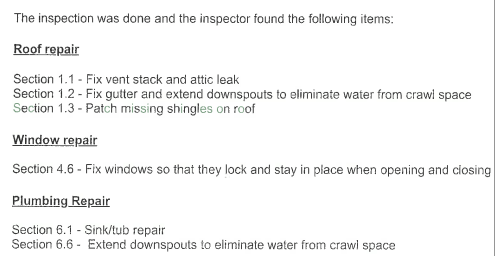
We received the home inspection on 8/14. We asked for the items below to be addressed, or to take $1000 off the purchase price. They agreed to fix the issues.
Property13 had been listed for nearly 3 months before we made an offer. It had been most recently listed at $105,500. Our offer was for $102,000 with $2,000 seller subsidy. We also included the following requirement in the contract: Seller agrees to remediate the water and mold in the crawl space, fix the down spout next to the crawl space door so that it channels the water away from the home, replace the missing gutter on the front of the house, and repair the rotted facia and sheathing on the front of the house.
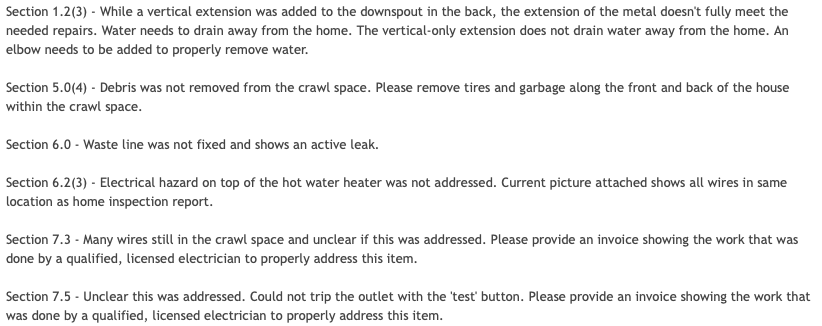
Additionally, we had a home inspection on the house and identified the following items for them to repair.
Getting the sellers to identify that these items were done before closing was not an easy task. We checked the day that closing was originally schedule for and noted that several things were not complete.
Then, at 7:30 pm the night before closing (which had already been delayed a week), we received one receipt identifying a couple of things were done. Eventually we received documentation that it was taken care of.
LOAN DETAILS
The options we typically ask for when considering the direction of our loan are as follows.
We chose the 25% down – 30 yr fixed option for both properties. Our goal is to not pay points, so that led us to the 25% down options. Since there was no incentive to take a shorter term (thereby increasing your monthly mortgage payments and decreasing your cash flow), we chose the 30 year option.
These loans were originated in September 2019. We processed multiple cash-out-refinances on some of our properties in December 2021; we used it to pay off about $66k on Property12 and about $74k on Property13.
LOAN PROCESSING & DELAYED CLOSING
We had a lender that we loved in Virginia. She couldn’t cover loans in Kentucky, but the company itself had a branch that could do it. She referred us to someone in Kentucky. It was the worst experience I’ve had in closings. Our closings are always annoyingly stressful in that last week, but this was bad throughout the month and then bad enough that our closing was delayed a week – completely due to the loan officer’s inability to manage the loan.
We had multiple issues over the course of the week we initiated our relationship just accessing the disclosures. They kept telling us to sign things we didn’t receive, or they’d tell us our access code and then when I say it doesn’t work, act like they never told us different information and give new information.
On August 16, I had to tell the loan officer that one of the addresses was wrong. THE ADDRESS. On August 26, we received conditional approval of our loan from underwriting. On August 27, we received our appraisal with no issues noted. But at that point, our August 30 closing was delayed a week already.
That’s where the problem was – our appraisal was ordered late, had to be rushed, and still didn’t make it in time for them to develop the Closing Disclosure (CD) and get us to a closing on August 30. The loan officer never once acknowledged that he ordered the appraisals late, causing this delay. It took asking for timelines from his supervisor, and piecing together emails we had on hand, to show that it was his fault.
On August 29, I finally made contact with the loan officer’s supervisor and was rerouted to someone else to get the job done. I had to repeat all of our issues and the errors that were found on the CDs.
On September 3, I was given disclosures that were still wrong. The new loan officer claimed that what she put in the system was correct, so she wasn’t sure what was wrong, causing me to once again outline all the errors.
On September 4, I was asked for more documentation that wasn’t caught during underwriting. I was furious.
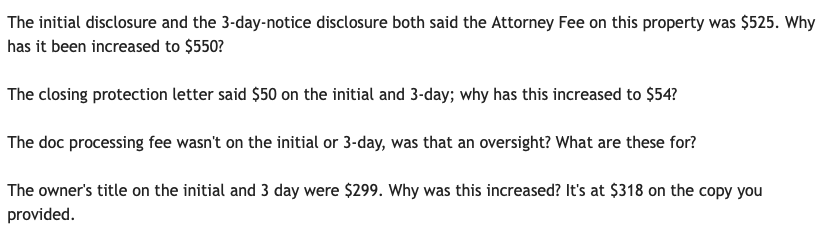
On September 5, I gave up talking to our lender about issues on the CD and spoke directly to the Title Attorney’s office, who was much more knowledgable and responsive. Here’s an example of what I’m questioning when I look over a CD. Some of these seem small (e.g., $4 difference, $25 difference), but you can see how these add up, both on a single transaction and when we’re processing several homes in one year. Not to mention – why pay more for something than you were quoted or you’re supposed to?
Another surprise that came our way was a “Seller Agent Fee” for $149 per transaction. At no point in time was an additional fee disclosed to us by our Realtor. A typical transaction has 6% commission paid by the seller, which is traditionally split 3% and 3% for the buyer and seller representation. Being that these were Rentals #12 and 13, in addition to 2 personal residences we had purchased, imagine the surprise when we, as buyers, were being charged for representation. We questioned why this wasn’t disclosed to us up front as a Re/Max requirement, and it was taken off our CD.
CLOSING DAY
I had planned to leave town the Friday after the original closing date because that was the last date that we had our apartment. I didn’t want to move me and the baby into my in-laws house and continue the poor sleep we had been dealing with by not being at home. So even though closing was delayed, I left. Mr. ODA had to be my power of attorney. He had to sign his name, write a blurb, and then sign my name on ALL those papers that are part of a closing….. times two. Eek. I didn’t know that at the time (but baby went back to sleeping perfectly once we were home, so it was worth my sanity 🙂 ).
At 11:30 am on closing day, the lender claimed that the power of attorney documents (from the lawyer…) were not complete enough to be counted as filed on their end. I appreciated the snip from the attorney when questioned.
I always wondered why tv shows always showed both at the closing table with a ceremonious passing of the key. We’ve had our share of weird closings (in a closet, in a parking lot, at our dining room table), but we never sat at the table with the seller in Virginia. We were so confused about how specific the closing attorney was being about the closing time options, and then we found out that the seller and buyer are at the table together in Kentucky. The seller for Property12 was so rude to Mr. ODA through the transaction! She kept grilling him on whether he addressed the utilities. The seller shouldn’t be allowed to talk to the buyer! We’ve since been able to process 3 transactions in Kentucky and avoid the seller at the table, but I’d like to advocate that Kentucky move away from this buyer/seller meeting process!
RENTAL HISTORIES
Property12 was listed at $895 on 10/2. Based on my birds-eye-view of the area, I thought $1000 was going to be easy to rent it at. Based on the 1% Rule that we had followed in Virginia, we should have a goal of $1,100 per month. However, we were trying for a Fall lease, which is more difficult than a Spring lease, so I thought listing at $995 would get quick movement instead of letting it sit for too long. Our property manager disagreed. She also said we were limited our pool of candidates by not allowing smokers; but, the whole house is carpeted and I was not budging on that.
We found a tenant on October 16 and allowed her to move in right away, but not start paying rent until November 1 if she agreed to an 18 month lease (we really wanted to be on a Spring renewal going forward). That was an unfortunate blow to our expectations – nearly two whole months without rental income on a house we didn’t need to do any work to.
We increased rent to $950 as of 6/1/2022 after no previous increases.
Property13 was listed for rent at $995 with no movement. We dropped to $875 and offered free October rent for however long was remaining in the month. A lease was established on 10/18/2019. Our property manager was supposed to establish an 18 month lease and didn’t. Luckily, the tenant agreed to a 6 month extension.
Property13 renewal came in April 2022. She had balked about the state of our economy in 2021, and we backed off the proposed increase at that time. Well, all the jurisdictions finally jumped on the increased assessments, and we saw a drastic increase in our costs. We told her that the new offer for a year lease is $950, which is higher than we’d typically increase in one year ($75 instead of $50). But we told her that we were willing to let her walk if she didn’t agree to it since she originally negotiated a lower cost and argued an increase at the 18 month mark, which we let go. She tried to fight it, but our property manager told her to check the rental options in the area to see that she’s still getting a deal. She agreed to the increase.
MAINTENANCE HISTORIES
Property12 requires a new heat pump in June 2021. We paid $3900 for a whole new system, which is a funnily low number just a year later.
The tenant there complained of high water bills. I asked to see a history of the water bills to know how much was considered higher than their average usage. The property manager agreed that the toilet was running and causing higher bills, but also admitted that they attempted to fix the toilet twice over a 3 week period, with multiple days between receiving a maintenance request and taking action. While I agreed that we could compensate her for the issue, I couldn’t quite pinpoint why this was my financial burden and neither the tenant’s nor the property manager’s. I followed up with more information from the property manager with questions like: Why did it take the tenant from 9/20 until 10/11 to identify the issue still remained and that there was a waste of water? They indicated that they believe they made a good faith effort to address the issues as reported. I eventually settled on a $25 concession on one month’s rent.
Property13 had several issues with the hot water installation that were eventually resolved, which was frustrating after we tried to manage issues with the hot water heater through the home inspection process and received documentation as if it was complete. The tenant requested pest control in July 2020 claiming that a vacant house next door caused an increase in pests. I was frustrated because that’s not how it works. I approved treatment at that time, and then she came back with another request in October. Luckily, I haven’t heard about pests since then. In my Virginia leases, we’ll handle some pest control requests, but if there are roach issues once a tenant has been there for some time, we don’t typically pay for that type of treatment.
SUMMARY
All in all, these tenants have been pretty quiet. They ask for random maintenance things here and there, but they’re not usually big-ticket items (except that HVAC replacement!). Our property manager has been more difficult than the tenants.
Being that we were used to the 1% Rule when we purchased these houses, it’s unfortunate that even at 3 years in, we’re not renting it at 1% of our purchase prices. Our cash-on-cash isn’t completely accurate right now because I won’t see our taxes for this year for another month or two. Being that jurisdictions kept the tax amount steady through the pandemic, I’m expecting to see an increase in assessments for this year. I’ve also seen big increases in our home insurance policies, so that will probably eat into our cash flow as well. Our cash-on-cash analysis on Property12 is about 6.5%, and it’s about 7.5% on Property13. These numbers are only slightly lower than our expectation/desire, with our average being about 8%.
In the upcoming year, we’re going to look to get rid of our property manager, so these houses may begin needing more attention from us. It’s been hard to take on more when paying a property manager has been a sunk cost at this point. However, the frustration of managing their management (e.g., making sure charges are correct, not getting a full picture of what work is being done, and then paying them a significant amount of management money and leasing money only for them to claim that checking on the property requires additional fees) has led to us wanting to take it on since we’re in town now. The current lease terms are up in April and May, so if we’re going to take on management, it should be before the possibility of paying them half a month’s rent for leasing it (not to mention they’re notoriously 4-6 weeks out in every leasing attempt they’ve done for us, whereas I’ve never had an issue getting a property leased within a week).
We took a week-long vacation the first week of August. I haven’t taken an entire week trip in a very long time. The kids are young, and the daily activities of swimming at the pool and the beach were exhausting for them, but we had a great time. I had projected about $500 worth of food expenses for the week, but we only spent $250 (including a grocery shopping trip). Our daily schedule was dictated by children sleeping, so it was a lot of little meals or snacks at the condo rather than looking to take the time to sit down at a restaurant. It also helped that we paid about $3.45 for gas (which is still terrible, but it’s not $4.30!), so our gas costs for the 11-12 hour trip each way was $190. Our lodging costs were significantly more than we’d typically spend, so the reduced costs in other areas was welcomed.
We’re still working on the new house and haven’t moved. That’s starting to weigh on me. We won’t see much progress this month based on our activity schedules, but hopefully we’ll knock nearly everything off the list next month. Our expenses were high in June and July for the house, but now it’s just a matter of finishing the projects that we already bought materials for, so hopefully expenses will be low the rest of this month. Our HELOC balance increased because we used it to pay for our concrete replacement at the new house (tear out driveway, garbage pad, walkway and stoop to the house, and 3 sidewalk squares; then replace everything in kind except widen the driveway).
RENTAL PROPERTIES
We offered our tenant that has paid rent late 71% of the months we’ve owned the house a new option, and they accepted. They had been paying rent around the 15th and then the last Friday of every month. After several months of this, I spoke up that it was unacceptable. They started paying the first half by the 5th, but the second half was still coming the last week of the month. That means every month, they’re paying $1450 in rent and $145 in late fee. We offered them the ability to pay half at the beginning of the month and half by the 15th. Each payment has a 5 day grace period, and then the late fee is tied only to the payment not made. However, since this is an inconvenience to us, the rent increased to $1500. They could be saving $95 per month if they pay both payments on time. However, they could also be paying as much as $1650 per month now if they pay each payment late.
We got one house turned over and rented last month, and rent was paid timely this month. We also received credits from our KY property manager for costs they overcharged us on.
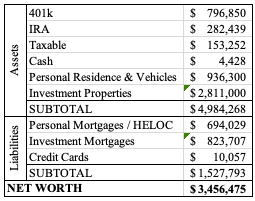
NET WORTH
We continue to hold high balances on credit cards because of 0% interest incentives. As I mentioned, you don’t typically see a personal mortgage line increase, but we drew almost $9k out of the HELOC to pay for concrete replacement at our new house. Our investments have increased in value over the last month, offsetting the additional draw on the HELOC and higher-than-average credit card balances, helping increase our net worth.
Welp, I haven’t posted in a month. We have been so busy and exhausted.
We bought a house on June 15. That process was not smooth in the week before closing, even through the day of. Our attorney had to come to our house the next day to have us sign other papers. Our lender was great, great, great, until they weren’t at the 11th hour. As always, everything went through, and we have ownership of the house. And that week will be a distant memory soon. But why does the mortgage industry get away with operating this way? I feel like there hasn’t been a single transaction we’ve done where there wasn’t a “where’s my paperwork????” or “why’s this wrong the day before closing???” moment (or my favorite, when we begged for the HUD-1 to review it before closing, and a traveling notary showed up at our house, only for the HUD-1 to be different than the closing disclosure and the numbers to be wrong on both documents).
We used our HELOC on our current house to pay the downpayment and closing costs on the new house, so that was a quick debt addition. We started with a balance of about 86k and have paid it down to 75k. We didn’t necessarily need to take the whole amount from the HELOC, but it was easier to get one cashiers check from the HELOC and immediately pay towards it than to transfer some from the HELOC and do a wire from our checking account.
This new house will be our personal residence, but it requires work. We’ve gutted the master bathroom, and I’ve been painting nearly all my free waking moments. I have the first floor mostly done (including making a ceiling go from navy to white.. ugh) and the kids’ bathroom done.
We opened two new credit cards in the last month, but I’ll get into that in the next post. Just note that our credit card balances are higher than our usual, and will remain that way.
We had opened a checking account for rewards a while back, and the account required $500 of direct deposits each month. It was one more account to manage, and it was no longer serving a purpose, so we finally closed that. Now we just manage two checking accounts.
RENTAL HOUSES
We have a vacant rental house as of June 30th, which I’ll also get into in a future post. The good news is that one of our houses that’s a repeat offender of not paying rent is now out of the picture. We still have one house that never pays on time, but I’ve at least got them paying half the rent by the 5th so that we aren’t constantly floating their mortgage and bills until the last Friday of every month.
We had two rental increases go into effect this month. One was for $20 (good tenants, long term, told us in advance they wanted to renew, but we also needed to cover our cost increases) and another was for $50.
Our property manager in KY hasn’t been easy. We’ve had to do a lot of managing the manager. All of our paperwork says not to charge the 10% fee on contractors. The document that they put in our file says it, and that’s the same document they put the charge on. I keep having to ask for all the documentation. Once I ask, they note the 10%, but it’s not until I ask.
We paid a plumber to fix a shower handle in one of our houses. On June 1st, she texted that it was loose. She didn’t really explain the situation, and I asked her to tighten the screw and let me know. She texted me on July 8th that it didn’t work. Where have you been for a month?! Then she said “let me know when the plumber is coming so I can wake my husband.” Um, you waited 5 weeks to tell me that it’s still broken, I’m not rushing a plumber out there today.
One of our insurance companies dropped us once they found out we don’t live within a certain radius of the houses. We have a property manager, so this rule doesn’t make sense to me. They let us finish out our policies, but they wouldn’t renew. Our agent quoted one company that doubled the cost we had been paying because the roof “may have been last replaced in 2000” (and we couldn’t prove otherwise). I said nope, and I asked another agent to give a quote. Their increased our cost by about $100, but it was better than $300. I executed that at the beginning of this month.
We had an HVAC go out, but luckily it was able to be fixed (for 225) than replaced.
NET WORTH
Well, even though our investments are declining and we took on a lot more debt, our net worth increased by 75k from last month. Truly, I’ve focused on the work we’ve had to do over the last month, and not necessarily on the spending or the market. At some point I’ll need to get through all our expenses and identify how our spending has changed, but perhaps that’s a job for another season while we continue to work on a new house and work towards moving our family in the coming months.
We ramped up our travel this month, which has actually led to us canceling a few trips that were planned for this next month. I went to visit my family for my sister’s baby shower, we went on a family trip for a long weekend, and then Mr. ODA was gone all week for work. We’ve done a few local activities, but several of our plans have been cancelled or postponed due to the current gas prices, which are about $4.75. Even Sam’s Club and Costco, which were holding strong in the low 4s, are both at $4.69 right now.
We’re working towards closing on a new house next Wednesday, so that’s been the stressor right now. We had a month and a half for closing, which is literally the longest we’ve ever had, and then yesterday I got asked for tax information. Seriously, what have you been doing for the last month since I signed off on the initial disclosures? We went with an online bank, so that’s been an extra factor in uncertainty through this process.
RENTALS
I served a notice of non-renewal to one of my tenants. Her lease ends on 6/30, and we want her out. It’s the first time in 6 years that we’re so fed up with a tenant that we actually said it’s time to leave. We’ve had issues with tenants in the past, but we’ve just increased their rent as a means of giving them the option to leave, or compensating us for our frustrations associated with them living there. She, of course, didn’t pay rent by the 5th. When I asked her where rent was, along with the balance of outstanding late fees and the current late fee, she said she was trying to secure a place to live, so she wouldn’t be able to “pay towards that” until the 17th. Pay your rent timely OR communicate a need for more time without the landlord having to hunt you down. That will keep a roof over your head so you don’t have to move when you don’t want to, and it’ll also put you in a position where your current landlord can actually provide a referral at a new place.
My other usual suspect, who I told needed to start getting their act together and pay rent before the last Friday of every month, paid half of rent on the 3rd and sent an email saying we won’t get the rest until the last Friday of the month. Progress, I guess.
We had a massive issue with our property manager in Kentucky. The accountant felt he had a little too much power and ran with it. Mr. ODA went to meet with them, where the accountant had to admit his mistake in charging us $900 in front of the owner. As a means of making amends, the owner credited us the management fee they took out of our security deposit. While I understand their thought process that our contract says “10% of income,” and a security deposit gets counted as income for tax purposes, I disagree with them taking a commission out of it. If that’s the case, our security deposits under them should be 10% higher than a month’s worth of rent. A security deposit’s purpose is to reimburse us for our costs to fix a unit that has been unreasonable mangled by a tenant before their departure. In this case, we have $4000 worth of costs. The security deposit was $895. Them taking $89.50 was insult to injury in this case, especially after they took 18 days before taking any action to confirm the place was abandoned. Moving on.
That house that was abandoned ended up getting rented for June 1st. We’re netting about $250 more per month with the higher rent there.
One of our mortgages was going to be paid off in May, which I mentioned last month. I scrambled to find out how to pay the taxes, which wasn’t easy (it’s a different jurisdiction than most of our houses… being in the county instead of the city). I finally got that figured out and paid the taxes at the beginning of the month.
PERSONAL FINANCES
This month we actually had a few “receivables” to expect. We learned that our lender wasn’t requiring an appraisal (we don’t get it), so they were going to refund us the appraisal fee of $525. We had a major issue with Home Depot and getting an appliance delivered, which ended with us going to the store, buying the appliance, putting it in our car, and driving it to the rental. We had to wait for the terrible delivery company to “scan” the not-delivered appliance back into their warehouse, and then we got $600 back. When I registered my kids for preschool, the system glitched and charged an extra $100, so we got that back. I had already registered my oldest at the same school as this year before we learned we’d be moving, and they were kind enough to return my registration fees, so that was $300.
All that to say, stay on top of your finances. Know what you owe so that you know when you’re overcharged. When someone says you’re owed a refund, pay attention that you receive it; we had to follow up on the refund, and it turned out she hadn’t processed it. Don’t be afraid to ask if there’s an option for a refund in some cases. Just those transactions are $1525 worth of money back in our pockets in a month’s time.
SUMMARY
We have work on a rental that’s still outstanding. I don’t expect her to actually be out on June 30th at 5 pm like she’s been instructed. I have our property manager handling the move out (even though she doesn’t manage that property). This way, if she’s not out on the 30th, I haven’t driven 8 hours to find out I can’t do any work on the property.
We plan on doing a lot of work on our new house after close next week. That’ll take up a lot of our free time over the next few months.
The stock market has somewhat rebounded. It’s not back to levels it was once at, but it’s nice to see balances go up instead of down. Our credit cards are down significantly because I am purposely keeping a low balance right before we close on a house (down by paying it off, not down by not spending…). Our funds for closing are coming from our HELOC, so it hasn’t been a stressor to keep a cash balance to go towards our cash-to-close.
Building off of my last post about tenant abandonment, here’s what it took to turn over that unit. We rarely have units to turn over in our portfolio. Last year we had 1. This year we expected to have 1, but this abandonment made it 2. To have continued renewals over 13 properties is a blessing.
Usually, we need to clean and paint. Every once in a while, we have more work to do, but it’s rarely a massive undertaking. This one was a massive undertaking.
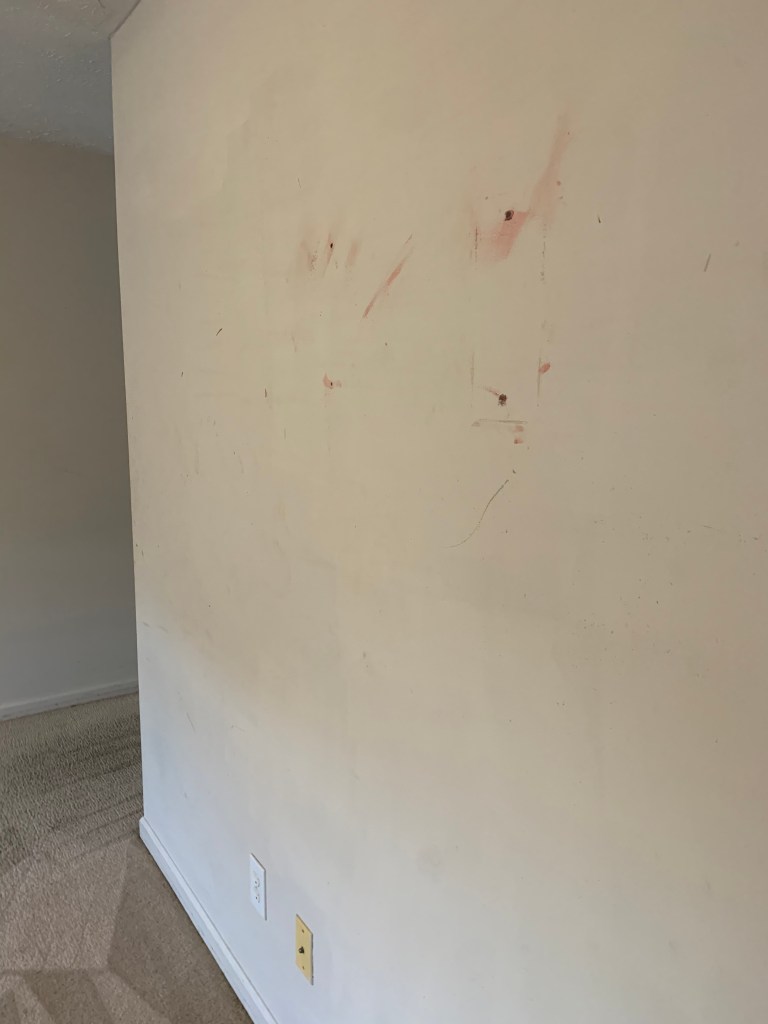
Our property manager walked through the house and saw that junk was left behind and it was filthy. There should be another word worse than filthy. I’m always surprised at how much damage someone can do to a place they have to eat and sleep in for two years.
This is a 3-story townhouse. The entry level is the garage and a den-type room; then there is a flight of stairs to the main living area of a kitchen, dining area, powder room, and living room; finally, there’s a flight of stairs to two nearly-identical bedrooms, each with their own bathroom. The two masters concept and a garage are benefits, but the two flights of stairs is a downside.
TURNOVER ACTIONS
The property manager had her maintenance staff remove everything left behind. I thought she was going to hire something like Junk Luggers, so I was pleased to see that this cost us less by her using in-house staff. They wiped down the baseboards, but didn’t clean. I was under the impression that it was going to be cleaned before I got there. I was also under the impression that the carpets were going to be cleaned on the 25th.
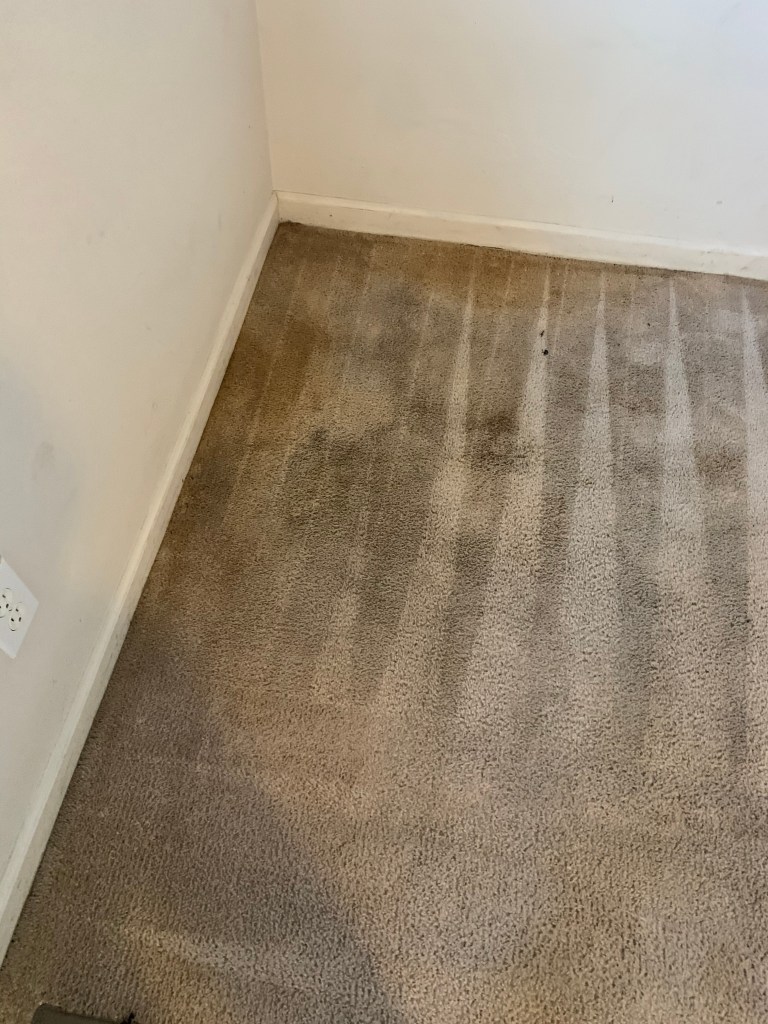
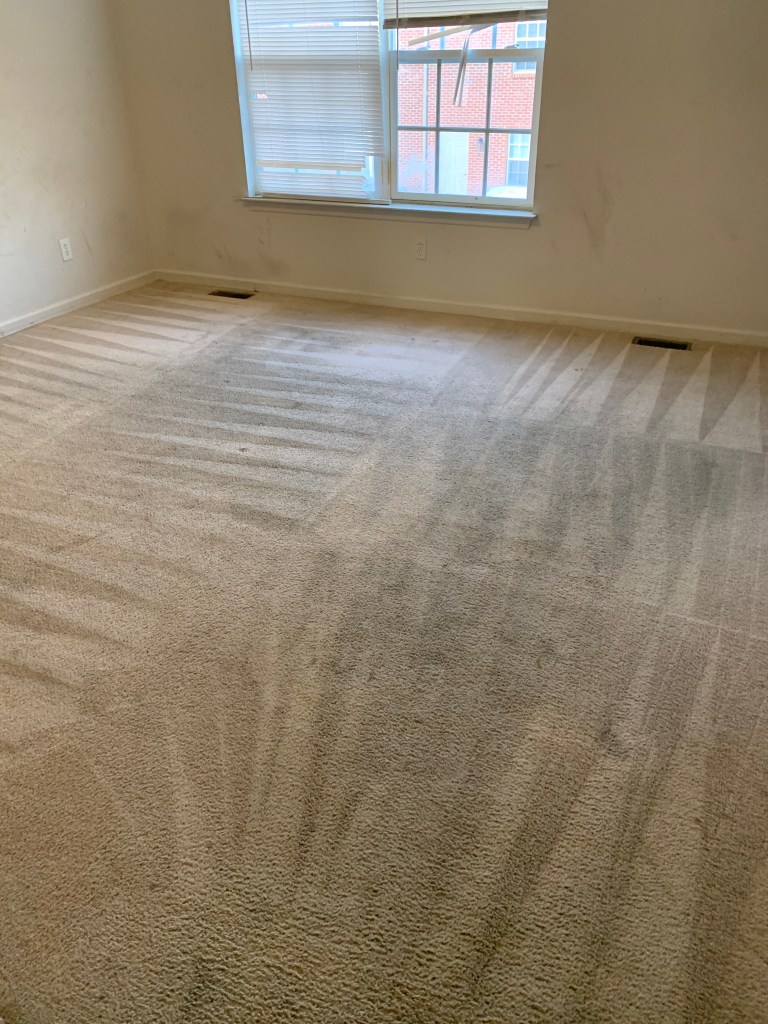
I was working weekends at the time, so I couldn’t get to the house until the 27th. I didn’t find the need to rush down there because I thought my property manager had action happening. Plus, I’m pregnant, so I didn’t want to be in someone else’s filth for extended periods of time, and I expected it cleaned up before I was scooting along the floors and in tight spaces. Well, I walked in and was so upset. The carpet was disgusting. It looked like someone made lines in the carpet with the steamer tool, but didn’t actually clean anything. Not a single thing was actually cleaned. The kitchen and bathrooms were horrendous. I’ll spare you pictures of what the bathrooms looked like. You can see “steamer” lines in the carpet, as someone had been there, but there was zero effort put into actually cleaning the stains.
I called the property manager, and she agreed to come meet me at the house. She agreed that the carpet cleaning was unacceptable, and I wouldn’t be charged for that. She explained that her guy didn’t have time to clean the place except for wiping baseboards, and they had decided to clean it once at the end. I said that would be fine if the house wasn’t this bad, but there should have been an initial cleaning. She showed me pictures, and even though the baseboards were gross, they had actually been wiped down because they had been even worse.
The property manager called her typically cleaner, and he agreed to get there the next morning. I showed up the next morning to find he was still there working. He said the house was in much worse condition than he was told, and they’d have to leave to go to another job and come back to this house. I wasn’t surprised, but I was very happy to see that everything was cleaned, and that I wasn’t completed grossed out by being there.
DECISION MAKING FOR TURNOVER WORK
There are costs that you just have to deal with in the turnover – junk removal, cleaning, carpet cleaning. Then there are costs that you don’t expect to be on your radar, but are necessary – replace broken floor vents, replace missing outlet covers. Then there are decisions that require more thought. For instance, we haven’t enjoyed this property in our portfolio, and we’re considering selling it. We’d like to recoup some of the costs we’re having to put into it now, but selling it is on our radar for the future. So do we want to clean the carpet, or start replacing the carpet with hard surface flooring to increase our property value for a future sale?
We recently received an updated assessment for our taxes on this property. I happened to look up their comps given. We bought this house for $86k. I noticed that the houses with no updates to it were selling around $110k, while houses with nicer flooring and fixtures were selling up to $130k. My goal was to start preparing for a sale in the future, and we’d have a few steps done instead of having to redo the entire house in a year or so.
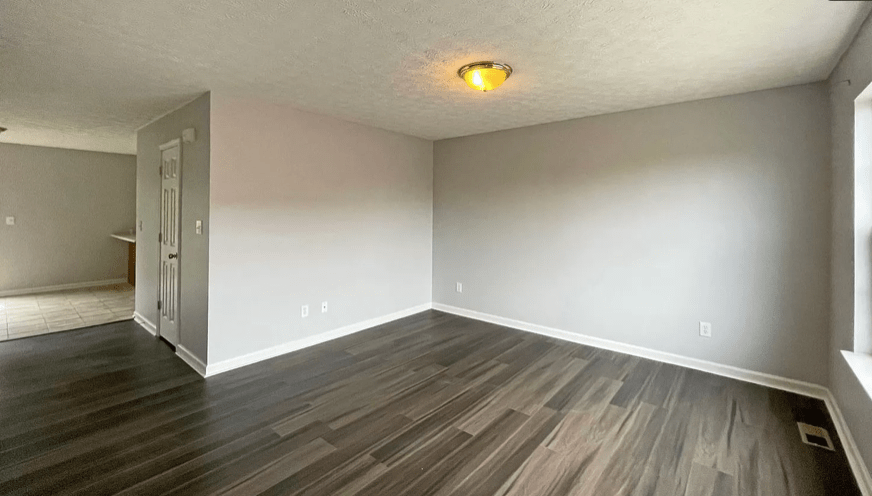
The biggest actions I took while looking into the future were: 1) I painted the main floor baseboards white. The baseboards, walls, trim, and doors were originally all painted the same color – an off-white or beige. Over time, we kept the trend going because it made it easier and quicker to turn over the house. While I didn’t paint all the baseboards white, I did it in the main living area and in the stairwells. I painted the interior doors of the main living area (main entry door at the top of the stairs, the laundry room door, and the powder room door) and all their trim white. 2) Repaint all the main walls. At the last turnover, Mr. ODA went into the house and touched up the walls. The paint had gone bad, so the touch ups were very noticeable. I painted everything except one bathroom, half the laundry room, the powder room, and the two bedroom closets. Every other wall surface (including two stairwells…gosh) got painted a gray. 3) We did get a carpet cleaning company to come out and rotovac, which is an incredible process that brings a carpet in rough condition almost completely back to new. It’s truly impressive. They also charged us $159 for this more intense process, while the original company that just made lines in the carpet was going to charge $244 for nothing. 4) Instead of cleaning the main living area carpet, I wanted to replace it with hard surface flooring. We’ve had this house, with the same carpet, since 2016. That’s 6 years of carpeting that has been beat up (understatement) by 3 different tenants. The carpet could even be older than that because it’s what we inherited when we purchased the property. I explained in a recent post all the reasons why we laid LVP and how we accomplished it ourselves.
COSTS OF TURNOVER
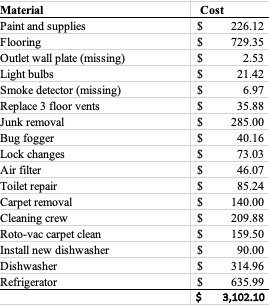
I had to supply my property manager with specific costs associated with the work I did, so here’s that, along with the charges they had on our account. Not all of this gets billed to the tenant. For example, the dishwasher and refrigerator were at its useful life and needed replacement, due to no fault of the tenant’s.
While it was hard to get started, seeing the mountain in front of me when I first walked into this house, I do appreciate having done most of the work myself. We spent over 28 hours at the house. I did about half of that by myself. Mr. ODA and his dad helped get some progress on the painting one day, and then Mr. ODA and I worked together on the flooring.
We also have the months of lost rent that were unexpected. With notice, we could have listed and shown the house before the current tenant vacated. We were caught on our heels, and we lost 2 full months of rent. Unfortunately, we truly lost 18 days of progress in those 2 months because our property manager didn’t enter the house to confirm abandonment timely.
LIGHT AT THE END OF THE TUNNEL
We ended up listing the house on May 6th. They had several showings, but the layout is hard to get rented. One couple submitted an application on a Thursday. When our property manager reached out to them, they never responded. Our property manager had pushed to list the house at $1250. Once that couple ghosted us, I told her to lower it to $1200. Just as I was about to give up and have it lowered, she was able to get another application and a signed lease. Luckily, being that it was May 25th, these people wanted a June 1st rental. We increased our rent by $275/month and only lost 2 months of rent, which is mostly made up by the drastic increase in rental income.
Another silver lining is that we paid off this property’s mortgage multiple years ago. Therefore, we didn’t have the extra “bleeding” of money by having to make two mortgage payments without having the cashflow to offset it.
We don’t expect to see a dime from the old tenant of what we spent to turnover the unit. We didn’t have any issues with him while he lived there, and his abandonment and lack of communication was surprising. Someone who leaves like that, and leaves the house in such poor condition, isn’t going to put forth effort to pay a $3k bill he receives in the mail. It’s in the hands of our property manager at this point and will likely move to collections. We’re just happy to have new renters in the unit and have this one behind us.
Most lease agreements state that you’re responsible for the entirety of the lease term, even if you try to leave early. Most landlords are willing to work out an agreement if you have a reason to leave the house early. We’ve let several people out of their leases early to either move out of the area or buy a new home (those are just the reasons we’ve dealt with, not saying those are the only reasons we’d let you out of a lease).
We usually default to two-months worth of rent as a “lease break fee.” You leaving early has increased our projected expenses for the house because turning over a house is expensive and you’re asking us to have more time without rental income. With that said, we’ve also left it at “you pay rent up until we get a new tenant in the house.” I’ve never taken more than a week to get a new tenant set up in a house, but my property managers (through companies, not the individual person we use in Virginia) consistently take 2 months to get a unit rented (I don’t get it!).
Then there are some people who just leave. No notice. No request. They abandon the property and stop communicating. Surprisingly, we’ve dealt with this twice in the last 6 years.
The positive, they’re mostly out of the house, and we can take action to get it re-rented, which is better than them living in the house while not paying rent. The negative, we’ve had no warning of their intent to stop paying rent. Plus, if a tenant is willing to just walk away from a house, s/he may not be leaving it in pristine condition.
ABANDONMENT #1
The first tenant abandonment ended well. In Virginia, if the house is abandoned for 7 days, it automatically returns to the landlord’s possession without the court getting involved.
I received a call from the public school system. They asked me if I was the owner and if so-and-so was living at this address. I truly could not answer. My property manager did the background check and set up the lease. I basically look at the lease to ensure the dates are correct and that all the initials and signatures are in place, but I certainly don’t commit names to memory. I gave the person my property manager’s contact. Connecting the dots, she must have confirmed the name of the tenant and the address because the tenant received notice that his children were no longer allowed to attend a school they were not districted for. This happened years ago. I always thought it was odd that they called in April to verify such a thing, when there was 4-5 weeks of school left. But then I was just telling this story last night, and someone said that if the kids are not causing trouble, they typically look the other way. So perhaps there was an underlying reason for the school system to go digging.
Well anyway, in true logical decision making, he blamed us for getting his kids kicked out of school. If I didn’t know his name, I certainly didn’t know how many kids he had or where he was sending them.
He let us know he was moving out, but he wasn’t cooperative. He said he’d be out by a certain date in May 2017, but he didn’t have everything cleared out. We finally got stern with him. By the end of May, he hadn’t paid what he agreed to, so we filed with the court.
We worked to get the house turned over in the last week of May, and we had new tenants move in on June 1st. We were only out 1 month worth of rent along with the costs of turnover. His security deposit covered a majority of the balance owed, so it wasn’t an immediate hit to our finances.
The court granted us the judgement. The total he owed was $1,074.76. Unfortunately, the judgement just writes the amount owed and whether interest is owed, but it doesn’t give a deadline for payment. The system expects the two parties to work together to make a payment plan. If he doesn’t live up to the payment plan, then we can go to the court and file for another judgement. We received $200 immediately from him, and then agreed to $200 every other Friday for the remaining $875.
He missed the second payment. We sent an email explaining that if he doesn’t reach out, our property manager will go to the court to file, which will then lead to a credit report hit and collections. He eventually started making a few payments, but I should have stuck to my guns and required 4-5 payments. In mid-November, he still had a balance owed of $685, plus 6% interest from the date on the judgement. We eventually got all the money he owed, but it took a year, and it was frustrating to constantly have to track him down and push him to finish the payment plan.
ABANDONMENT #2
The second abandonment just happened. In March, our property manager was tipped off by a neighbor that our tenant was moving out. Our property manager asked if he was moving out, and he denied it. Then he didn’t pay April’s rent, so she continued to follow up, but received no responses. I am not clear why it took until April 12 to decide to post notice to enter the property, and then why she didn’t actually enter the property until April 18, but that’s what happened. That’s 18 days of lost rent and lost productivity for us to turnover the unit. That’s $555 worth of rent that is just lost. We could have been working on cleaning out the house during that time.
Our property manager entered the unit and took pictures. She found that the tenant had left some furniture and garbage behind, but it was clear enough that he left and wasn’t returning. The house was also in bad shape. All the walls required a new coat of paint. The floors were filthy, as if things were spilled all over, never cleaned up, never vacuumed, and he left all the windows open for water to leak in. The kitchen was covered in fruit fly type bugs. The bathrooms were so horrendous that I refused to even be in the house until they got cleaned. It was impressively dirty. I always wonder how people live in such conditions. This is YOUR toilet. Why would you enter this room and think “yes, this is where I want to sit!”
The property management company had their staff remove the pieces of furniture and garbage from the house. Then they wiped down baseboards so that I could start painting. It was so bad when I entered that I had them get a professional cleaner in there before I’d spend much time there. I painted all 3 levels (including two stairwells), except for 1 bathroom and 3 closets. Then we got carpet cleaners in there and some maintenance items taken care of.
It was an extra 3 weeks worth of work that we did ourselves and coordination with contractors to get the house turned over. We lost April’s rent, and then we were set up to lose May’s rent. We didn’t get the house listed until May 6th, and then we didn’t get a confirmed renter until May 25th, for them to start a June 1st lease.
The silver linings here are that we improved the condition of the property over those 3 weeks; we could have lost even more weeks of rent, but we were lucky to find someone that wanted it nearly immediately; we have the unit rented $275 more per month than we had it leased for. Had we kept it rented through the end of the lease, we would have brought in about the same amount for the year that we’re bringing in now with the increase in rent, even though we lose 2 months worth of rent.
The tenant’s final cost, being billed for April, May, and June rent (I don’t know why the management company chose to include June), is $3,868.12. That’s after applying his security deposit to the balance owed. We probably won’t see a dime of that. If a tenant is willing to lie that they’re moving out, and then not respond to anything being sent after that, they’re not willing to work with us on a payment plan. We didn’t have any maintenance issues with the house, and we didn’t think he was unhappy with anything. Granted, I don’t know if our property manager was not responding to issues, but we weren’t aware of any. This house is in Kentucky, so we don’t have a grasp on how the court system works like we do in Virginia.
While it’s stressful and frustrating, eventually you move on. Once the house is re-rented, you start to feel better about the situation. Each day that you’re working on the house and each day there’s no application received for the property, you just keep building anxiety. While the first situation ended well in that we eventually received all our lost money, I don’t expect this second abandonment to end as well. Our long term (or more like 1-2 year short term) plan is to sell this property, so we’ll recoup that in the equity made over the last 6+ years with the house.
This has been a whirlwind of a month. Our crashing investment accounts have been offset by home values, so we’re still over $3 million net worth. But those investments are very low; it’s the first time I’ve seen a negative in my 12-month performance history for my ‘401k.’
HELOC
A couple of months ago, we were standing outside playing with the kids when a neighbor walked by and introduced themselves. Being that we easily have $150k worth of equity in our house, we started talking about how we should open a Home Equity Line of Credit to be able to float a future purchase. The process was initiated, but not really started, when we made an offer on another house to be our personal residence. More to come on that. But we close on the HELOC today at $100k, which was the maximum she could do as an “administrative authorization” (for lack of a better term, and to pull on my government background), which essentially just meant no appraisal cost.
NEW HOME PURCHASE
We’re about 3 weeks in being under contract on a new house. We’ve submitted all our files to an online bank that we’re using as our loan, and we’ve locked our rate at 4.0% on a 5 ARM. Closing is expected to be 6/15. We’ll need about $75k or 80k out of the HELOC for closing on that.
We found out that our appraisal that was ordered for this house got cancelled. A quick inquiry to our lender and we found out that they decided our credit profile doesn’t need one! They’re going to refund us what we already paid, which was a pleasant surprise.
PART TIME WORK
I worked the weekends in April at the local racetrack. It’s good money and only required 8 days of me actually working. This meet’s experience was slightly different, and I didn’t enjoy it as much as the Fall meet, but I made more than I did in during that meet.
RENTAL UPDATES
We had a tenant abandon a property on April 1st, so that was a lost month of rent that we weren’t expecting. Our finances aren’t in a position that we need that money. It also helps that we don’t have a mortgage on the property. But we still put over $2,000 into the house (including two appliances) and a week’s worth of our time in turning it over since it was left in poor condition. We’ve been fighting Home Depot on getting a dishwasher delivered and installed, and that still isn’t resolved.
We had our usual suspects not pay rent on time. One did manage to pay in full (not the late fee though) by the 7th. The other I finally told that paying on the last Friday of every month is no longer acceptable, and it needs to change. She sent a nice email back, but we still haven’t seen a dime from them this month.
We had one rent increase go into effect; it went from $1025 to $1100. That also increases our property management cost by $7.50 going forward.
We had an insurance company drop us by not renewing us since they found out we moved out of state. We told them we have a property manager, so there is someone available taking care of the houses, but they didn’t care. Luckily, not all insurance companies have such a requirement, and our agent was able to find someone with nearly the same price that accepted a property manager.
We have officially paid off one of the loans that we had with our partner. We had intended to pay the loan off this month, on our terms. Instead, because the balance was about $400, the loan company took it upon themselves to use our escrow and close the account. We were purposely waiting until after escrow paid the taxes due this month, and now we need to scramble and figure out the tax payment.
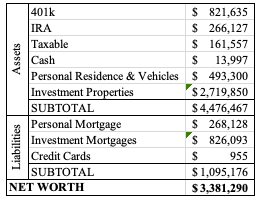
NET WORTH
SUMMARY
We now commence a very busy time of life. We have several trips planned, we expect to turnover a rental that we’re kindly asking a tenant to vacate, and we have a lot of work we want to do on our new personal residence. Hopefully the turnover of the one house goes smoothly, we get the house that was abandoned in April re-rented, and that there are no more surprises in our rental world. We also had our AC go out in our 18 month old house, so here’s to hoping there are no more surprises in the personal expense world too.
The market has recovered a good bit, so our net worth jumped. Our retirement accounts were at an intriguing low, but they’re back on track now. We also saw a few sales in the neighborhoods where our rentals are, so that increased our net worth based on the comps. We added a new property over the course of the last month as well.
NEW HOUSE IN OUR PORTFOLIO
We closed on a new house on March 24th. We worked on it for a few days, I held an open house, and we were able to get it rented as of April 8th. We had 16 days of vacancy. While showing it, most people were looking for a May or June start date, so we were lucky someone qualified for an April date. Back in 2016-2019, we were looking to follow the “1% Rule.” That means that if you buy a house for $100,000, your goal is to set rent at least $1,000 per month. This house isn’t even close. This market doesn’t allow for such a goal anymore because housing prices are soaring. The next goal would be to list for about $1/square foot. This house is 2100 square feet, but since the upstairs has smallish rooms and the basement is all open, we thought it wasn’t really worth pushing for $1/sf.
We bought it for $240k net, and ended up renting it at $1750. I wanted $1800, Mr. ODA wanted $1695, and when I went to list it, Zillow suggested $1750, so we went with that. Multiple people commented on how they appreciated the price, so we may have been able to get $1800 without an issue. I’m happy to have it rented, and I think these people are going to take good care of the house.
RENTALS
We put more money towards the house that we’ve been paying off, which is owned with a partner. We put our half towards it ($8,500), and it has a balance of about $600 now. The pay off quote required us to pay the anticipated taxes that will be paid out of escrow in May. We didn’t appreciate that, so we just went ahead and paid it down. We’ll let the May mortgage payment go through, wait for the taxes to get paid out of escrow in mid-May, and then pay it off. That’ll make 7 houses that are owned outright! But that also means I need to stay on top of insurance and tax payments.
We were just informed that one of our properties in Lexington that’s under a property manager hasn’t paid rent. She said it’s unlike them and that they aren’t even responding. She’s going to go to the house tomorrow to check on the situation. Since we’re paid a month after rent is received, this hasn’t affected us. A neighbor reported that they were moving out last month, but the tenant denied it. Perhaps they abandoned the property.
Once again, our two usual suspects didn’t pay rent on time. However, both of them actually made a better effort than they have been. One has paid this month’s rent in full, but has a balance of $286.31 (seriously…) to make up several late fees. I’m happy to waive late fees when it’s someone who communicates and isn’t always a fight to collect rent, but I’m holding this one to the balance owed. Another one told me that they wouldn’t pay until the last Friday of the month. I drafted an email to tell them that this is unacceptable because it’s been several months that they’re paying this late, and we need to work towards getting back to paying rent at the beginning of the month. Right after I drafted that, she sent half of this month’s rent. Better than nothing!
SPENDING CHANGES
Over the past month, we didn’t go out to restaurants very much. We haven’t been traveling because my family came into town for our daughter’s birthday party, and then I’ve been working on the weekend. Most of our spending went to gas (going back and forth to Lexington (half hour drive) multiple times per week!) and expenses to get the new house ready for a tenant.
I’m flying to my sister’s baby shower next month, so that another large and unusual expense on our credit cards ($250).
SUMMARY
We still have our state taxes to get paid. We went through the process of entering all our taxes, but we haven’t hit submit just yet. Surprisingly, we’re expecting a refund from the Federal side. The amount owed and the refund basically end up as a wash.
Our new property’s loan is a commercial loan, so it doesn’t get paid on the typical mortgage schedule, but on the 1 month anniversary of the opening. Therefore, the next payment is due on 4/24, and there’s no “1 month without a payment” type thing.
Clearly, our cash balance dropped significantly since last month because we had the closing. That was about $46k that we wired out, which was the expectation when we completed all the maneuvering with the cash out refinances in January. Our credit cards reflect our lower spending too, coming in about half what the balances were last month.